





 Portuguese
  English
  Spanish
  5 min of reading
  1 comment





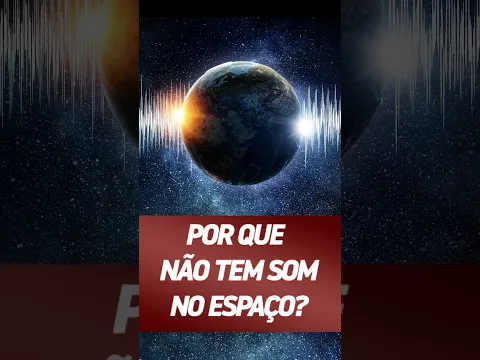
In Space, There Is No Noise Because Sound Needs Matter to Propagate; Yet, Astronauts Talk via Radio and Even Ship Explosions Would Be Silent.
When we say that in space, there is no noise, we are asserting a basic principle of physics: sound is a mechanical wave that depends on a material medium. In the almost perfect vacuum of outer space, there are not enough particles to compress and rarefy, so the vibration simply does not “travel”. That’s why movie scenes featuring booming noises in a vacuum are wrong.
Even so, missions operate with constant communication. Astronauts convert their voice into radio signals, which are electromagnetic waves capable of traveling through a vacuum, and the receiver reconverts everything into audio inside the helmet or the pressurized spacecraft. In other words: the silence of space coexists with radio conversations.
Sound Needs Medium: Why the Vacuum “Kills” the Wave
Hearing occurs when vibrations reach the eardrum through a material medium such as air, water, or solids. Without enough molecules to transmit the energy, the sound wave does not propagate. In space, the particles are so far apart that compression and rarefaction cannot be sustained along the way. Result: physical silence, not just “lack of noise”.
-
These living root bridges and ladders are over 700 years old and help indigenous people survive in one of the rainiest regions in the world.

-
From sertanejo star to international investor: Ana Castela invests millions in a mansion in the USA, creates a themed accommodation in Orlando, and shows that the “boiadeira” also wants to grow away from the stage.

-
The 10 most stunning motorhomes in the world: a $3 million trailer with a rooftop nightclub and garage for a Ferrari, “palaces on wheels” with Italian marble, private cinema, and five-star hotel luxury for billionaires.

-
Trump wanted to spend $400 million on the White House, but the courts prohibited the million-dollar construction.


This rule applies from both historical and experimental perspectives. Since the classic vacuum chamber experiments that remove air around a bell, sound disappears as the medium vanishes, and only returns when air is reintroduced. This is direct evidence that “in space there is no noise” because the vehicle for the wave is missing.
If There Is No Sound, How Do Astronauts Talk?

Radio, Not Direct Voice. Inside the suit, there is air; the microphone captures the astronaut’s speech and converts it into radio waves. These waves travel through the vacuum to another suit or station, where a receiver reconverts the signal into sound, once again audible in a pressurized environment. It’s a “teleportation” of information, not of air vibrating in the vacuum.
This process has clear steps: capturing the voice in the helmet, modulating in radio frequency, transmitting through the vacuum, and demodulating at the destination. That’s why space can be silent while panels and speakers “speak” loudly. The confusion in movie screens comes from ignoring this technological bridge.
Where Sound Exists in the Spatial Environment
Inside ships and stations, there is air, so sounds propagate normally: clicks of panels, footsteps, fans. On planets and moons with atmospheres, sound can also travel, although at velocities, timbres, and ranges different from those on Earth. And in solids, vibrations can traverse structures: if an astronaut touches the helmet to a wall of the station, they can “hear” vibrations through conduction. These scenarios do not contradict the idea that “in space there is no noise”; they simply show pockets with a material medium.
Dense clouds of gas and dust can also carry vibrations at peculiar scales and frequencies, but the density is so low that it does not consist of audible human sound over long distances. The vacuum dominates; sound only exists where there is enough matter.
Ship Explosions Would Be Silent
In fiction, explosions in space sound like thunder. In reality, the detonation would release light, particles, and debris but would not produce audible sound in the vacuum. The flash would be seen, the fragments would gain speed, and… silence, because in space there is no noise. You would only be able to hear something if you were inside an environment with air connected to the vibrating structure.
This contrast between visual spectacle and physical silence is a lesson in scientific literacy. Noises depend on a medium; without a medium, there is no sound wave. Seeing is not hearing in space.
History in a Nutshell: How We Arrived at This Certainty
The intuition that sound needs air began with natural philosophy and gained strength through vacuum experiments that “erased” a bell by removing the air. The mathematical formalization of waves solidified the idea that propagation depends on the medium and its properties (density, elasticity).
The space age cemented the verdict: communications depend on radio; without a material medium, no one “hears” out there. The “beeps” and “static” we know come from speakers inside air-filled cabins, not from the vacuum. It’s applied physics, not an editing trick.
Sonification: “Hearing” Data, Not the Vacuum
Agencies and researchers transform measurements of plasma waves and electromagnetic fields into audio for analysis and dissemination. This is not sound traveling through a vacuum; it’s data translated into audible frequencies. It serves to perceive patterns, variations, and events intuitively.
This approach does not contradict the principle. We still have no sound in the vacuum; we indeed have sounds generated from data. It’s a powerful pedagogical bridge to understanding the invisible dynamics of space.
What You Need to Remember About “In Space, There Is No Noise”
Three keys explain everything. First, sound is a mechanical wave and needs matter. Second, space is a nearly perfect vacuum, with insufficient particles to propagate audible vibrations. Third, communication works via radio, which does not require a material medium. This triad dismantles the cinematic illusion and makes it clear why in space there is no noise.
The practical consequence is simple: there is sound only where there is a medium. Ships, suits, and planets with atmospheres; solids that conduct vibrations; laboratories with air. Outside of that, the universe is a movie without a physical soundtrack, though full of light and particles.
In space, there is no noise because the essential ingredient of sound is missing: matter to vibrate. Astronauts “speak” via radio, and explosions would be visual, not auditory. Distinguishing sound waves from electromagnetic waves is what avoids misconceptions and brings fiction closer to physics.
And you, who have seen space scenes with loud sound: what mistake bothers you the most — thunderous explosions in the vacuum, “open-air” dialogues, or roaring engines among the stars? In your opinion, should cinema adopt realistic silence or does poetic license help tell the story? Share in the comments how this difference changes your perspective on space.








No filme interestrelar, respeitam a física do som. A nave explode e não se ouve nada de som de uma explosão.