





 Portuguese
  English
  Spanish
  7 min of reading
  0 comments


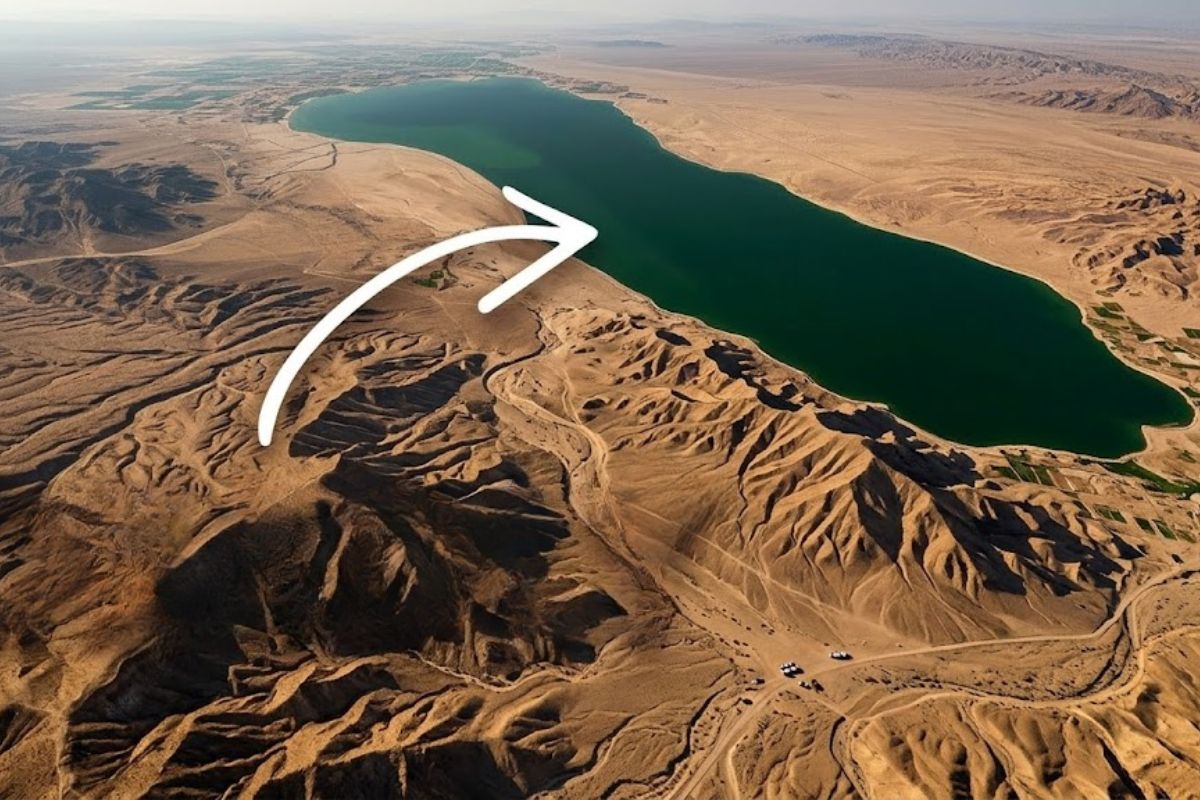
The Huge Lake In The California Desert Seems Natural From A Distance, But The Salton Sea Appeared By Accident When Engineers Lost Control Of The Colorado River, Turned A Dry Depression Into The Largest Lake In The State, And Left A Legacy Of Salt, Dust, And Lasting Environmental Crisis For Millions Of Residents.
The huge lake in the middle of the California desert was never supposed to exist. The Salton Sea appeared when engineers lost control of the Colorado River in 1905, allowing water to flow for 16 months into a dry and deep basin, accidentally forming the largest lake in the state.
What started as an engineering mistake became, for a few decades, an unlikely symbol of recreation and prosperity. Then, the same construction began to reveal another side, harsher and more enduring. Without a natural outlet, the huge lake began to concentrate salt, agricultural waste, and environmental instability, transforming an artificial landscape into one of California’s most troubling ecological issues.
When The Colorado River Unintentionally Created The Salton Sea
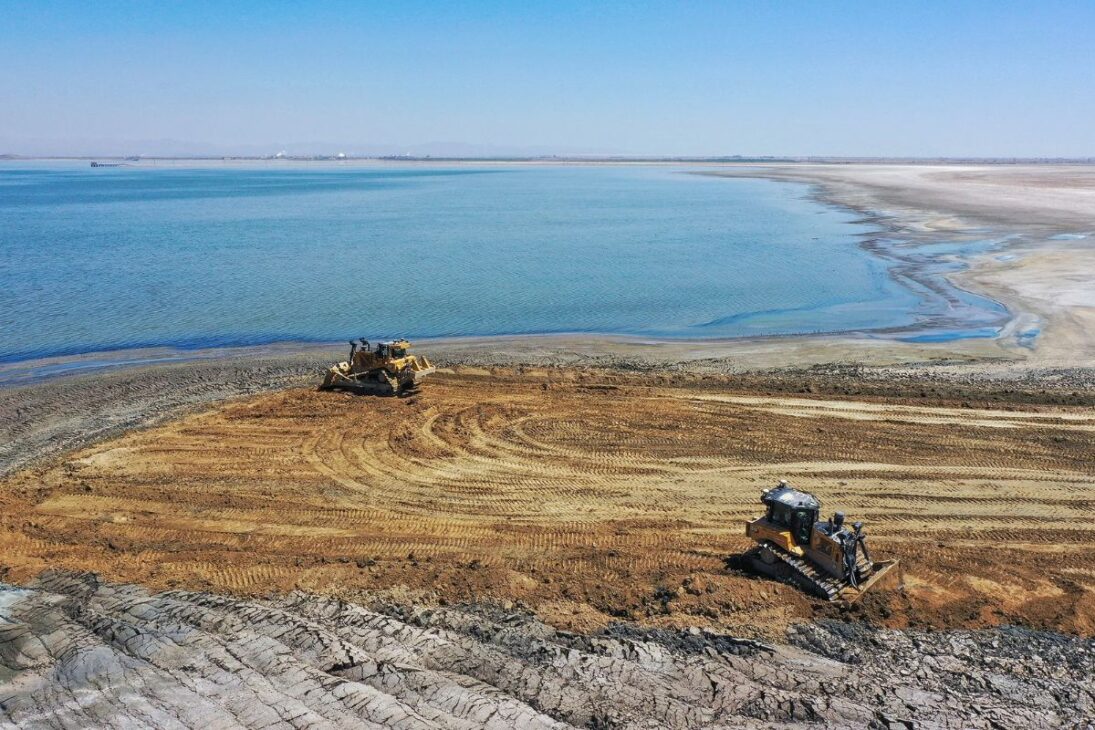
In 1905, the California Development Company was attempting to divert water from the Colorado River to the Imperial Valley and expand irrigation in the California desert. The idea seemed simple on paper: open a canal, control the flow, and use that water to make dry areas fertile. The mistake was thinking that a river of that scale could be contained with fragile, makeshift structures. The control failed catastrophically.
-
China is building a city in Brazil: a complex with an investment of R$ 5.5 billion comes to light, but allegations involving workers draw attention.
-
While Argentina buys old war equipment, Brazil is keeping an eye open and joins the select group of nations with advanced military technology by investing $5.2 billion, producing 36 Gripen fighters in the country, and reducing operational costs.

-
Brazil on alert? Why invading Brazil is a NIGHTMARE for the USA: 8.5 million km², 213 million inhabitants, Amazon covering 60% of the territory, trillion-dollar war, and resistance that even 13,000 aircraft could not control.
-
How to build a floating island from scratch with reeds, giant blocks, and stakes in the lake in a process that needs to be repeated almost every day.

When the Colorado River breached the system, all the flow poured into the Salton Basin, a dry depression located about 270 feet below sea level. The water flowed for 16 months while engineers tried to contain the disaster with stone barriers, wagons loaded with gravel, and concrete. Nothing could hold back the advance. When the flow was finally stopped in November 1906, the Salton Sea already existed as a huge lake about 45 miles long and 15 miles wide.
The scale of the accident helps explain why it remains so striking. It was not a localized flood, but a permanent alteration of the territory. The huge lake was born from the failure to tame a natural force greater than the engineering of that time could control. What was supposed to be just irrigation infrastructure turned into geography.
This episode also answers a central question. Why is the Salton Sea there? Because the Colorado River, diverted by human hands, found a perfect basin to accumulate water in the middle of the California desert. The lake did not come from rain, glaciation, or natural elevation. It was created by mistake, persistence, and time.
The Desert Paradise Did Not Last Long Because The Huge Lake Had No Outlet
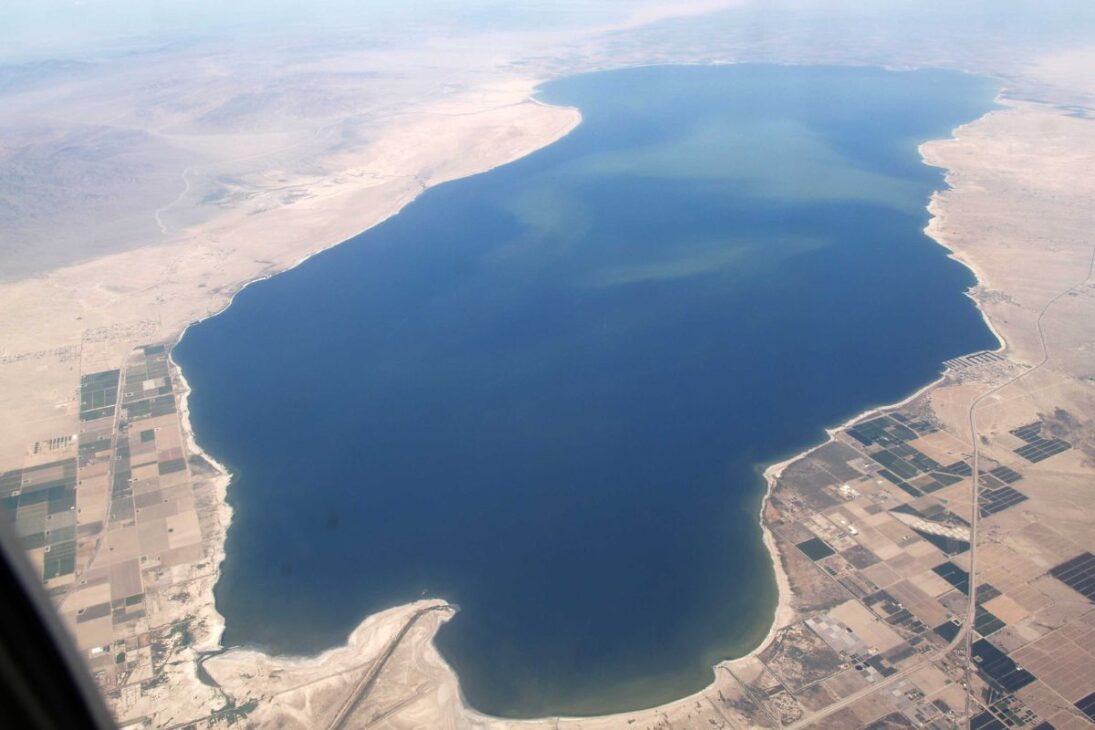
After the accident, the Salton Sea didn’t disappear because the water had no place to drain. In a closed basin, the only possible outlet was evaporation. And when water evaporates en masse in the desert, it leaves behind everything it carried. This detail condemned the huge lake from the start.
For decades, agricultural runoff continued to flow into the Salton Sea with fertilizers, pesticides, and lots of salt. Initially, the volume of fresh water coming from irrigation helped to stabilize salinity and maintained the appearance of balance. That’s why the site experienced a phase of glamour. In the 1950s and 1960s, the huge lake gained resorts, water sports, hotels, and the nickname Riviera of California.
The problem is that the system was never stable. Since there was no real renewal of water, salt kept accumulating endlessly. Gradually, the Salton Sea became saltier than the Pacific Ocean and continued to worsen. What seemed like a large recreational lake in the desert was, in fact, an artificial basin trapping everything that flowed into it.
The first signs emerged before the definitive collapse. Occasional fish deaths, foul odors, and scientific alerts indicated that the balance was fragile. But property values, tourism, and the allure of having water in the desert weighed more heavily. For a time, the appearance of paradise spoke louder than the chemistry of the huge lake.
When The Water Retreated, The Salton Sea Stopped Being An Attraction And Became A Threat
Starting in the 1970s, 1980s, and 1990s, the situation deteriorated rapidly. With increasing salinity, fish populations collapsed, algae proliferated, and the oxygen in the water plummeted. In 1999, the scale of the crisis became brutally visible when 7.6 million tilapia died in a single day. This type of event destroyed any illusion of normalcy in the Salton Sea.
Without fish, the migratory birds that depended on that ecosystem also began to die. In 1996, more than 10,000 white and brown pelicans died from avian botulism, along with nearly 10,000 other piscivorous birds. The huge lake that once supported a crucial stop on the Pacific migratory route became an ecological trap. Tourism retreated, property values plummeted, and towns like Bombay Beach became a picture of abandonment.
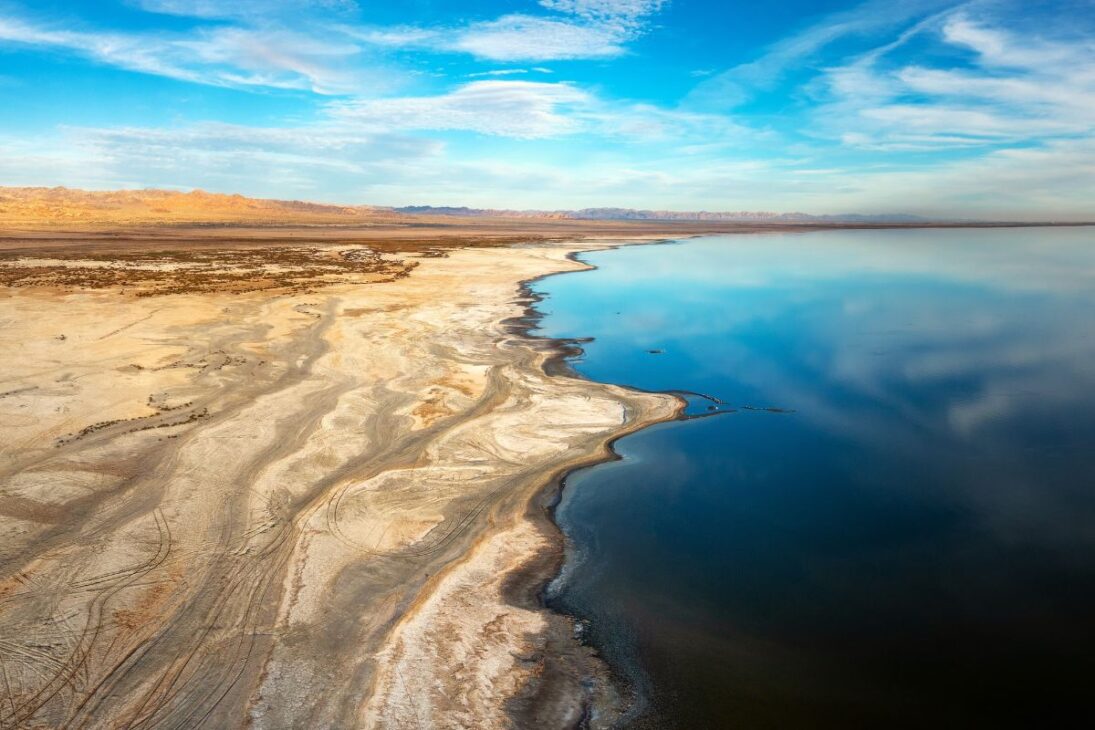
At the same time, the Salton Sea began to shrink. The waterline receded, exposing the so-called white ring around the basin, the physical mark of how much the lake had lost. Places that used to be shoreline became distant from the water. Clubs, marinas, and real estate projects in the California desert started to look like remnants of a bad bet.
This phase was decisive because the center of the problem was no longer just the lake’s water. When the huge lake shrinks, the danger does not die with it. It changes shape. What was once dissolved in the water begins to appear on the dry ground and circulates in the air.
The Real Crisis Is In The Toxic Dust That The Desert Spreads
When the Salton Sea loses water, it leaves behind sediments laden with over a century of agricultural runoff. This exposed bed is not ordinary desert dust. It is a fine mixture of salt, chemical residues, and particles that can penetrate deep into the lungs. The huge lake is becoming a source of air contamination.
This dust affects at least 3 million people in the area, according to the database you provided, and hits low-income communities in the Imperial Valley hardest. Children in nearby areas have asthma rates nearly three times higher than the national average, and air quality often exceeds federal safety standards. The cruelest effect is social: those who suffer the most tend to be those with the least resources to escape, filter the air, or pay for medical treatment.
The irony is heavy. The same agricultural system that helped sustain the local economy contributed to the deterioration of the Salton Sea. And the same water diverted for more profitable uses in other areas of California accelerated the shrinkage of the huge lake. The engineering accident turned into a public health crisis.
This is the point at which the case ceases to be a geographical curiosity and becomes a political alert. The Salton Sea is not just a strange lake in the desert. It shows how decisions about water, irrigation, and territorial growth can produce consequences far more lasting than their authors imagined.
Restoration Tries To Buy Time, But Does Not Address The Main Wound
California has begun to respond with restoration projects, including the Species Conservation Habitat Project, which envisions thousands of acres of artificial wetlands, channels, levees, and salinity control. The engineering is sophisticated and tries to create habitat for birds and reduce dust emissions. It is a serious attempt to prevent the huge lake from collapsing completely.
But the very magnitude of the effort reveals the limitation of the solution. The project uses hundreds of millions of dollars to artificially recreate part of what has been lost, without addressing the structural problem: the Salton Sea continues to have little fresh water entering, continues to shrink, and continues to concentrate salt. The project helps, but it does not restore the original balance or give the huge lake true stability.
There is also an ecological paradox. Even amid disaster, the Salton Sea has served as a refuge for the desert pupfish, a fish adapted to extreme conditions. This shows how desert ecosystems can react in unexpected ways. But it also reinforces that every intervention generates new effects that are hard to predict. Solving one problem in this landscape almost always creates others.
In the end, the story of the Salton Sea is less about a lake in the wrong place and more about the cost of treating arid landscapes as if they were easily correctable systems. The Colorado River was manipulated, the desert was forced to receive water, and California is now trying to manage an accident that has already spanned over a century.
The huge lake in the middle of the California desert exists because the Colorado River went out of control and created the Salton Sea by accident. Later, evaporation, salt, and agricultural runoff transformed this engineering mistake into an environmental and health crisis that remains without a definitive solution.
In your view, can the Salton Sea still be saved or has it already become an example of a disaster too big for any complete fix?






Seja o primeiro a reagir!