





 Portuguese
  English
  Spanish
  4 min of reading
  0 comments


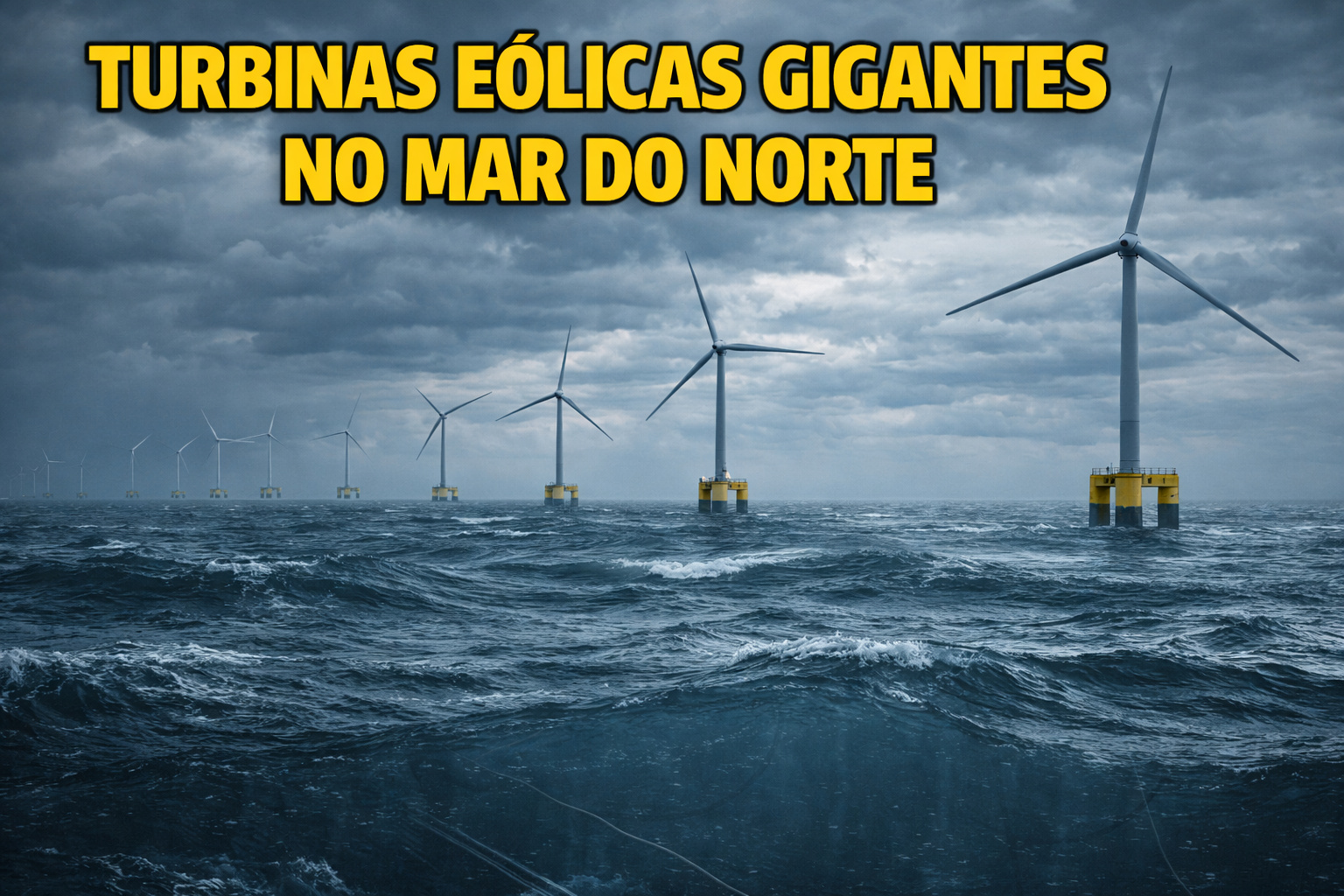
Norway Leads Floating Wind Energy With Giant Towers, 5,000-Ton Bases, And Submarine Cables That Bring Energy From The Sea To Industries On The Mainland.
According to Equinor (formerly Statoil), the International Energy Agency (IEA), and the Norwegian Ministry of Petroleum and Energy, the country operates the largest floating wind farm in the world as of 2023/2024: Hywind Tampen, located in the North Sea. Construction officially began in 2019, turbine installation took place between 2021 and 2023, and the system entered partial operation in November 2022, achieving expanded operation in 2023.
Norway had previously tested floating technology with the Hywind Scotland project, installed in 2017 in partnership with the United Kingdom, demonstrating to the world that wind farms can be installed in deep waters and beyond the continental shelf, something conventional fixed turbines cannot do due to depth limitations.
What sets the Norwegian case apart is the scale, depth, structural weight, and industrial integration: the turbines feed not only into the traditional electrical grid but also offshore oil platforms, reducing the use of natural gas for energy generation — something documented by Equinor itself.
-
Giant of the winds in Rio Grande do Norte: Serra do Tigre Wind Complex receives new investments and accelerates the expansion of clean energy generation to supply millions of Brazilian homes.
-
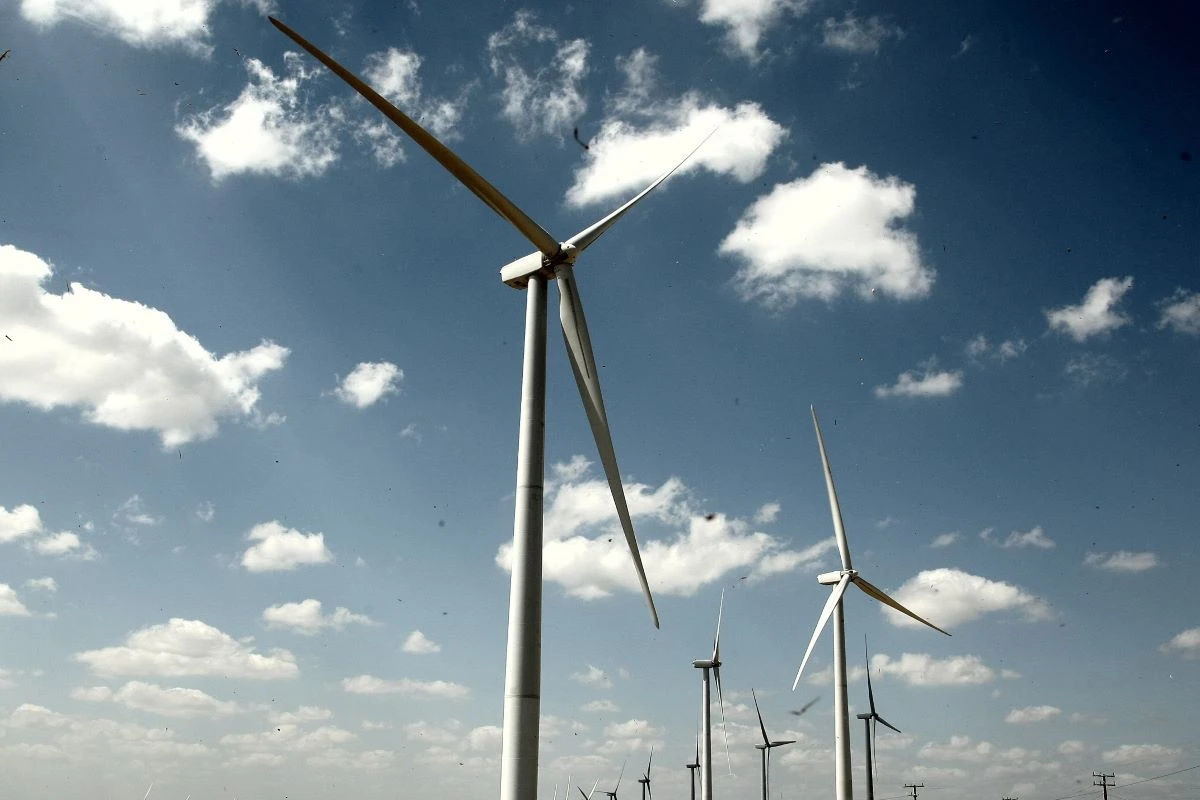
Urgent energy transition: Greenpeace advocates for massive investments and points to Brazil as a global leader in wind energy production in the coming years.
-
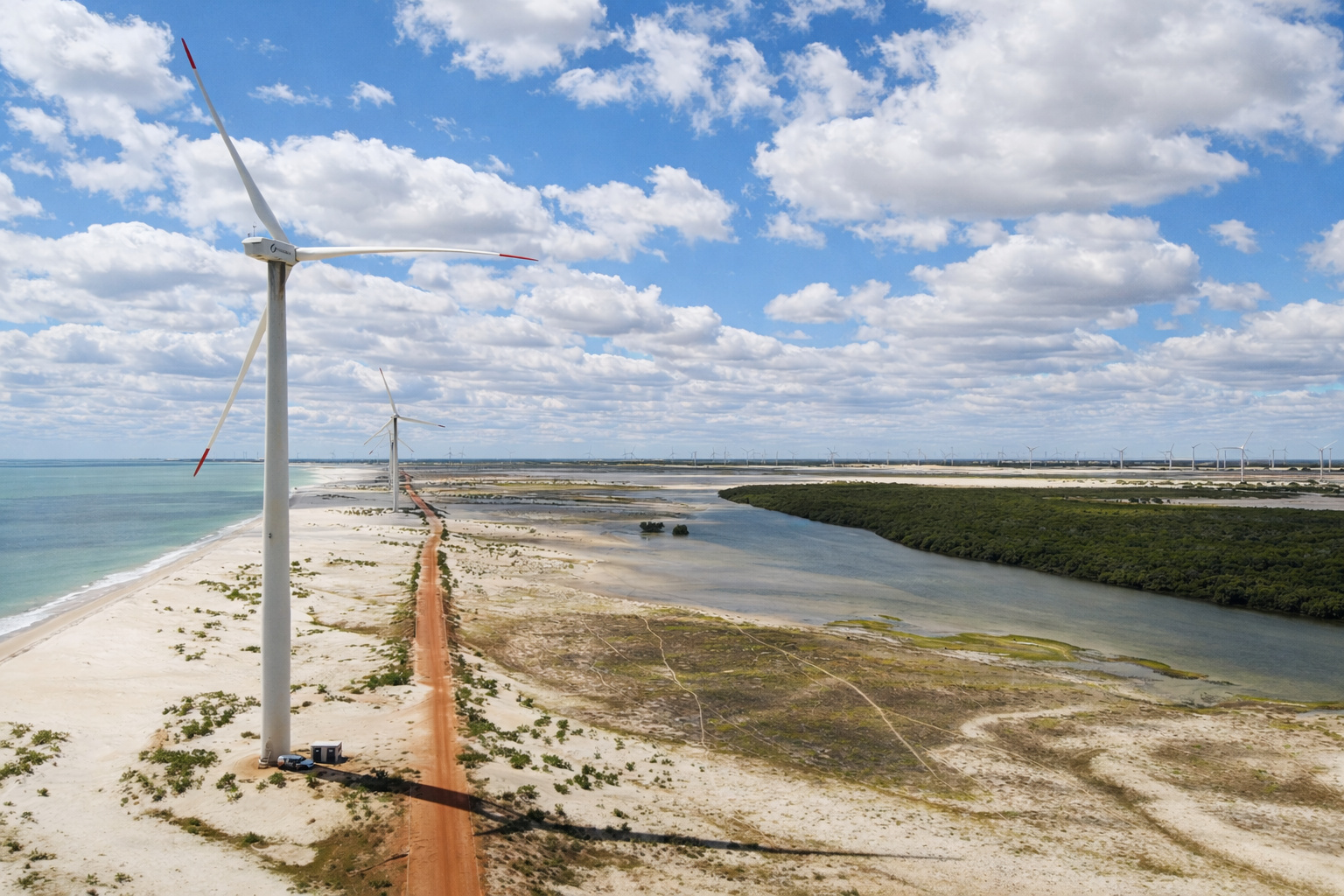
Conflict in the Sertão: Rural communities in Rio Grande do Norte report issues with wind farms and the new challenges of clean energy in the semi-arid region.
-
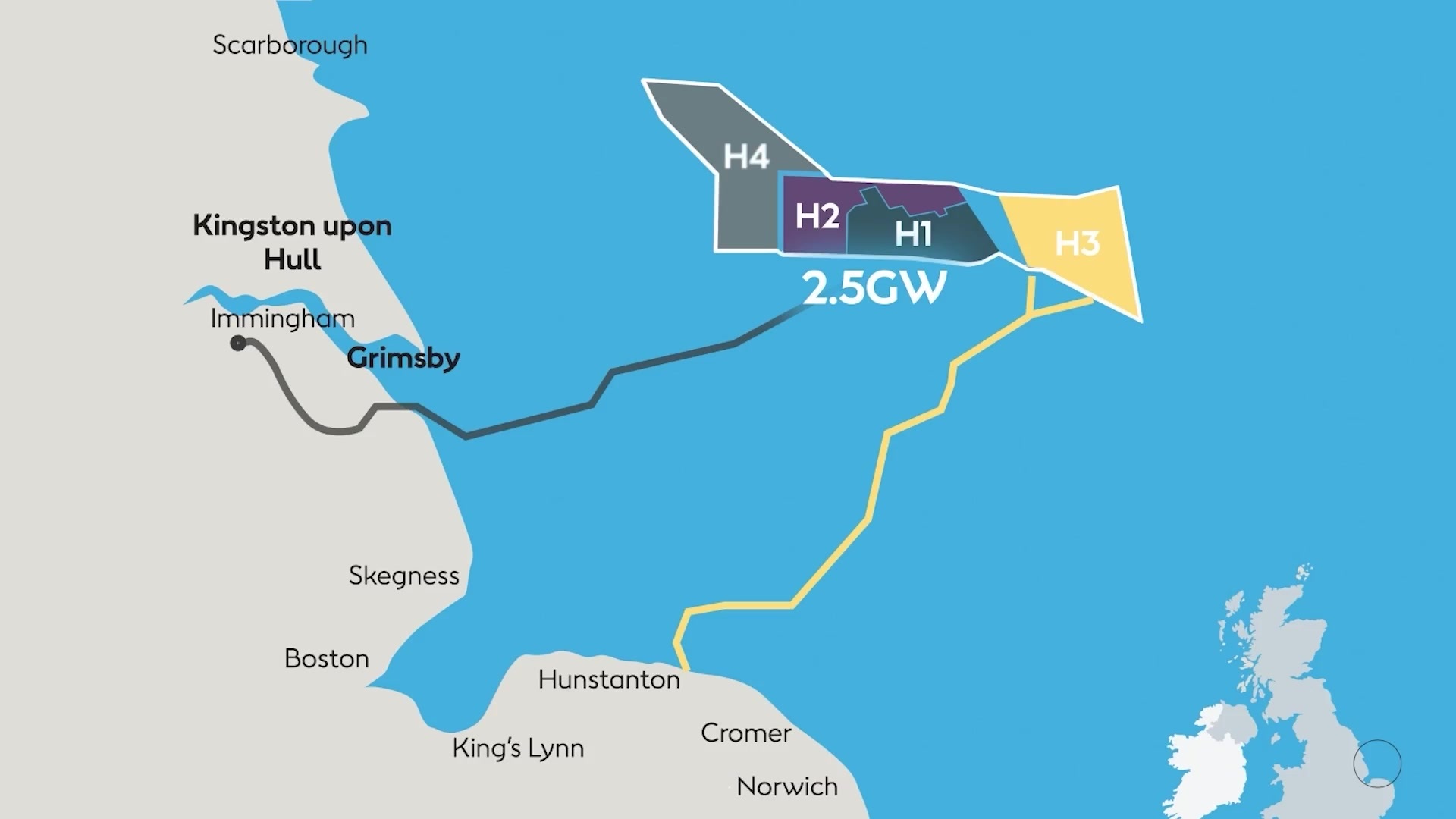
231 turbines of 260 meters at 160 km from the coast, monopiles weighing as much as nine blue whales embedded in the North Sea, and a crane ship taller than the Eiffel Tower: Hornsea 3 will be the largest offshore wind farm on the planet by 2027, and its first components have already arrived in England.

Why Did Norway Need To Build Floating Wind Turbines?
The Norwegian coast is one of the deepest in the world. A few kilometers offshore, the depth already exceeds 300 meters, and in many areas, it surpasses 1,000 meters. In such deep waters, it is not possible to install fixed towers with stakes, as is done in the United Kingdom, Denmark, Germany, or China.

The solution found by the Norwegian energy sector was to apply concepts from: naval engineering, wind energy, and offshore oil and gas. Norway has 50 years of experience with floating platforms, FPSO ships, subsea catenaries, mooring lines, and energy export cables, which facilitated the technological transition.
The Engineering Behind The Giant Wind Towers
The turbines used in Hywind Tampen are of the floating ballast type, supported by structures called spar platforms — similar to cylindrical oil platforms. According to Equinor, each unit has:
- Height of over 100 meters above the surface
- About 80–120 meters below the water line
- Floating bases of up to 5,000 tons
- Blade diameter close to 167 meters (in some models)
- Operational depths between 200 and 800 meters
These bases are anchored with steel cables and mooring systems capable of withstanding waves of up to 20 meters, winds over 100 km/h, and strong ocean currents.
Each turbine is connected by high-voltage submarine cables that run along the seabed of the North Sea to reach the processing systems.
Offshore Energy To Power Offshore Platforms
One of the most interesting aspects of the Norwegian project is the closed industrial cycle: the energy generated at sea powers oil and gas platforms, reducing emissions associated with production. According to official data released by Equinor and confirmed by the International Energy Agency:
- Hywind Tampen has an installed capacity of 88 MW
- It can supply up to 35% of the energy demand of platforms such as Snorre and Gullfaks
- Annual emissions are reduced by about 200,000 tons of CO₂
This transforms floating turbines into components of the energy transition, and not just conventional electricity generation.
Construction: From Dock To Ocean
The construction process involves:
- Manufacturing in Port
The floating bases and structural components are assembled at Norwegian or Scottish shipyards. - Coupling The Towers
The towers are erected while still in the port or in dry docks. - Installation of the Blades
The blades are mounted vertically, in a high-precision operation with offshore cranes. - Ocean Towing
The complete turbine is towed by tugboats to the anchoring point. - Submarine Connection
Electrical cables and anchoring lines are positioned with ROVs (remotely operated vehicles).
The set forms a generating plant offshore, without artificial islands, without fixed platforms, and without the need for massive dredging.
Scale, Costs, And International Impact
According to official estimates released during the development of the project, Hywind Tampen cost approximately 7.4 billion Norwegian kroner, with financial support from the Norwegian government to stimulate industrial innovation. The impact is considered global for three main reasons:
- Deep Waters Dominate The Best Winds On The Planet
IEA studies show that 80% of offshore wind potential is in deep waters where fixed turbines cannot be installed. - Oil Companies Are Becoming Electric
Equinor, Shell, and BP are investing in floating wind, and part of this shift was born from Norwegian engineering. - Countries Without A Continental Shelf Can Now Join The Game
Japan, South Korea, the USA (West Coast), Norway, and Spain share similar geography — deep coasts, where fixed turbines are impractical.
How This Changes The Global Energy Map
Norway is not only generating energy: it is exporting technology. Countries that have already announced or operate floating turbines based on Norwegian concepts include:
- Japan — pilots post-Fukushima
- United Kingdom — Hywind Scotland operational since 2017
- Portugal — WindFloat platform
- South Korea — major studies on the east coast
- Spain — plans on the Atlantic coast
- USA — projects in California and Oregon
The IEA estimates that if the entire potential of deep waters is explored, floating wind could supply 11 times the world’s electricity consumption — a figure cited in official agency reports.
Why Is This Model Interesting For Other Countries?
Several strategic factors make Norway a global energy laboratory:
- Challenging Geology → demands innovation
- Mature Naval Engineering
- Established Shipyards And Offshore Industry
- Strong State Capital And Energy Governance
- Consolidated Environmental Policy
Coastal states with similar conditions may replicate the model, including countries with little shallow coast.









Seja o primeiro a reagir!