





 Portuguese
  English
  Spanish
  5 min of reading
  1 comment


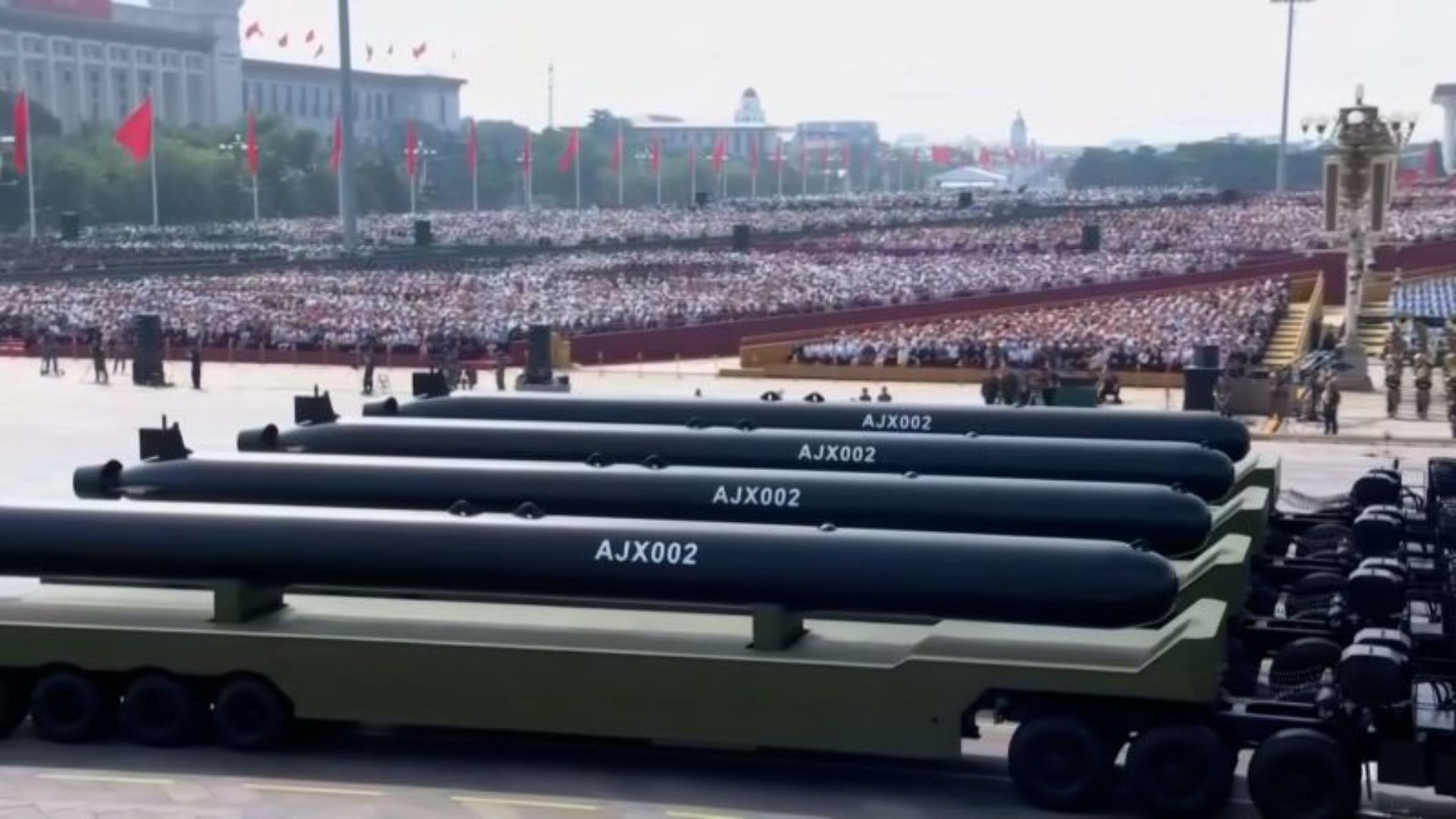


Chinese Military Advance Brings Stealth Submarines, Hypersonic Missiles, and Smart Drones Into an Integrated Network That Combines Operational Silence, Extreme Speed, and Advanced Automation, Redefining Strategic Standards for Maritime and Aerial Deterrence in the Contemporary Global Scenario.
A new generation of military systems attributed to China has started to attract international attention due to the level of automation, stealth, and speed described in its naval and aerospace projects, according to a detailed analysis presented by the Poder da Indústria channel.
This technological set features low acoustic signature submersibles, hypersonic missiles, and unmanned platforms interconnected by artificial intelligence, forming an integrated architecture that prioritizes connectivity, rapid decision-making, and reduced human exposure in high-risk environments.
Stealth Submarine AJX002 and War in the Depths
Among the highlights mentioned is the AJX002, described as a stealth-profile submarine or underwater vehicle designed to operate with minimal sound emission, drastically reducing the possibility of detection by traditional maritime surveillance systems based on sonar.
-
These living root bridges and ladders are over 700 years old and help indigenous people survive in one of the rainiest regions in the world.

-
From sertanejo star to international investor: Ana Castela invests millions in a mansion in the USA, creates a themed accommodation in Orlando, and shows that the “boiadeira” also wants to grow away from the stage.

-
The 10 most stunning motorhomes in the world: a $3 million trailer with a rooftop nightclub and garage for a Ferrari, “palaces on wheels” with Italian marble, private cinema, and five-star hotel luxury for billionaires.

-
Trump wanted to spend $400 million on the White House, but the courts prohibited the million-dollar construction.



According to the presented description, the project employs propulsion systems with controlled mechanical vibration and advanced acoustic coatings able to absorb or disperse sound waves, a strategy that would enhance operational discretion during prolonged missions in deep waters.
It is also pointed out that atmospheric regeneration systems would allow for prolonged submersion, expanding the operational range without the frequent need to surface, a feature that enhances the element of surprise and reinforces strategic response capabilities in complex naval scenarios.
In addition to extended autonomy, the capability to launch smart torpedoes and missiles from great depths is presented as a central element of the proposal, indicating integration between structural stealth and concentrated offensive power.
Robot Dogs and Artificial Intelligence in Ground Combat
While the underwater environment evolves in technological silence, in the terrestrial field there is an advancement of four-legged armed platforms known as robot dogs, developed to operate in rough terrains or urban areas where heavy vehicles face operational limitations.
These units are described as capable of transporting advanced sensors or light armaments, moving with agility and maintaining constant communication with other platforms, which expands tactical coverage and reduces direct exposure of human troops.

The strategic differential would be the integration through distributed artificial intelligence, allowing multiple units to share encrypted data in real time and react collectively to threats detected by any member of the formation.
With this networked architecture, operational decisions could be executed in fractions of a second, reducing dependence on direct command and increasing response efficiency in dynamic confrontation scenarios.
OW5 Laser System and Directed Energy Air Defense
In the field of air defense, the mobile OW5 laser system emerges as a symbol of the transition from gunpowder to directed energy, being described as a ground platform capable of neutralizing drones and projectiles through concentrated high-energy beams.
Unlike conventional interceptors, the equipment would use electricity as its primary input, which, according to the presented analysis, could represent a significant financial advantage in containing low-cost threats launched in large volumes.
The invisible and instantaneous beam would allow for millimeter precision operation, varying intensity according to the target and offering everything from sensor deactivation to structural damage on metal surfaces, depending on specific operational needs.
Railgun and Long-Range Electromagnetic Artillery

In parallel to the development of lasers, research into electromagnetic guns, known as railguns, that use intense magnetic fields to accelerate solid projectiles to speeds above 2,500 meters per second is highlighted.
At this extreme speed range, the kinetic energy of impact makes the use of conventional explosives unnecessary, enhancing the destructive power while reducing logistical complexity associated with the storage of traditional munitions.
With an estimated range of over 200 kilometers, the system would expand engagement capacity beyond the visual horizon, integrating with naval platforms and strengthening deterrence strategies in vast maritime environments.
Swarms of Drones and Strategic Numerical Superiority
Another strategic avenue presented involves the use of swarms of drones coordinated by algorithms, replacing exclusive dependence on high-value aircraft with a large volume of smaller units operating in a synchronized manner.
By saturating adversary defenses with multiple simultaneous vectors, this approach alters the traditional equation of cost and interception, imposing significant mathematical challenges to systems designed to handle isolated threats.
The distributed coordination would allow for automatic reconfiguration of routes and leadership if a unit is neutralized, maintaining group cohesion and ensuring mission continuity even under heavy defensive pressure.
Stealth Drone FH-97 and Automated Aerial Combat
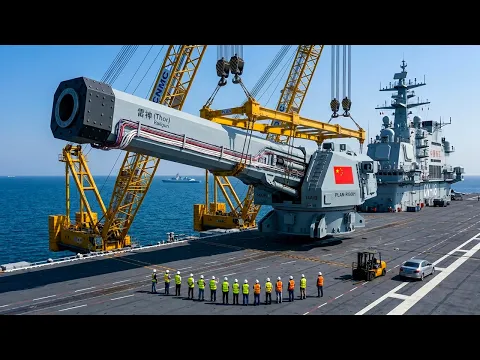

In the aerial segment, the FH-97 is cited as an example of a long-range stealth drone designed to operate alongside manned fighters or autonomously, expanding sensory coverage and coordinated attack capability.
With real-time tactical processing, the platform would reduce human biological limitations in high-speed environments, enhancing immediate responses and integration with other connected combat systems.
In the hypersonic domain, missiles capable of reaching speeds above Mach 10 with maneuverable trajectories are presented as a transformative element, complicating predictive interception calculations by traditional defensive systems.
Military Miniaturization and Surveillance with Microdrones
Technological miniaturization completes the described panorama by introducing biomimetic microdrones comparable to insects, designed for surveillance and reconnaissance missions in confined or hard-to-reach environments.
Equipped with micro-cameras and audio sensors, these devices could transmit data in real-time while operating with visual discretion, enhancing information-gathering capabilities in sensitive urban or strategic scenarios.
According to the analysis from the Poder da Indústria channel, the convergence of stealth, artificial intelligence, directed energy, and hypersonic speed signals a structural reorganization of military capabilities, with a direct impact on the contemporary dynamics of global deterrence.








O vosso problema é de exibir o pouco que têm… O americano nunca vai te mostrar o seu armamento.