





 Portuguese
  English
  Spanish
  3 min of reading
  0 comments



Scientists Create Metal Alloy With Memory That Operates At Extreme Temperatures, Opening The Way For Safer Space Probes And More Efficient Cryogenic Systems
A new discovery made by Japanese researchers promises to revolutionize the aerospace sector and the cryogenic industry. It is a copper, aluminum, and manganese-based metal alloy that retains its functional structure even at -200 °C, a common condition in deep space.
According to the study published in July 2025 in Nature Communications Materials, the new alloy can recover its original shape even after severe deformations, operating as an actuator without relying on electricity or sensors. The team led by Hirobumi Tobe successfully tested the material at cryogenic temperatures, making it ideal for space missions, satellites, and liquid hydrogen applications.
A Material That Withstands The Extreme Cold Of Space
In the vacuum of space, temperatures can drop to -270 °C. Most metals with “shape memory” cease to function around -20 °C. The new discovery surpasses this limit, maintaining stability and performance at -198 °C. This is only possible due to the internal structure of the metal, which rearranges its atoms in response to cold, generating precise mechanical movement.
-
Motorola launched the Signature with a gold seal from DxOMark, tying with the iPhone 17 Pro in camera performance, Snapdragon 8 Gen 5 that surpassed 3 million in benchmarks, and a zoom that impresses even at night.

-
Satellites reveal beneath the Sahara a giant river buried for thousands of kilometers: study shows that the largest hot desert on the planet was once traversed by a river system comparable to the largest on Earth.

-
Scientists have captured something never seen in space: newly born stars are creating gigantic rings of light a thousand times larger than the distance between the Earth and the Sun, and this changes everything we knew about stellar birth.

-
Geologists find traces of a continent that disappeared 155 million years ago after separating from Australia and reveal that it did not sink, but broke into fragments scattered across Southeast Asia.

This phenomenon is called thermoelastic phase transformation, and allows for the creation of mechanisms that open, close, or contract on their own, without motors or electricity. This reduces the risk of failure in satellites or probes facing severe thermal cycles.
Practical Applications In Space Missions And Clean Energy
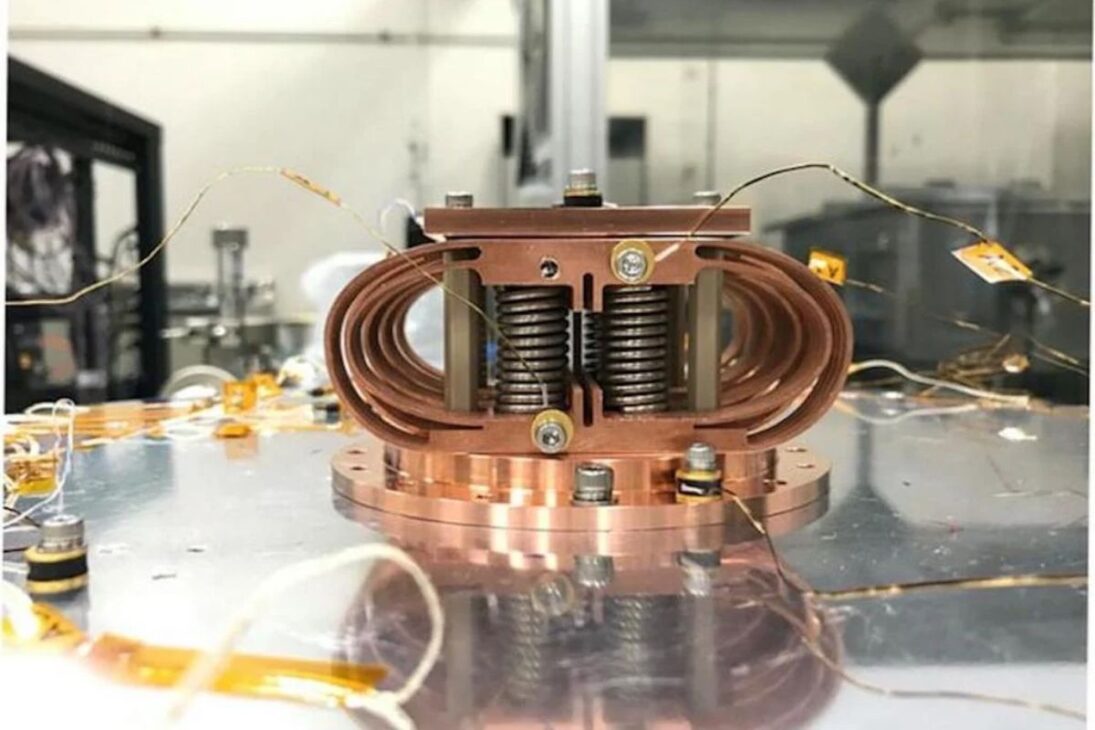
The research team developed a mechanical thermal switch using this alloy, capable of automatically opening and closing a heat channel upon reaching a specific temperature. The system was successfully tested at -170 °C and can be used in space telescopes like the James Webb, which operates at -223 °C.
Additionally, the new discovery can be applied in systems using liquid hydrogen, such as fuel tanks for rockets or clean energy technologies. Passive actuators, activated only by ambient temperature, could serve as emergency valves — simple, lightweight, and without energy consumption.
Potential For The Future Automation
The material also impresses with its ability to “learn”. By adjusting the ratio of the elements in the alloy, scientists can calibrate the exact temperature at which it will be activated. This enables the creation of custom components, with surgical precision, for extreme environments.
According to the authors of the study, this new discovery represents more than a technical advance. It can enable long-duration missions in deep space, increase the reliability of satellites, and open new frontiers for industrial automation and intelligent cooling systems.
Do you believe this new technology can accelerate space exploration? How could this material be used here on Earth? Share your thoughts in the comments.








Seja o primeiro a reagir!