





 Portuguese
  English
  Spanish
  3 min of reading
  0 comments


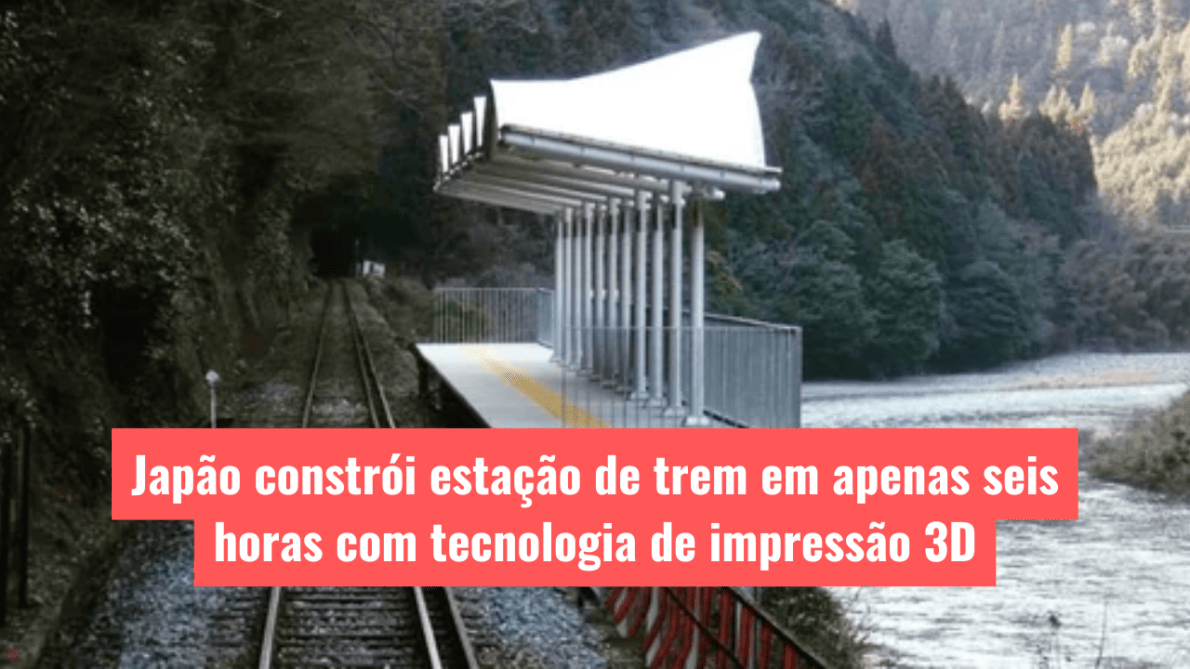
Japan Builds Train Station in Just Six Hours with 3D Printing Technology. Innovative Project Revolutionizes Railway Construction!
In a pioneering initiative that could transform the maintenance and expansion of railway infrastructure in remote areas, Japan demonstrated the power of innovation by constructing a 3D printed train station in just six hours.
The project, carried out in the city of Arida, in the Wakayama province, combines cutting-edge technology with the demands of a country facing the challenge of an aging population and a shrinking workforce.
An Innovative Solution to Real Challenges
With the gradual decline of the population in various regions of Japan, maintaining essential services like railway transport in remote communities has become increasingly complicated.
-
The Caspian Sea intrigues scientists as it is neither officially a sea nor a lake: the largest lake on the planet holds a hybrid crust, submerged cities, mud volcanoes, and billions of barrels of oil hidden at the bottom.

-
Why did the sky turn blood red in the west of Australia and it wasn’t sunset? Discover what is behind the change that took over the horizon for miles.

-
The most feared warplane of the United States is over 70 years old, carries 32 tons of explosives, flies 14,000 kilometers nonstop, and has just been sent to the United Kingdom amid escalating tensions with Iran.

-
Satellites and radars revealed, beneath 2 kilometers of ice in Antarctica, a lost world the size of Wales, with rivers, valleys 1,200 meters deep, and plateaus sculpted by water, frozen for 34 million years, when the continent had temperate forests and was part of a supercontinent that included South America.

Train stations, especially in rural areas, face difficulties justifying investments in conventional buildings, which can take months and incur high costs.
In this context, the strategy of using a 3D printer to construct a new train station proves to be not only a viable alternative but also a revolutionary approach to railway construction and modernization.
The Hatsushima Station, Built with a 3D Printer
Located in the quiet coastal city of Arida, which has about 25,000 residents, the new station, named Hatsushima, was designed to serve a demand of approximately 530 daily passengers, including 19-year-old university student Yui Nishino, who uses the railway transport daily.
The project began with the printing of parts at a factory in Kumamoto province, located on Kyushu Island. In just seven days, the 3D printed parts were reinforced with concrete, demonstrating the efficiency and robustness of this innovative method.
The central idea was to replace a wooden building that had served the community for over 75 years, which, due to time and costs, presented a challenge for traditional construction and maintenance.
With the use of a 3D printer, the new station was assembled in a surprisingly short time – between the last train of the night and the first train of the morning.
This achievement not only underscores the agility of 3D printing technology but also paves the way for the construction of other essential structures in hard-to-reach areas.
Impacts on Railway Infrastructure and Daily Life
The use of 3D printing technologies in constructing train stations brings a series of benefits to Japan’s railway network.
Railway operators such as West Japan Railway Co. report that the assembly of the new station took only six hours, compared to more than two months that would be required with conventional methods, while also significantly reducing costs.
The savings in time and labor are crucial given the reality of a declining population and an increasingly restricted job market.
In addition to the economic aspect, the innovation also has a strong social impact. Residents of Arida came together to watch the assembly of the new structure, showing pride and hope that more projects using emerging technologies could revitalize rural areas.
The Hatsushima project, with its minimalist design and cultural touches – such as the presence of graphic elements reminiscent of mandarin oranges and swordfish, local specialties – reinforces the identity of the community while promoting modernity and efficiency.
Challenges and Prospects for Construction Using 3D Printers
Despite the success of the project, experts recognize that the implementation of this technology on a large scale will still face challenges.
Adapting traditional construction techniques to incorporate 3D printing requires investments in research and training, as well as a restructuring of logistical processes, especially when it comes to transporting printed parts over long distances, such as the 800 kilometers traveled to Arida.
However, the results obtained already demonstrate that the technology can be an effective solution for keeping railway operations running in places where the economic viability of conventional methods is questionable.
The expectation is that other regions of Japan, and even other countries, may draw inspiration from this model to revitalize their infrastructure, ensuring that isolated communities remain connected and public transport remains efficient.





Seja o primeiro a reagir!