





 Portuguese
  English
  Spanish
  5 min of reading
  0 comments


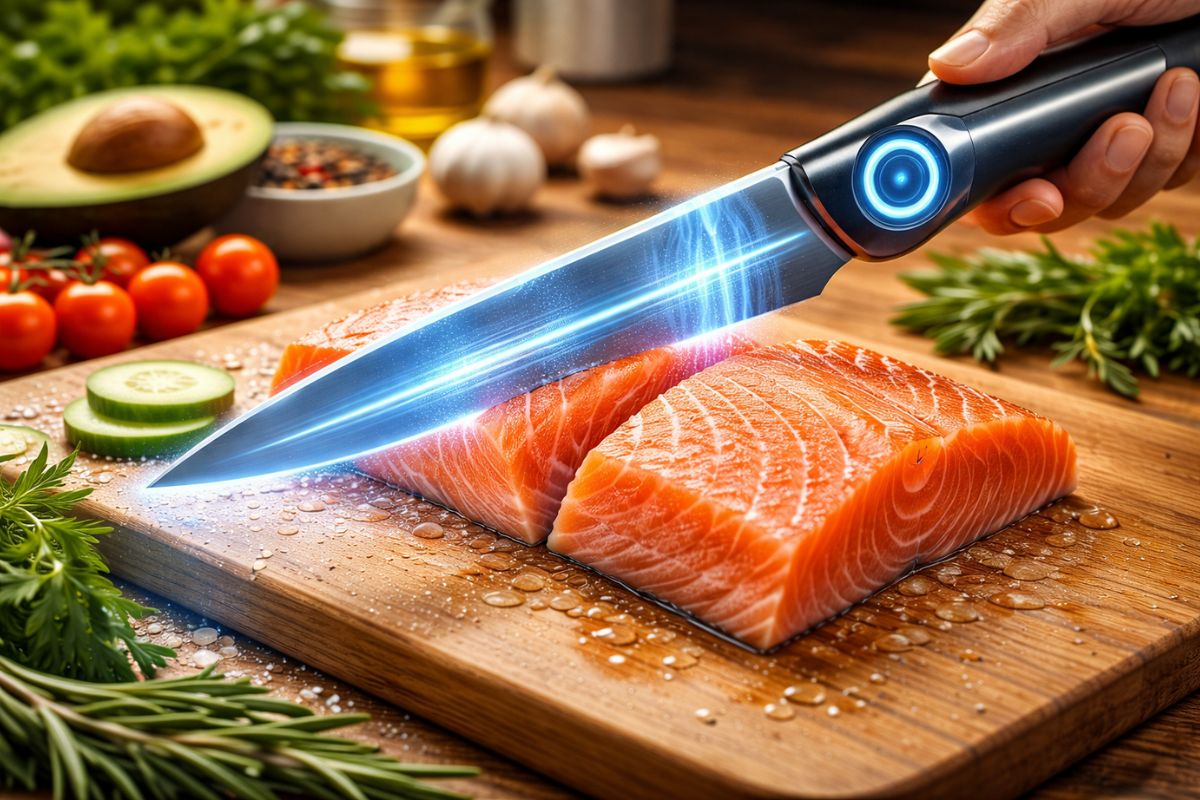
Ultrasonic Knife Uses High-Frequency Vibrations in Cutting to Reduce Food Resistance, Maintain Good Performance Even with a Blunt Blade, and Prevent Food from Sticking.
In recent weeks, the internet has been flooded with videos and discussions about an ultrasonic knife, and curiosity has grown because ultrasonic technology has been used for years in the industry, including in cutting systems and ultrasonic cleaners. The difference now is the promise of bringing this principle to a daily kitchen object, with the aim of making cutting easier even when the edge is not at its best.
The ultrasonic knife presented at CES 2026 was associated with the company Sear Ultrasonics and appeared as an ambitious project: instead of relying solely on the blade to “bite” the food, it adds an active component that works together with the blade. The person commenting in the video identifies as someone from the cutlery and sharpening industry, and thus tries to separate what is real effect from what is marketing, explaining what the knife does, what it does not do, and where practical gains may lie.
Why the Ultrasonic Knife Is a Hot Topic Now
The central argument is that “ultrasonic” has become a meaningful term, like other technologies that have emerged from niches and gained widespread use over time.
-
In a flooded well, archaeologists found a 1,700-year-old Roman egg that still contains clear and yolk intact inside the very thin shell.

-
Something is happening around the Earth: Inside the huge explosion of fireballs in 2026

-
A hot air bubble coming from Argentina expands over Brazil, causing thermometers to exceed 38 degrees with a thermal sensation of 40 degrees in late March, affecting 6 states at once.

-
The radish leaf that almost everyone throws away has more polyphenols, flavonoids, and fiber than the consumed root, and a 2025 study showed that the leaf contains compounds that protect the intestine, combat inflammation, and may inhibit the growth of cancer cells.


The comparison made is that many innovations first appear in specific contexts and then migrate to common products, and the ultrasonic knife enters this narrative as an attempt to bring industrial technology into the kitchen.
The attention-grabbing point is not just the novelty, but the problem it tries to tackle: many people use dull knives in their everyday lives and do not have a sharpening routine. If the blade can cut better even when not perfectly sharpened, it directly impacts a common habit within the home.
How the Ultrasonic Knife Works in Cutting Practice
The explanation uses a simple analogy: imagine a small motor inside the handle or body of the knife, generating high-frequency vibrations while you make the normal cutting motion.
The mentioned video describes an alternating motion up and down, as if the blade gains micro-movements while advancing through the food.
The expected effect is that you do not “feel” a noticeable vibration in your hand, but notice the result of the blade passing through the food more easily. In practice, the ultrasonic knife aims to reduce cutting resistance, making the sensation softer and requiring less force for the same task.
Does the Ultrasonic Knife Get Sharper or Just Cut Better?
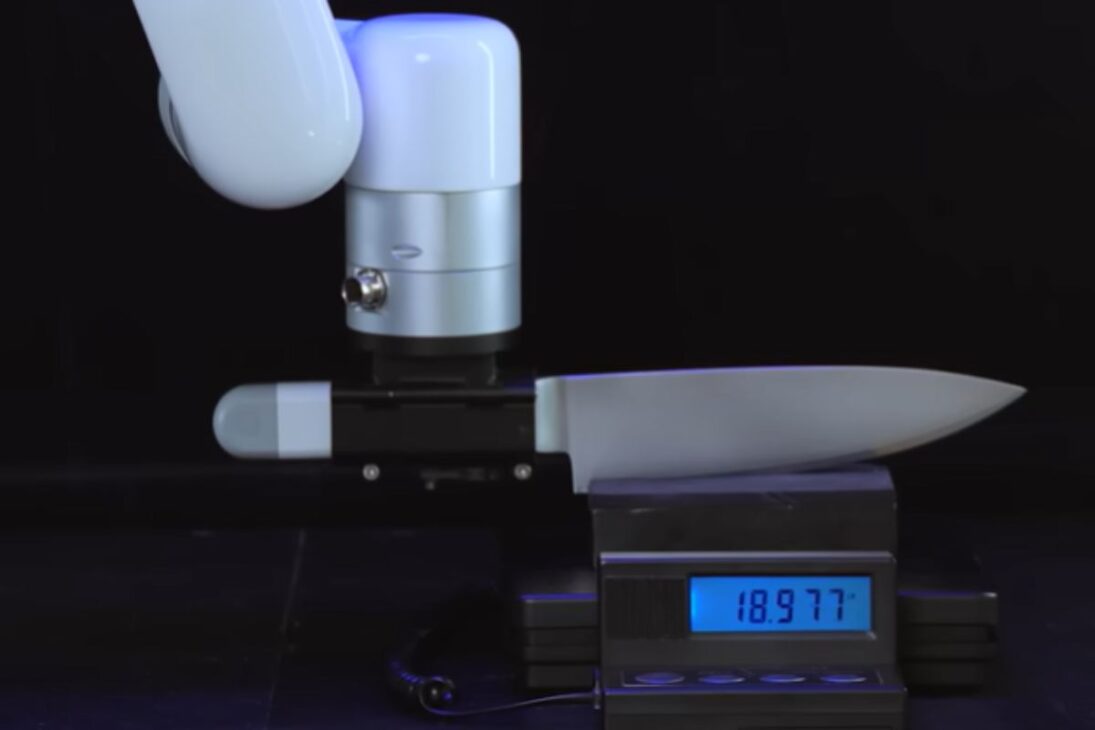
Here a crucial distinction from the commentary comes in. The blade remains metal and, in terms of sharpening, every knife depends on an edge.
The argument is that the ultrasonic knife does not magically become sharper, but is able to deliver better performance even when the blade is already “half-life” or has become “blunt.”
This changes the conversation because it does not eliminate sharpening, but reduces the dependence on a perfect edge for acceptable cutting in everyday life. For those who do not sharpen frequently, this is the most straightforward promise: to keep cutting with less effort, even without maintaining the blade always sharp.
Design, Handle, and Construction Designed for Durability
Without having held and tested it personally, the analysis in the video discusses public perceptions and design choices. A recurring criticism was that the handle appears thicker, which would make sense if there are more internal components to accommodate.
At the same time, it is noted as a positive point that the knife comes without a “gavião,” indicating that there was ergonomic and grip study.
A layered construction, “sandwich-style,” is also described, associated with the Japanese san-mai concept, with the idea of improving durability and edge retention by using more than one metal in the composition.
Charging Base and Solution for Storing the Knife
Another detail mentioned is the existence of a holder that acts as an induction charger and can be mounted on the wall. The logic is simple: in addition to recharging, the holder addresses a common issue, which is where to store the knife safely and easily accessible.
It is also mentioned that the ultrasonic part could be charged via USB-C, and that the knife could be used turned off, but with the note that, in this case, the main product proposal loses its meaning. Within this logic, the ultrasonic knife tries to sell itself as a complete system, not just a different blade.
The Most Interesting Gain: Food Does Not Stick to the Blade

In addition to the feeling of a lighter cut, the commentary highlights an advantage that seems truly distinct: reduction of food sticking to the blade.
Anyone who has cut potatoes, cheese, or certain vegetables knows how food can stick and disrupt the rhythm, requiring pauses to “clean” the blade.
The promise described is that the ultrasonic knife decreases this resistance, which is not just comfortable. In cooking, less sticking also means more fluidity in preparation and fewer interruptions while cutting.
Price, Taxes, and the Challenge of Bringing It to Brazil
The video mentions that pre-sales are around 400, and raises a hypothesis that, upon arriving in Brazil with taxes and costs, it could reach much higher prices, creating a commercial dilemma for anyone trying to resell with margin.
This section is presented as concern and projection, not confirmation. The idea is that the technology draws attention, but the final price could be the deciding factor in whether it becomes a niche product or gains scale.
What Still Needs to Happen for the Ultrasonic Knife to Convince
Even with a well-structured explanation, the commentary itself admits a limit: without testing, feeling, and comparing, it is difficult to assert how much the gain compensates.
The ultrasonic knife seems promising in theory and demonstrations, but what defines success is the real experience with different foods, routines, and edge levels.
Still, as a concept, it enters the arena as a new technology: it does not replace the blade, does not replace sharpening, but adds a resource that can improve the lives of those who cook with dull knives and feel that in their hands every day.
Would you buy an ultrasonic knife to cut better even with a dull edge, or do you think it is still a technology that needs to prove its value in real use before being worth the investment?







-

Uma pessoa reagiu a isso.