





 Portuguese
  English
  Spanish
  4 min of reading
  115 comments


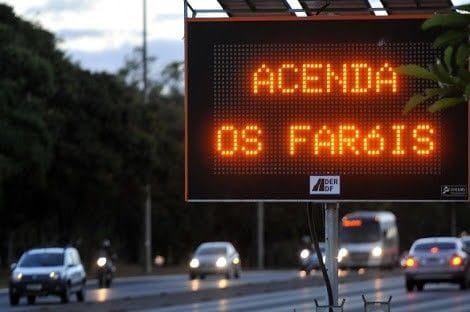

The New Traffic Legislation in Brazil Imposes Strict Fines and Even Vehicle Removal for Irregularities in the Lighting System. Drivers of All Brands Need to Be Alert to Avoid Penalties. The inspection is strict and requires that all equipment complies with the regulations.
Imagine driving your car peacefully through the city streets and suddenly being stopped by the police for something as simple as a headlight. Seems exaggerated? Not anymore.
The new traffic legislation in Brazil is causing anxiety among Brazilian drivers. The penalties for infractions related to vehicle lighting systems are stricter than ever, with heavy fines and even the removal of the vehicle. But what exactly has changed and how can these issues be avoided? Let’s uncover that now.
In Brazil, the vehicle lighting system is regulated by several resolutions from the National Traffic Council (Contran) and the Brazilian Traffic Code (CTB). Contran Resolution 993/2023 is the most recent and details the mandatory equipment that each vehicle must have to travel safely.
-
Larger than entire cities in Brazil: BYD is building a 4.6 km² complex in Bahia with a capacity for 600,000 vehicles per year, but the discovery of 163 workers in conditions analogous to slavery has shaken the entire project.

-
With an investment of R$ 612 million, a capacity to process 1.2 million liters of milk per day, Piracanjuba inaugurates a mega cheese factory that increases national production, reduces dependence on imports, and repositions Brazil on the global dairy map.

-
Brazilian city gains industrial hub for 85 companies that is equivalent to 55 football fields.

-
Peugeot and Citroën factory in Argentina cuts production by half and opens a layoff program for more than 2,000 employees after Brazil drastically reduced purchases of Argentine vehicles.


Among the requirements are brake lights, headlights, auxiliary lights, and daytime running lights (DRL), which are essential for the vehicle’s visibility on public roads.
The New Rules and Their Implications
According to Article 223 of the CTB, driving with misaligned headlights or with high beam in a way that disturbs the vision of other drivers is considered a serious infraction.
Drivers caught with headlights in poor condition or using high beams in inappropriate places may face fines of R$ 195.23 and receive five points on their driver’s license. Furthermore, the vehicle may be held until the issue is corrected.
Another common infraction is the improper use of high beams. According to the National Traffic Secretariat (SENATRAN), high beams should only be used on unlit roads and must be turned off when approaching another vehicle to avoid dazzling.
Otherwise, the driver may receive a minor fine of R$ 88.38 and three points on their license. Vehicles with automatic high beam technology must be properly adjusted to avoid penalties.
The correct use of low beams is also fundamental. According to Article 250 of the CTB, low beams must be activated in low visibility conditions, such as at night, during rain, fog, or overcast, and in tunnels.
Drivers who do not comply with this rule may be fined R$ 130.16 and receive four points on their license. The same rule applies to buses, trucks, and public transport vehicles, which must keep their headlights on on highways, unless equipped with DRL.
Additional Equipment and Inspection
The use of daytime running lights (DRL) is permitted during the day, but at night, low beams must be used. Vehicles that operate solely with DRL at night will be subject to fines.
Additionally, turn signals are essential for indicating a vehicle’s direction, and driving with burnt-out turn signal bulbs can result in penalties under Article 230 of the CTB.
The enforcement of these regulations is carried out by traffic agents who can stop vehicles to check if all lighting systems are functioning properly.
According to federal highway police officer Antoniel Lima, in an interview with portal g1, during inspections, headlights, taillights, auxiliary devices, and license plate lighting are checked. In cases of irregularities that cannot be corrected on-site, the vehicle’s document (CRLV) may be retained, and the owner has up to 30 days to regularize the situation.
More Serious Consequences Due to Headlights
In more serious cases, such as using devices not permitted by law, such as intermittent auxiliary lights, the vehicle may be removed to a lot until the equipment is taken out.
Strobe lights, commonly known as “flashing lights,” are prohibited, except for emergency and public service vehicles. Non-compliance with these rules can lead to vehicle confiscation.
The new legislation requires drivers to stay alert and perform regular maintenance on their vehicles to avoid problems.
It is essential to check the functioning and adjustment of the lights, as well as understand when and how to use each type of lighting. The inspection is stricter, and the penalties are severe for those who do not comply with the regulations.
And you, have you checked if your car’s lighting system is in compliance with the new legislation? Respond in the comments!






Quem Elabora uma legislação desse tipo!! , só tem uma intenções.
Não vejo de outro ângulo!!! ARRECADAÇÃO.
Eu mesmo desenvolvi meu sistema automático de farol que permite ligar assim que aciona a chave.
E os motoboy com cano de escape modificado( barulhento) Quando vão criar uma lei para começar a punir esse tipo de inflação????