





 Portuguese
  English
  Spanish
  5 min of reading
  28 comments


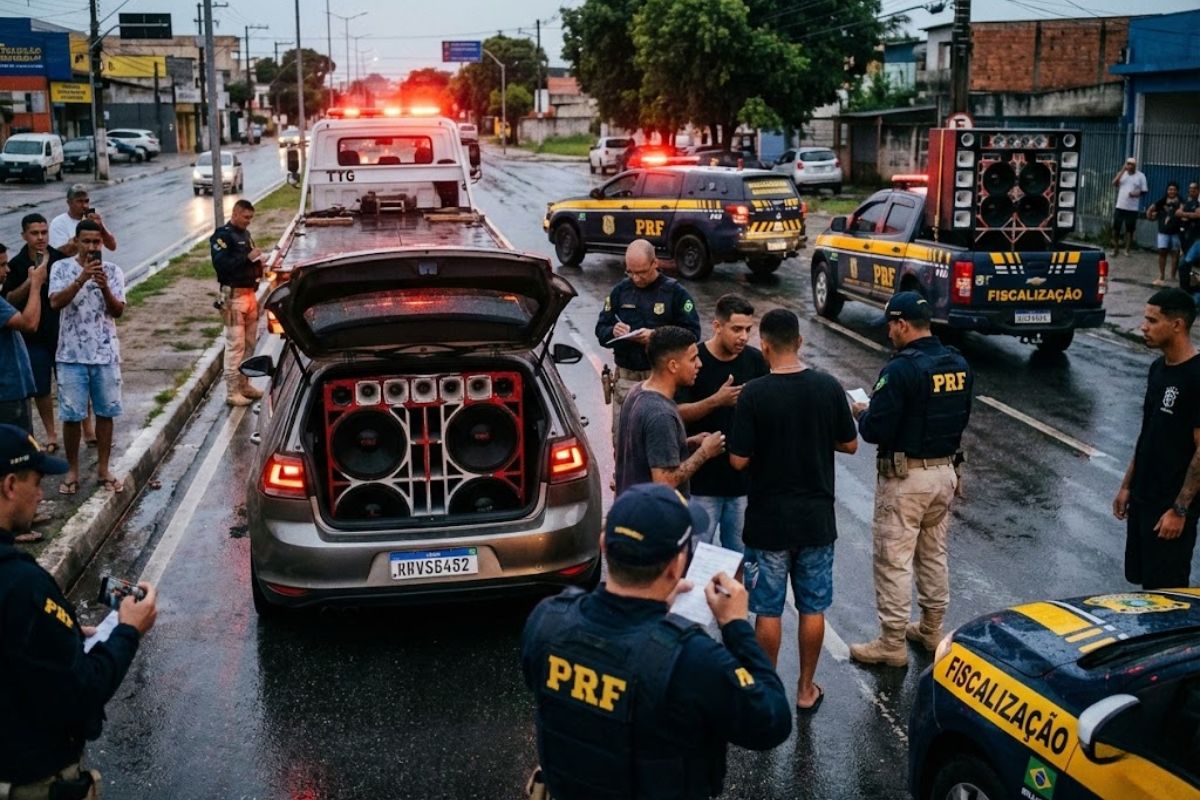


Understand How the Automotive Sound Law Changed Enforcement on the Streets, Allows Fines Without a Decibel Meter, Increases the Financial Burden and Points on the Driver’s License, Foresees Vehicle Retention and Prioritizes the Peace of Residents, Pedestrians, and Drivers on Any Type of Urban Road in Brazil During Sensitive Hours.
Since the publication of Resolution 624 by the National Traffic Council (Contran), the automotive sound law has allowed drivers to be fined solely for disturbing the peace, without the need to measure noise levels with a decibel meter at the time of the approach. The focus has shifted to the discomfort caused to those outside the vehicle, rather than just a number recorded on a device.
The change directly affects the daily enforcement on residential, commercial, and high-traffic roads, giving more decision-making power to traffic agents. Anyone who insists on driving with loud automotive sound now faces a higher risk of fines, more points on the driver’s license and even vehicle retention for regularization, depending on the severity of the case and the assessment of the traffic authority.
What Changed with the Automotive Sound Law
The new regulation establishes that the sound emitted by the vehicle cannot be perceived as disruptive from the outside when it constitutes a disturbance of the public peace.
-
The Senate approves a bill that criminalizes misogyny, hatred, or aversion towards women, and includes the crime in the Racism Law with a penalty of up to 5 years.

-
Chamber Approves Bill That Allows Pepper Spray for Women Over 16 and Imposes Strict Rules for Purchase, Possession, and Use as Self-Defense
-
Chamber Approves Law to Combat Leucaena, Fast-Growing Plant That Dominates Land and Threatens Native Species in Various Regions of the Country

-
Asset Division: Know What Cannot Be Divided in Case of Divorce


In other words, the main criterion changes from merely the volume in decibels to the real impact of that sound in the urban environment.
The traffic agent must analyze the concrete situation, considering factors such as time, location, flow of people, type of road, and intensity of the noise.
A sound that may be tolerated on a busy roadway, for example, tends to be perceived as disruptive in strictly residential areas during the night.
The main novelty of the automotive sound law is that the citation for loud sound no longer requires, in all cases, technical measurement with a decibel meter.
It is enough for the agent to identify that the sound is audible and disturbing from outside the vehicle for the infraction to be characterized, which reduces dependence on specific equipment and simplifies the enforcement of the law.
Penalties for Loud Automotive Sound in Traffic
According to the Brazilian Traffic Code, the use of automotive sound capable of causing disturbance to the peace is classified as a serious offense.
This means that the driver is subject to fines, points on their National Driver’s License, and the possibility of vehicle retention until the irregularity is corrected.
With the recent adjustments, the fines related to the automotive sound law have been updated, following the national policy for the correction of penalties.
The intention is to make the cost heavier for those who use sound equipment at excessive volumes in residential areas, commercial regions, or high-traffic points.
This increased rigor aims to dissuade the use of loud automotive sound, preserving the peace of residents, workers, and pedestrians, as well as contributing to road safety, since intense noise can distract drivers and hinder the perception of other important sounds, such as horns and sirens.
How Enforcement Works in Different Locations
In practice, enforcement of the automotive sound law tends to be more intense in areas known for recurring complaints.
Included in this list are busy avenues, areas close to nightclubs, gas stations, and residential neighborhoods where loud vehicle sounds have become a frequent problem for nearby residents.
In many municipalities, joint operations between traffic authorities, municipal guards, and urban enforcement are conducted during critical times, such as Friday and Saturday nights, holidays, and periods of higher passenger vehicle traffic.
These actions seek to curb abuses and directly respond to complaints of noise pollution.
Agents are instructed to document in detail the observed situation, mentioning the context of the infraction, location, time, and movement conditions.
The better the circumstances of the disturbance of peace are described, the greater the legal security of the infraction notice and the clearer the analysis in any potential administrative appeal.
What Sounds from the Vehicle Can Result in Fines for Excessive Volume
When discussing loud automotive sound, the focus of the regulation is on the sound systems used for entertainment inside the vehicle, such as powerful radios, amplifiers, and speakers that project audio outside the car.
It is this type of equipment, used at excessive volume, that usually generates disturbances and falls under the law’s purview.
The Contran resolution makes it clear that not all noise from the vehicle is covered by the automotive sound law.
Excluded are horns, alarms, reverse warning signals, sirens, and other mandatory safety components, as long as they are used within the regulations and without deviation from their purpose.
Sounds used in previously authorized activities, such as mobile advertising, sound cars for campaigns or cultural events in defined locations, are also permitted.
In these cases, operation must comply with the licenses, hours, and conditions established by the local government, under penalty of losing authorization and facing applicable sanctions.
Precautions to Avoid Being Fined by the Automotive Sound Law
To avoid problems, the main recommendation is to keep the car sound at a moderate volume, especially in residential areas, near hospitals, schools, and during the night.
Many complaints are linked not only to volume but also to intense bass that makes windows, doors, and facades vibrate, increasing the feeling of discomfort.
Some simple practices help prevent citations, complaints, and conflicts with neighbors, pedestrians, and other drivers, while keeping sound use more aligned with the automotive sound law:
- Avoid playing music at high volume with the windows down on urban roads, as this directly projects the sound outside.
- Reduce volume when entering residential neighborhoods, especially during rest hours, such as late at night and early morning.
- Turn off the sound when parking in front of houses, buildings, or sensitive establishments, such as hospitals, schools, and active churches.
- Check if events using automotive sound have municipal authorization and strictly adhere to the hours and conditions imposed by the local government.
- Adjust boosted sound systems for more intense use only in controlled and previously authorized locations, avoiding turning public roads into permanent party environments.
Ultimately, the message of the automotive sound law is clear: the right to listen to music in the car exists, but it must coexist with the right to peace for those living, working, or traveling on the streets.
And you, have you ever witnessed a situation where a car’s sound exceeded the limit and would deserve a fine under the automotive sound law?










Vcs tem que vir aqui no bairro do Conceição aqui e uma verdaderia bagunça de som alto como carros bares e residência com som alo aí vc liga para 153 guarda Municipal de osasco falam que está registrada a ocorrência, como também para 190 polícia eles manca aparecem e um desrespeito com a população
Por um lado é bom e por outro é ruim.
É bom para que possa manter a ordem pública, porém abre ****, para abuso de poder, pois se o guarda de trânsito não for muito com a sua cara, ele pode aplicar a multa mesmo com o som desligado !!
Todo dia 24 h por dia. Ubatuba SP. Acham que podem tudo