





 Portuguese
  English
  Spanish
  8 min of reading
  14 comments




With 1,300 kilometers in length and an investment of US$ 5 billion, the Lobito Corridor emerges as a strategic alternative to compete with China’s New Silk Road.
The growing economic influence of China through the New Silk Road in Africa is a reality that the United States can no longer ignore. Since 2009, when China surpassed the US as the main trading partner of the African continent, the economic disparity between the two nations has only increased. For this reason, Americans are betting on the Lobito Corridor.
Currently, China’s trade volume with Africa is four times greater than that of the US, highlighting a gap that worries American strategists and policymakers.
-
Spain challenges the USA and closes its airspace for operations against Iran, raising global tension and provoking the threat of a trade rupture.

-
While no other country manufactures tanks in Latin America, Argentina activates the TAM 2C-A2 and raises a curiosity about the technological lag in the region.

-
A Russian ship with 730,000 barrels of oil has just arrived in Cuba while Mexico negotiates fuel sales through private companies: the communist island is desperately seeking alternatives after losing its supply from Venezuela due to American military action.

-
Iranian drones and missiles destroyed a 270 million dollar American spy plane in Saudi Arabia, splitting the E-3 Sentry aircraft in half and injuring 12 military personnel in an attack that exposes the vulnerability of U.S. bases in the Persian Gulf.

To counter this trend, the United States has intensified its efforts to strengthen economic ties with the African continent.
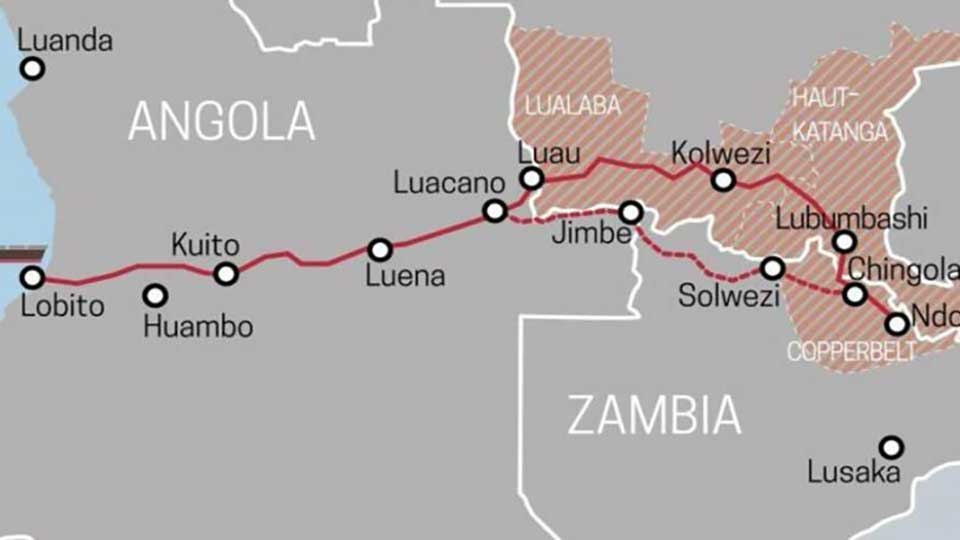
A clear example of this attempt is the Lobito Corridor, a 1,300-kilometer railway that crosses Angola, the Democratic Republic of Congo (DRC), and Zambia. An investment of US$ 5 billion is expected, with part of this amount financed by the US.
Announced in 2023, the initiative is seen as a direct attempt to compete with the powerful New Silk Road.
New Silk Road – The Chinese Strategy and Its Results in Africa
The New Silk Road, launched in 2013, is one of the largest infrastructure and economic development initiatives in the world.
So far, 52 African countries have signed agreements with China, resulting in billions of dollars invested in the construction of roads, ports, railways, and other essential infrastructure.
In 2023, for example, the New Silk Road allocated approximately US$ 21.7 billion in loans for projects on the African continent.
These investments, however, are not merely economic. China has also secured strategic access to Africa’s vast mineral resources.
In the DRC, Chinese companies control about 72% of cobalt and copper mines. In Guinea, Chinese dominance over bauxite and the Simandou iron mine further solidifies its position as a key player in the exploration of natural resources on the continent.
The Lobito Corridor: A Strategic Response
The Lobito Corridor is an attempt by the US to compete with the New Silk Road in terms of relevance and economic impact.
Announced during the Global Gateway Forum of the European Union in October 2023, the project brings together efforts from the African Development Bank (AfDB), the Africa Finance Corporation (AFC), the US, and the European Commission.
The goal is to connect northwest Zambia to the port of Lobito in Angola on the Atlantic Ocean through a strategic railway network.
The US has already allocated more than US$ 3 billion to finance projects related to the initiative, covering sectors such as transportation, logistics, agriculture, clean energy, health, and digital access. A large part of this funding comes from the Partnership for Global Infrastructure (PGI), a consortium of G7 countries created to increase Western presence in global infrastructure projects.
Infrastructure and Economic Impact
The Lobito Corridor plans to build 550 kilometers of new railway tracks in Zambia, connecting Jimbe, at the border with Angola, to the country’s copper belt located in Chingola.
This new railway line will integrate with existing tracks on the Angolan side of the border, forming a connection with the Benguela railway, which is already operational. Additionally, the project includes the construction of 260 kilometers of access roads and renovations to the old Benguela railway, which has more than 120 years of history.
The expected impact goes beyond infrastructure. The corridor will allow Zambia, traditionally dependent on eastward export routes, to access the Atlantic Ocean for the first time.
This creates new trade possibilities and reduces dependence on the port of Dar es Salaam in Tanzania, which has historically been the main maritime outlet for copper and other metal exports.
Geopolitics and Natural Resources
Like the New Silk Road, the Lobito Corridor is more than an infrastructure project. It also serves the strategic and economic interests of the West.
By creating trade routes to the Atlantic, the project facilitates the transport of essential minerals and commodities for the energy transition, such as copper and cobalt, both abundant in the DRC and Zambia.
The focus on Zambia’s copper belt is strategic. With the growing global demand for essential minerals for green technologies like batteries and renewable energy, the Lobito Corridor could become a crucial route to supply Western markets.
Moreover, the DRC, with its vast reserves of copper and cobalt, plays a central role in this plan, consolidating the corridor as a Western alternative to trade routes dominated by China.
Challenges and Perspectives
Although promising, the project faces significant challenges. China has already established a solid presence in Africa, with decades of economic and diplomatic engagement. The New Silk Road has not only invested billions in infrastructure but has also built long-term strategic partnerships with African governments.
In comparison, the Lobito Corridor is still an emerging initiative that will need time to demonstrate its impact.
Additionally, the financial sustainability of the project is a concern. Just like in the New Silk Road, investments in infrastructure may not be immediately profitable but aim to boost long-term economic growth. For this, a continuous commitment from the involved countries will be necessary, as well as effective collaboration between the public and private sectors.
Expansion Plans
The plans for the Lobito Corridor took a new turn in August 2024, when the United States revealed intentions to expand the project to Tanzania, connecting the Atlantic Ocean to the Indian Ocean.
Helaina Matza, special coordinator of the Partnership for Global Infrastructure (PGI), emphasized that this expansion seeks to transform the corridor into a broad trans-African connection, reinforcing the US regional approach to the continent’s development.
Matza also brought good news about progress in the first phase of the project: the renovation of the historic Benguela railway.
Copper shipments from the Democratic Republic of Congo (DRC) to the United States have already been made through this route, marking a significant logistical advancement. The second phase, which includes the construction of a new railway in Zambia, still depends on the completion of feasibility studies.
Connection to the Indian Ocean and Soft Power
Expanding the Lobito Corridor to Tanzania may seem counterintuitive from a geopolitical standpoint, as this opening facilitates trade to the east, where China exerts greater influence.
However, the strategy aligns with the American goal of building resilience in global supply chains. The connection with the Tazara railway — which already links the port city of Dar es Salaam to the interior of Zambia — requires the construction of only 200 kilometers of tracks to integrate the corridor with Indian trade routes.
Moreover, this approach reinforces the US intentions of soft power, promoting good governance and regional development instead of prioritizing immediate economic benefits.
According to Matza, the goal is to ensure that critical minerals flow to global markets efficiently, creating a resilient trade system that is less dependent on unilateral agreements or dominant economic blocs, such as the one promoted by China’s Belt and Road Initiative (BRI).
Challenges for the US in Africa
Despite ambitions, the timing of American engagement in Africa is delicate. Chinese foreign direct investment (FDI) in the continent, although it has declined in recent years, is still higher than Western investment. Between 2019 and 2021, Chinese FDI reached an average of US$ 4 billion annually, while US investment performed negatively in some periods.
However, the landscape is changing. China’s economic slowdown in the post-pandemic period and the challenges of maintaining high levels of lending have affected the pace of the New Silk Road.
Investment from the initiative in Africa fell from US$ 16.5 billion in 2021 to US$ 7.5 billion in 2023, a reduction of 55%. Additionally, growing concerns about excessive debt and a lack of transparency in some contracts have generated dissatisfaction in several African countries.
These factors open a window of opportunity for initiatives like the Lobito Corridor, which presents itself as a more transparent and multilateral alternative, seeking regional and global engagement in its operations.
The Multilateral Perspective
Unlike China’s predominantly unilateral approach, the Lobito Corridor prioritizes partnerships with regional and international institutions. From the outset, the project has received support from the African Development Bank (AfDB), which plays a central role in its execution. In 2023, the AfDB helped raise US$ 1.6 billion to finance the project.
This multilateral collaboration brings financial and political benefits. Financially, it helps share the burden of long-term projects with low initial profitability. Politically, it reduces fears of neocolonial exploitation by major powers like the United States or China.
Other global actors have also shown interest in the Lobito Corridor. The World Bank contributed US$ 300 million to a complementary local initiative, marking its first significant investment in African infrastructure since 2002.
The European Commission has also taken responsibility for conducting environmental and social impact studies to minimize harm to vulnerable communities along the route.
Very Little, Very Late?
The lingering question is: Will the United States be able to regain ground in Africa with initiatives like the Lobito Corridor? Despite China’s advance on the continent, there is still room for Western engagement.
Africa is a diverse continent, with 54 countries, each with unique development needs and different experiences with international partners.
The urgent need for capital and infrastructure creates opportunities for Western initiatives that promote more inclusive and transparent approaches. Competition between the US and China may benefit African countries, allowing them to negotiate better conditions with both powers.
President Joe Biden traveled on December 1 to the country to reinforce the support of the world’s largest economy on the African continent. This is Joe Biden’s first trip to Africa.
To Counter China and the New Silk Road, Trump May Support Project in Angola
Although Biden’s trip takes place in the final days of his presidency, Donald Trump is expected to support the project and remain a close partner of Angola upon resuming the White House in January, according to sources who were part of his first term.
Tibor Nagy, former ambassador and former senior envoy to Africa during the Trump administration, highlighted that the future American president will likely have two priorities on the continent: strategic competition with China and Russia, and the pursuit of access to critical minerals.
If successful, the Lobito Corridor will not only strengthen US trade and diplomatic ties with Africa but will also contribute to a more sustainable and collaborative development model.
The expansion to Tanzania and the creation of a trans-African corridor are ambitions that show that the US is willing to strategically compete, connecting the continent to global markets through innovative trade routes. With information from geopoliticalmonitor.










Bem haja a África
Brasil na Rota da Seda sempre
Tio San só se preocupava em estimular guerras entre as tribos, lêvantes contra governos, ditaduras e etc. Nunca vi antes o tiozao fazendo investimento estrutural. Observava também o pouco caso da Rússia com a África. Ai vem a China e tal e coisa e tome investimento. Agora o “gigante” acordou? Xi, com aquele jeito silencioso e preocupado tem colocado o tiozao no chinelo. Avante Xi, vossa excelência tem meu respeito.