





 Portuguese
  English
  Spanish
  4 min of reading
  0 comments


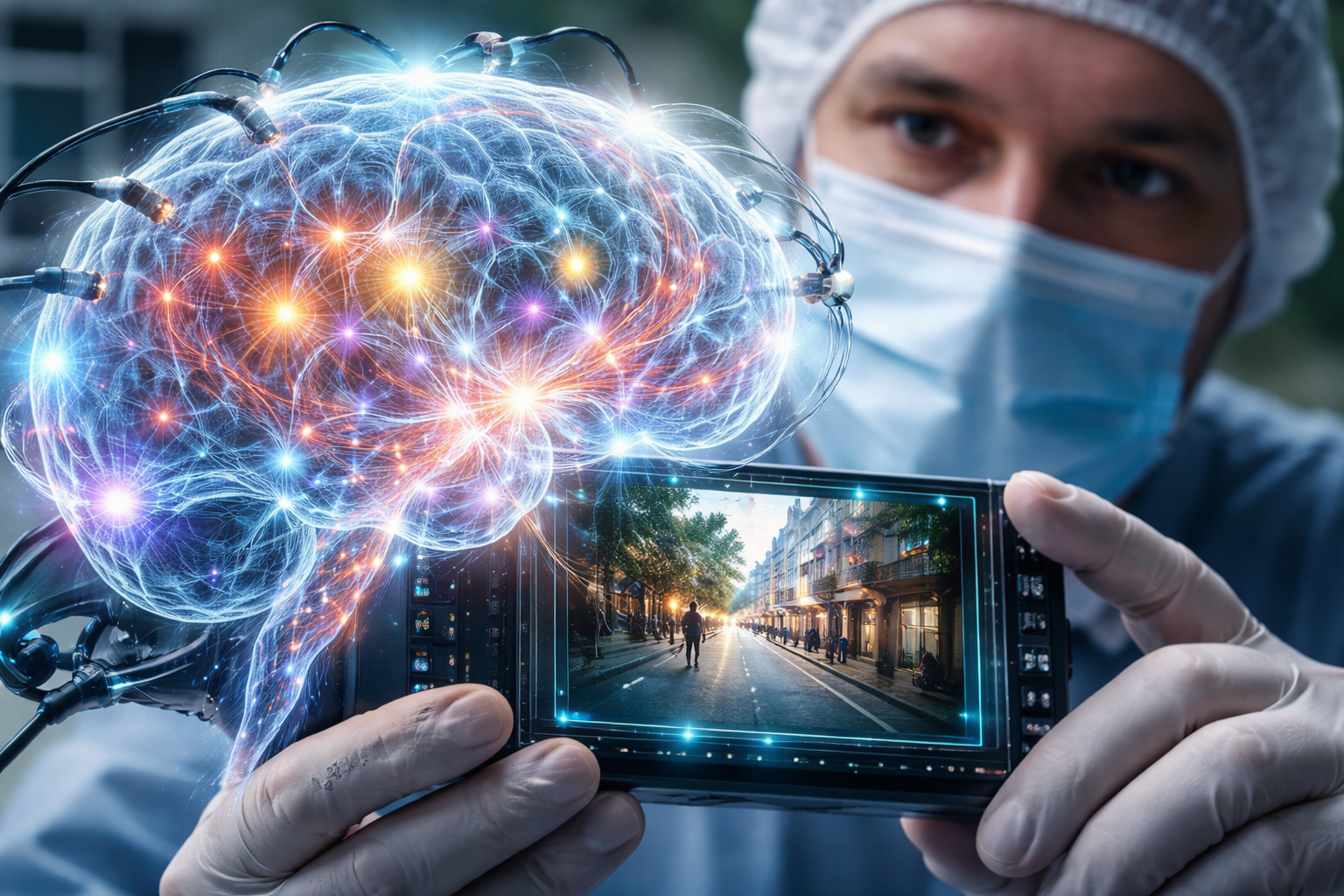
Technology Created by Researchers at University College London Can Reconstruct Videos from Brain Activity Recorded in the Laboratory, Revealing That the Mind Does Not Record Reality Like a Camera, Opening New Clues About How We Perceive the World
Have you ever thought about watching a video and, without looking at the screen, someone being able to figure out exactly what you saw just by analyzing your brain? This is very close to what scientists at University College London, in the UK, managed to do in the lab. The team was able to reconstruct videos from a study using only the brain activity of animals.
The result attracted the attention of researchers worldwide because it shows something intriguing. The brain does not function like a perfect camera. It interprets the world in its own way.
And the most surprising thing is that scientists managed to transform brain signals back into images.
-
In a flooded well, archaeologists found a 1,700-year-old Roman egg that still contains clear and yolk intact inside the very thin shell.

-
Something is happening around the Earth: Inside the huge explosion of fireballs in 2026

-
A hot air bubble coming from Argentina expands over Brazil, causing thermometers to exceed 38 degrees with a thermal sensation of 40 degrees in late March, affecting 6 states at once.

-
The radish leaf that almost everyone throws away has more polyphenols, flavonoids, and fiber than the consumed root, and a 2025 study showed that the leaf contains compounds that protect the intestine, combat inflammation, and may inhibit the growth of cancer cells.


The Experiment That Transformed Brain Signals into Real Images Viewed by Mice
It all started with a simple but extremely challenging objective. The scientists wanted to understand how the brain transforms what we see into images within the mind.
To do this, the mice watched short videos while the researchers monitored their brain activity.
The focus was on the visual cortex, the region responsible for interpreting everything that comes through the eyes.
While the animals watched the videos, researchers recorded the activity of specific neurons. These small electrical signals function like internal messages from the brain.
After that came the most impressive part of the study.
The scientists created a computer model capable of analyzing these signals and attempting to reconstruct the images that the animals were seeing.
The result was videos around 10 seconds long recreated solely from the recorded brain activity.
The Technological Secret That Allowed the Transformation of Brain Activity to Reconstruct Videos
The technology used in this study is different from other previous attempts made with humans.
In many experiments, researchers use exams like functional magnetic resonance imaging to observe the brain. The problem is that this type of technique only shows large areas of activity.
In this study, scientists analyzed individual neurons, which greatly increases the precision of the reading.
To make this work, the system monitored chemical signals within the brain cells. When a neuron became active, there was an increase in calcium within the cell.
These signals were used to indicate which parts of the brain were reacting at each moment of the video.
Then, a computer program started with a blank image and adjusted the pixels until it arrived at something that resembled the animal’s visual experience.
The Surprising Detail That Revealed That the Brain Does Not Show Reality Exactly As It Is
When researchers compared and managed to reconstruct videos with the original versions, something caught great attention.
The images were not perfect copies.
Some details appeared modified, distorted, or emphasized. This led scientists to an important conclusion.
The brain, therefore, does not record the world as a camera records a filming.
According to the researchers themselves, the visual system makes constant adjustments. It highlights some information while ignoring others.
This adaptation helps the animal respond better to its environment.
In other words, what we see may be more of an interpretation by the brain than an exact reproduction of reality.
The More Neurons Analyzed, the Clearer the Image Reconstruction Becomes
Another important point of the study appeared during the tests.
Scientists noticed that the quality of the reconstructed images improved as more neurons were analyzed.
The greater the volume of brain signals captured, the closer the reconstructed video was to the original.
To measure this, researchers used a comparison method between the pixels of the real video and the pixels of the video generated by the computer.
According to scientists, the increase in analyzed brain data directly improves the fidelity of the reconstruction.
This indicates that future research could achieve even more precise results.
Why This Discovery Could Change How Scientists Study the Brain
The goal now is to expand the technology.
Researchers want to increase the resolution of the reconstructed images and capture signals from even more neurons at the same time.
If this happens, experts believe it will be possible to understand, then, much more clearly how different species perceive the world.
This type of technology could also help study vision-related problems or neurological diseases that affect how the brain interprets images.
According to experts, understanding this process could reveal how the mind constructs the reality we perceive every day.
And this discovery shows that the brain may be much more of an interpreter than a mere observer.
The possibility of transforming visual thoughts back into images opens a new phase in the research on how the mind functions.
Now we want to know your opinion. Do you think that in the future it will be possible to reconstruct exactly what a person is seeing or even remembering? Leave your comment.






Seja o primeiro a reagir!