






 Portuguese
  Spanish


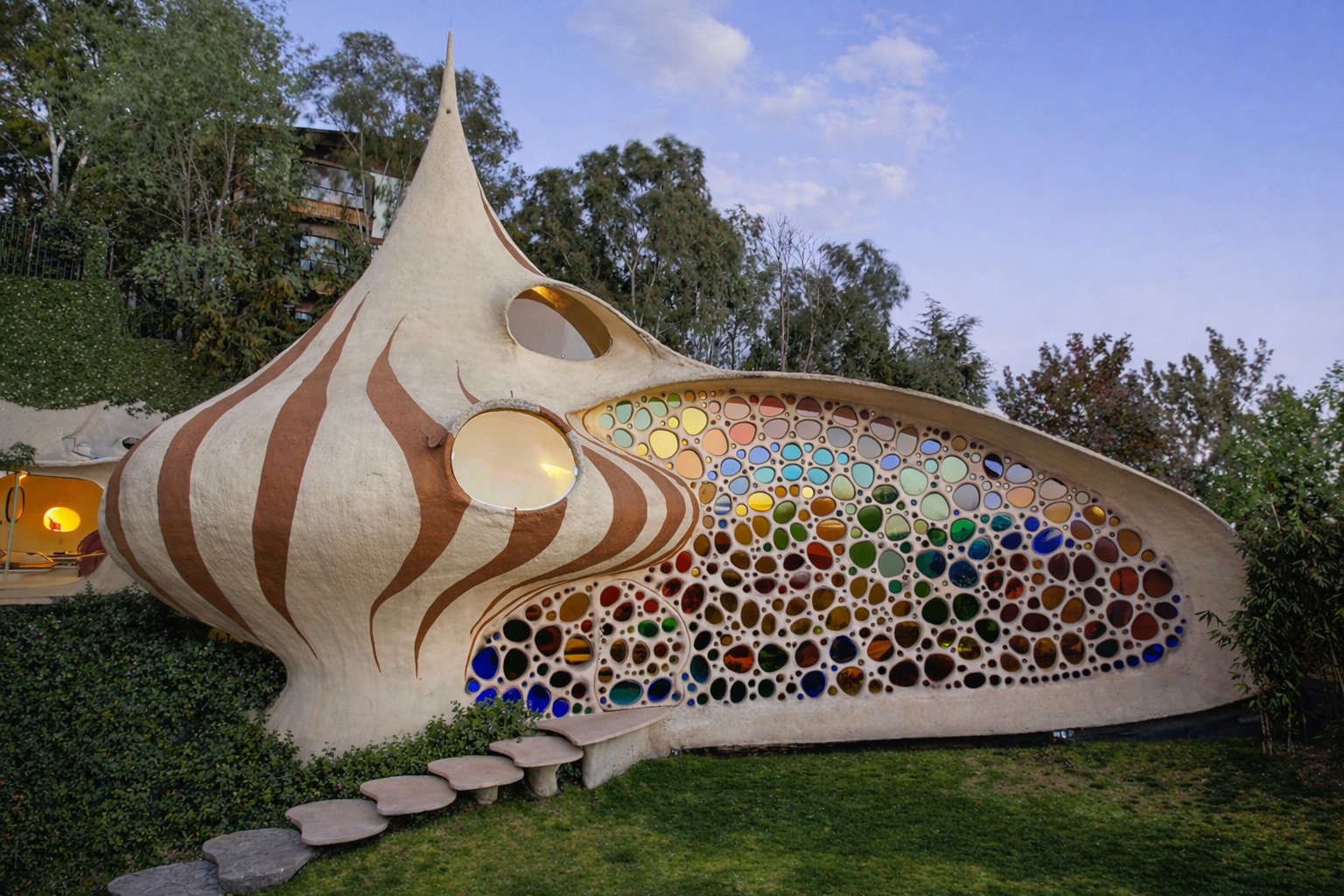


Designed By Javier Senosiain In Naucalpan, The Shell-Shaped House, Nautilus House, Uses Steel Concrete To Create Structural Curves Without Columns And Catches Attention For Its Earthquake-Resistant Construction And Visual Impact
How about stepping into a shell-shaped house, where there is not a single right angle? No square walls, no visible columns supporting the ceiling. Just continuous curves, as if the concrete had been shaped by nature.
That’s exactly what Mexican architect Javier Senosiain decided to do when designing the Nautilus House in Naucalpan, Mexico. And what seems like just an aesthetic eccentricity turned into a laboratory for structural engineering in practice.

The Nearly Unthinkable Challenge In A Seismically Active Country: Building Without Traditional Columns
Mexico has experienced earthquakes throughout its history. Building there requires rigorous structural calculations and solutions that ensure resistance.
-
U.S. City Builds Tiny Home Village on Water Company Land to House 136 Homeless People: Inside the Social Housing Units

-
Woman Turns Shipping Container into Home, Embraces Rural Life to Cut Monthly Expenses to Just Over $330
-
France Revamps 530 Social Housing Units with Large Balconies and Glass Facades Without Demolishing Existing Buildings

-
Facing high rent, couple transforms parents’ garage into a fully functional apartment, creating a complete home at a fraction of the market cost.




Eliminating columns and right angles in this scenario sounds like a technical provocation. But that was the bet of the so-called bioarchitecture adopted in the project.
The proposal was clear: to create a house inspired by the shell of a Nautilus mollusk, respecting its natural spiral shape, without adapting the idea to the conventional format of civil construction.
This meant abandoning the dominant square pattern in the sector and facing an inevitable question: how to support all of this safely?

The Structural Secret Is In Steel Concrete, A Material That Allows Complex Curves And Resistance To Earthquakes
The answer came with the use of steel concrete, a system that combines steel mesh with a thin layer of concrete.
This material allows for shaping complex structural curves, something practically impossible with traditional techniques based on straight beams and robust columns.
In addition to formal freedom, steel concrete offers structural resistance. According to experts, curved structures tend to distribute loads better and may respond more efficiently to seismic vibrations.
There is no official number disclosed about the house’s specific performance in seismic tests, but the concept behind the material is already known in engineering for its flexibility and robustness.
Here lies the point that draws attention in the industry: the structure dispenses with traditional columns, which completely alters the internal logic of support.
When Architecture Becomes An Industrial Experiment And Challenges The Square Standard Of Civil Construction
The Nautilus House is not just a different residence. It questions the model that dominates construction sites worldwide.
Conventional civil construction relies on straight walls, vertical columns, linear beams, and right angles.
By eliminating these elements, the project calls into question the historical dependence on the square format.
The dispute here is silent but real. On one side, established and replicable traditional methods. On the other, an organic proposal that requires differentiated calculations and artisanal execution.
This type of approach does not replace industrial-scale models but opens up space for alternative solutions in special projects, especially in regions with seismic activity.
Stained Glass, Natural Light, And Structural Engineering Meet In The Same Concept
Besides the structure, another element transforms the internal experience: the colored stained glass windows.
When light passes through the glass, the interior is bathed in colors that change throughout the day. It is not just about aesthetics. Natural light integrates with the organic design, reinforcing the proposal of fusion between construction and nature.
This combination of structural technique and visual impact explains why the project has become a reference when it comes to bioarchitecture.
The house ceases to be just a shelter and thus serves as a constructive manifesto.

What This Project Signals For The Future Of Engineering In Seismically Active Regions
The construction of the Nautilus House raises, therefore, a question that directly interests the engineering sector: to what extent can organic shapes offer structural advantages?
Estimates indicate that techniques using curved geometries may gain ground in specific projects, especially when combined with materials that allow greater structural flexibility.
This is not about replacing skyscrapers or large industrial complexes with giant shells. The discussion is different.
The work shows that engineering can move away from the rigid standard without compromising safety. And in countries with significant seismic activity, any advancement in this direction draws immediate attention.
In the end, what seemed like just a different house reveals something greater: a real test of how far civil construction can go when it decides to abandon the square format and invest in curves that nature itself has been using for millions of years.
And you, would you live in a house without right angles and without visible columns? Do you believe that organic constructions can gain space in cities? Leave your opinion in the comments.









Es realmente muy original y está hecha con buen gusto
Com certeza.
Moraria sim 😍🤩💞👏👏👏