





 Português
  Inglês
  Espanhol
  6 min de leitura
  17 comentários




With the New Speed Limit on BR-040 between Belo Horizonte and Juiz de Fora, the Highway Gains Series of Speed Cameras, Sectorized Limits from Forty to One Hundred Kilometers per Hour, and Requires Drivers’ Attention to Avoid Fines, Time Loss in Checkpoints, and Unwanted Surprises on the Daily Weekend Route
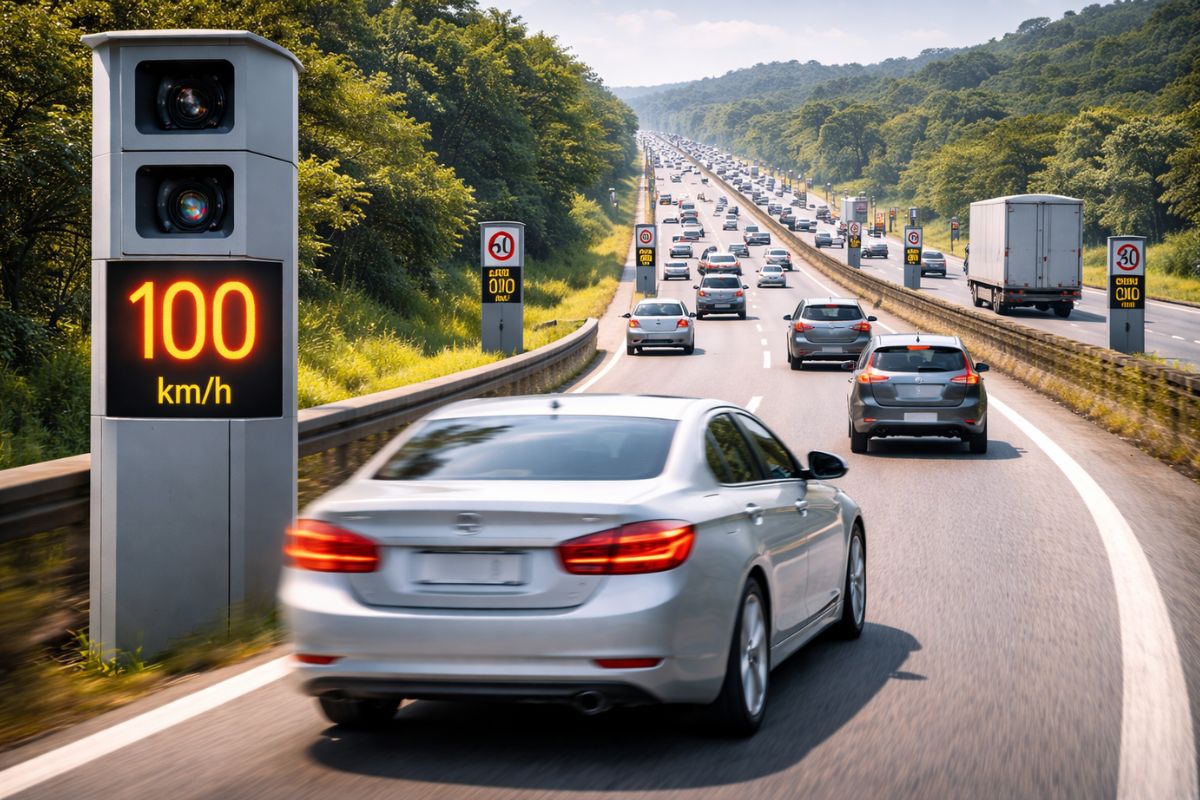
Since mid-2025, the new speed limit on BR-040 in the stretch between Belo Horizonte and Juiz de Fora has begun to change the routine of those who depend on the highway. The redefinition of speed limits between 40 km/h and 100 km/h, combined with the installation of new speed cameras and a complete renewal of signage, has transformed an already busy corridor into a route that requires constant reading of signs and quick adaptation to the surroundings of each kilometer.
On December 23, 2025, with vacations, extended holidays, and intense traffic of passenger cars, trucks, and intercity buses, the practical effect of the new speed limit on BR-040 becomes even more visible. Those who do not keep track of lane changes, the type of roadway, and the presence of urban accesses run the real risk of turning a simple trip into a sequence of fines, especially in stretches where the electronic monitoring is associated with accident history or disregard for traffic rules.
What Changed with the New Speed Limits on BR-040
The term new speed limits on BR-040 summarizes the main change for drivers.
-
In a silent race, Shopee signs a mega contract in Guarulhos and accelerates the e-commerce war with faster deliveries, pressured shipping, and a new threat to rivals in Brazil.

-
Oil surged to $115 a barrel due to the war in the Middle East, and diesel in Brazil has already risen to R$ 7.45 per liter, while the United States…
-
Brazilian city bets on the business environment to generate jobs and attract investments in the energy sector — secretary reveals strategy at Macaé Energy 2026.

-
50 viaducts, 4 tunnels, 28 bridges, and 40 kilometers of bike paths: BR-262 in Espírito Santo will receive 8.6 billion reais for the largest engineering project in the state’s history, inspired by the Immigrant Highway in São Paulo.


Instead of a single limit, the stretch between Belo Horizonte and Juiz de Fora has been divided into sectors with distinct speeds, defined according to the design of the roadway and the immediate environment.
In areas with many accesses, tighter curves, or proximity to neighborhoods, signage pulls the limit down, reaching 40 km/h.
In more linear segments, with good visibility and less urban interference, the new speed limit on BR-040 allows up to 100 km/h, provided the driver respects the traffic and weather conditions.
The stated goal is to reduce sharp variations in speed and decrease the risk of head-on collisions and run-off-road incidents.
In practice, this means that drivers can no longer “memorize” a single number for the entire route.
Reading the signs has become a central part of driving, especially for those who frequently travel the BR-040 between Belo Horizonte and Juiz de Fora and tend to act on autopilot.
Where Do the Speed Cameras Come in on BR-040 and How Does Surveillance Work
The implementation of the new speed limit on BR-040 came with the installation of speed cameras on BR-040 at critical points, many of them associated with recurring accident records or speeding.
The responsibility for enforcement and the imposition of fines remains with public traffic agencies, while the EPR Via Mineira concessionaire operates and maintains the equipment.
The cameras were positioned in stretches where the change in limit requires extra attention, such as approaches to urban accesses, construction areas, and segments with a history of dangerous overtaking.
With the speed cameras on BR-040 integrated with cameras and electronic panels, drivers are now faced with real-time alerts about heavy rain, above-normal traffic flow, and temporary interventions on the roadway, which requires continuous adjustments in speed.
For distracted drivers, the combination of signage, electronic panel, and speed camera in the same stretch can represent the shortest route between a minor oversight and a fine on BR-040, especially on heavy traffic days or during nighttime trips when reading signage is naturally more challenging.
Signage, Road Safety, and Driver Adaptation
The new speed limit on BR-040 was not implemented in isolation.
Since the beginning of the concession by EPR Via Mineira, the stretch received a comprehensive package of interventions in signage and road safety.
Thousands of visual guidance elements have been installed, such as reflective studs, vertical signs, and renewed horizontal markings along the BR-040 between Belo Horizonte and Juiz de Fora.
Among the measures adopted to make driving more predictable and safe are:
strengthening vertical signage with new speed limit signs, warning signs, and distance indicators
readjusting horizontal signage, with repainted lanes, crosswalks, and containment areas
installing reflective studs to increase nighttime visibility, especially in curves and hills
monitoring by cameras and radar for speed enforcement and operational support
upgrading safety devices, such as metal barriers, roadblocks, and protection on bridges and overpasses
The idea is that drivers can identify in advance the type of stretch ahead, such as long descents, urban accesses, or construction areas, and adjust their speed without sudden braking.
But this can only happen if drivers actually read the signs and adopt a defensive posture instead of trying to maintain the same speed throughout the route.
Fines on BR-040 and the Impact on the Wallet of Those Who Ignore the New Speed Limit
With the new speed limit on BR-040 sectorized and the speed cameras on BR-040 operating at strategic points, the risk of fines on BR-040 for those who insist on driving as if nothing has changed increases.
Brazilian traffic legislation classifies speeding into categories ranging from medium to severe violations, with varying fines and points on the license scaled according to the difference between the measured speed and the indicated limit.
This means that two drivers on the same highway can face very different consequences: someone who slows down upon seeing a 40 km/h sign in an urban area tends to get away unscathed, while someone who maintains a speed close to 100 km/h in a restricted area may be charged under the heaviest penalty categories.
In stretches subject to continuous monitoring, a sequence of errors throughout the trip can lead to multiple fines on BR-040 and accumulation of points on the driver’s license in a short period.
For those who use the corridor daily, knowing critical stretches, respecting limits, and maintaining a safe distance from other vehicles is the most efficient way to translate the new rule into a safety gain rather than an additional cost to the family budget.
BR-040 between Belo Horizonte and Juiz de Fora in the Coming Years
The BR-040 between Belo Horizonte and Juiz de Fora is a strategic axis for the transport of goods and passengers in Minas Gerais.
With the new speed limits on BR-040 already in effect and improvement works underway, the trend is for a gradually more organized highway with clearer circulation rules and modernized infrastructure.
In the coming years, users should expect to deal with operational adjustments, temporary signage in construction areas, and interventions in safety devices, such as point duplications and new physical barriers.
Observing the signs, electronic panels, and guidance from traffic agencies will remain critical to ensuring safety and smooth flow, especially during prolonged holiday periods and peak tourist seasons.
For those who drive every day, the message is clear: the new speed limit on BR-040 is here to stay, and the cost of ignoring this new logic can go far beyond frustration with the speed cameras and discomfort with the changes.
In your opinion, does the new speed limit on BR-040 between Belo Horizonte and Juiz de Fora with so many speed cameras actually improve safety, or does it just increase the risk of fines on BR-040 for those who depend on the highway every day?








O excesso de radares, em alguns pontos merece uma sinalização mais claras, em.alguns pontos ela não é o suficiente, até para evitar acidentes de colisão traseira.
É impressionante como o meio de comunicação deixa a desejar, uma matéria que se perde pela falta de informação de maneira mais completa, o mais importante não foi efetivamente informado, ou seja, onde estão os equipamentos?
Fica a crítica.
Sinalização fraca. Placas somente a direita.. O caminhão encobre a placa e quem vem à esquerda nao enxerga a mudança. Só se for médium ou paranormal