





 Portuguese
  English
  Spanish
  3 min of reading
  0 comments


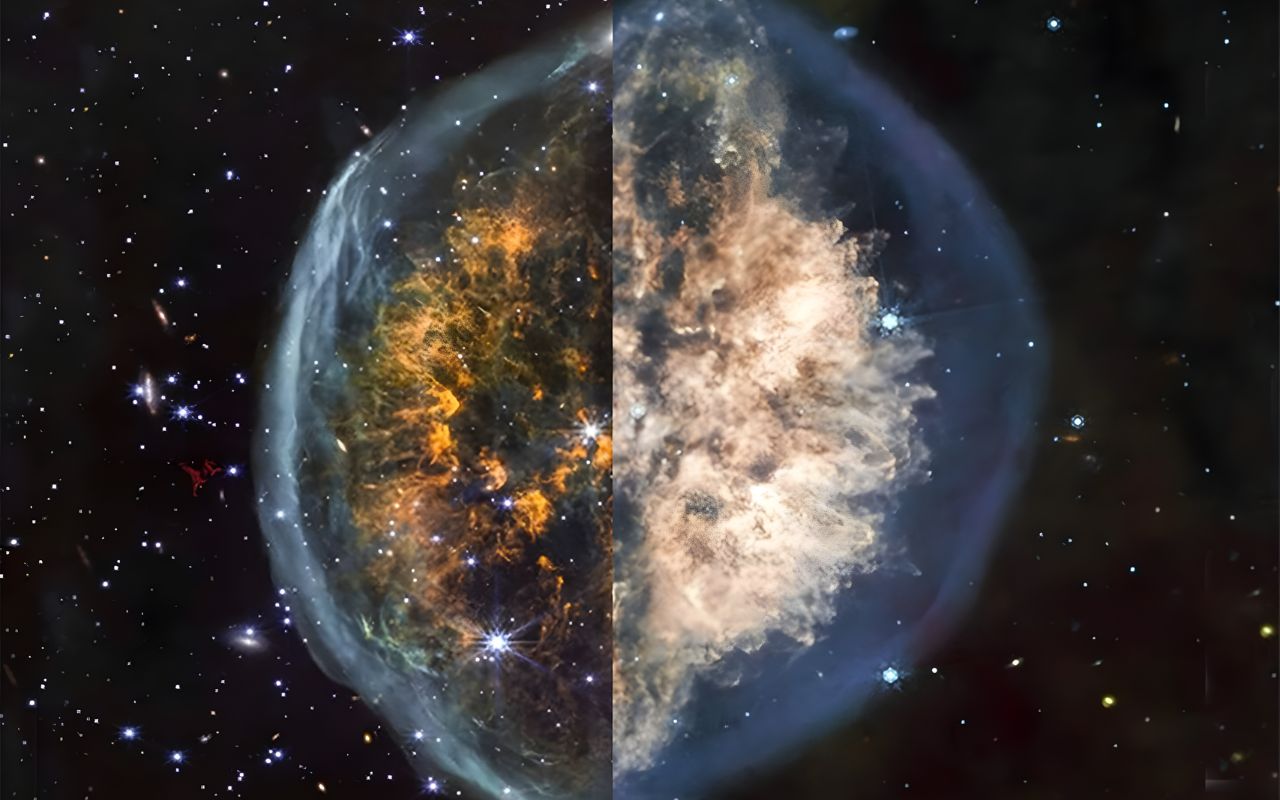
The NASA James Webb Space Telescope Reveals Unprecedented Details of the Skull Nebula, Including Internal Layers and Jets of Gas. The Images Show Hot and Cold Regions of the Cloud of Dust and Gas, Offering New Perspectives on the Evolution of the Central Star.
The NASA James Webb Space Telescope (JWST) captured impressive images of a little-known nebula, revealing internal structures never seen before.
The observations, made in infrared light, allow us to penetrate dense clouds of dust and study the shape and behavior of gas and dust around a star that is nearing the end of its life.
The cloud of gas and dust, officially named PMR 1, has been nicknamed the “Exposed Skull Nebula” due to its resemblance to a brain within a translucent skull.
-
To transform desert into forest, the owner prepares a road, gravel, and ramps for 12 volunteers; a mini Chinese truck carries stones, while 50 Afghan pines receive manure, biochar, and cactus glue before the rain.

-
A study with 280,000 people reveals that concern about money can increase the risk of heart problems more than smoking and places financial pressure at the center of health.

-
6 fruits that help protect the brain against Alzheimer’s and dementia, with 7 warning signs, data from Lancet 2024 and findings in Nature 2025, as well as precautions with grapefruit and starfruit.

-
A new extratropical cyclone is forming between Uruguay and Rio Grande do Sul this week and will cause storms with wind gusts of up to 90 km/h in the South, Southeast, and Midwest of Brazil between April 6 and 10.


Internal structures create the impression of two distinct hemispheres, making its appearance even more intriguing.
NASA James Webb Space Telescope Reveals Layers and Material Flows of the Skull Nebula
The images show that the nebula is not homogeneous. An outer layer, predominantly composed of hydrogen, was ejected first by the star.
Inside it, there are denser and more organized areas, cut by a dark band that runs through the cloud from top to bottom.
This band suggests the existence of jets of material being ejected in opposite directions, a common phenomenon in stars in the advanced stages of life, which shapes the surrounding gas in complex ways.
Exploring the Skull Nebula from Multiple Angles
The James Webb Space Telescope captured the Skull Nebula using two instruments that highlight distinct aspects of the cloud.
With NIRCam, scientists observed the hottest gas and internal details, including the dark band that visually divides the nebula.
Meanwhile, the MIRI focused on the colder regions, highlighting the dust being expelled by the star and emitting mid-infrared light.
Together, these perspectives allow researchers to analyze both the heat and the composition of the material, providing a comprehensive view of the nebula’s dynamics.

Comparison with Previous Observations
Before the JWST, the nebula had already been recorded by the Spitzer Space Telescope, also from NASA, more than ten years ago.
At that time, only the presence of the cloud was observed, without details of the internal layers or the movement of gas and dust.
Now, with the advanced technology of the JWST, researchers can study how the star influences its nebula and how the material continues to move and evolve over time.
The future of the star depends on its mass: if it is very massive, it may explode as a supernova; if it has a mass similar to the Sun, it will gradually shed its layers and leave behind a dense core called a white dwarf, which will cool over billions of years.
Meanwhile, the gas and dust continue to form complex and fascinating structures, allowing scientists to observe stellar processes in almost real-time, even millions of light-years away.
Scientific Relevance of the New Images of the Skull Nebula
The JWST images offer a unique opportunity to study the death of stars and the evolution of nebulae.
The Skull Nebula serves as a natural laboratory, allowing researchers to observe the interaction between gases, dust, and stellar radiation, as well as to identify material flows and regions of different temperatures.
This ability to see both hot and cold simultaneously transforms our understanding of the formation and evolution of cosmic clouds in the universe.
With these new images, NASA and scientists can accurately analyze the Skull Nebula, gaining a better understanding of the dynamics of stars in the final stages of life.
The James Webb Space Telescope proves to be an essential tool for revealing details invisible to the human eye, opening new perspectives on the cosmos and the complexity of stellar structures.
Source: Olhar Digital









-

-

-

-

14 pessoas reagiram a isso.