





 Portuguese
  English
  Spanish
  4 min of reading
  0 comments


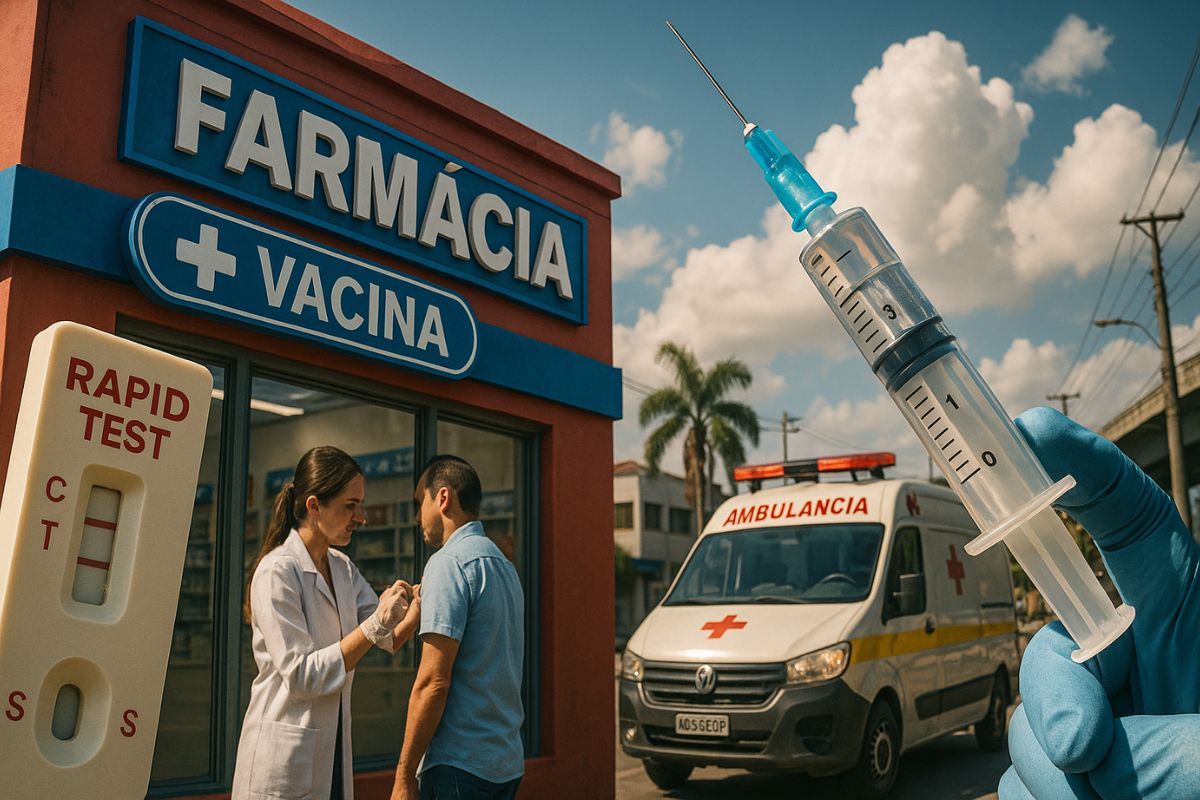
The New Anvisa Regulations Allow Pharmacies to Perform Dozens of Rapid Tests and Administer Vaccines, Making Them Mini Health Posts That Expand Access for the Population, Ease the Public System, and Elevate the Role of Pharmacists in Primary Care.
The new Anvisa regulations changed the way pharmacies operate in Brazil. With the publication of the RDC 978/2025, these establishments will offer rapid screening tests and vaccination services under regulated conditions, expanding the reach of basic health care.
The aim of the measure is to decentralize care, reduce queues in public units, and increase the efficiency of the system, ensuring safety and quality in the execution of procedures. The advance also reinforces the prominent role of the pharmacist as a clinical agent responsible for guiding and referring patients.
What Changed with the New Anvisa Regulations
The RDC 978/2025, which replaced RDC 786/2023, allows the performance of rapid screening tests, such as blood glucose, lipid profile, Covid-19, HIV, and Beta-hCG.
-
The Senate approves a bill that criminalizes misogyny, hatred, or aversion towards women, and includes the crime in the Racism Law with a penalty of up to 5 years.

-
Chamber Approves Bill That Allows Pepper Spray for Women Over 16 and Imposes Strict Rules for Purchase, Possession, and Use as Self-Defense

-
Chamber Approves Law to Combat Leucaena, Fast-Growing Plant That Dominates Land and Threatens Native Species in Various Regions of the Country

-
Asset Division: Know What Cannot Be Divided in Case of Divorce

These tests are preliminary and serve to guide the patient, without replacing a medical diagnosis.
The regulation maintains the prohibition of supervised self-tests and remote laboratory tests, a practice where the collection is done at the pharmacy and analysis at another location.
The restriction avoids health risks and the misuse of intermediaries between the patient and clinical laboratories.
The results obtained at pharmacies serve only as support for screening decisions and professional guidance.
When there is suspicion of anomalies, the pharmacist must refer the patient to a doctor or an accredited laboratory.
Structure and Technical Responsibilities of Pharmacies
The new resolution establishes strict infrastructure and qualification requirements.
Pharmacies must possess sanitary license, registration in the National Registry of Health Establishments (CNES), and an exclusive room for conducting tests, ensuring privacy and biosafety.
Only qualified and properly trained pharmacists can perform the procedures.
They are also responsible for initial interpretation of results, for adequate guidance, and for applying the quality protocols defined by Anvisa.
Management of biological waste must follow standard operating procedures (SOP) and safe disposal regulations.
The storage of samples and materials used must comply with biosafety requirements.
Data Protection and Patient Privacy
With the collection of sensitive information, the new regulations reinforce the need for full compliance with the General Data Protection Law (LGPD).
Pharmacies must obtain formal consent from the patient and ensure absolute confidentiality regarding their information.
The electronic or physical storage of results must be done securely to prevent unauthorized access.
The pharmacist, in turn, has ethical responsibility regarding professional confidentiality, and any leakage or misuse of data constitutes a serious offense.
Vaccination: Expanded Services with Health Control
Vaccination in pharmacies, authorized since 2017, has gained new technical parameters.
With the regulatory update, licensed establishments can administer vaccines from the national SUS calendar and complementary immunizations, such as flu and Covid-19, following strict safety standards.
To offer the service, the pharmacy must have an immunization room with minimum square footage defined by Anvisa, dedicated refrigerator with temperature control, transport coolers, and continuous monitoring equipment for the cold chain.
Administration can only be performed by health professionals qualified and certified in immunization, and each dose must be registered on the patient’s card and reported to the health system.
These records ensure traceability and integration with the public system.
Inspection, Penalties, and Integration with SUS
Anvisa, in partnership with state and municipal health surveillance agencies, has intensified monitoring of establishments.
Inspections can occur at any time to verify licenses, structure, professional qualifications, and documentation.
Failure to comply with regulations can result in warnings, fines, closure, or revocation of the sanitary license.
Reports of irregularities can be made by the public directly to the Anvisa ombudsman or to local surveillance agencies.
The new regulations also encourage the gradual integration of pharmacies into the Unified Health System (SUS), especially in the notification of vaccines and screening tests.
This cooperation seeks to expand coverage of services and improve national epidemiological monitoring.
Impacts on Public Health and the Citizen
The regulation aims to ease the public health system by allowing some simple tests and vaccines to be performed at pharmacies.
As a result, SUS can focus efforts on more complex cases.
The model enhances the population’s access to fast and low-cost services, especially in medium and small cities, where health post coverage is limited.
The expectation is that this measure will reduce wait times and increase early disease detection.
On the other hand, the success of the policy depends on continuous oversight, adequate training of professionals, and maintenance of the quality of services offered, avoiding the risk of trivialization or poor execution.
What the Citizen Should Check Before Using the Service
Before undergoing a test or vaccination at a pharmacy, the patient should confirm that the establishment has a sanitary license, verify that a qualified pharmacist is present, and request formal recording of results or immunization.
It is essential to understand that pharmacy tests are screening tests and do not replace a medical diagnosis.
The patient should always follow the guidance of the pharmacist and seek clinical evaluation when there are doubts or altered results.










-

-

2 pessoas reagiram a isso.