





 English
  Francês
  Alemão
  Italiano
  Japonês
  Norueguês
  Portuguese
  Spanish
  3 min of reading


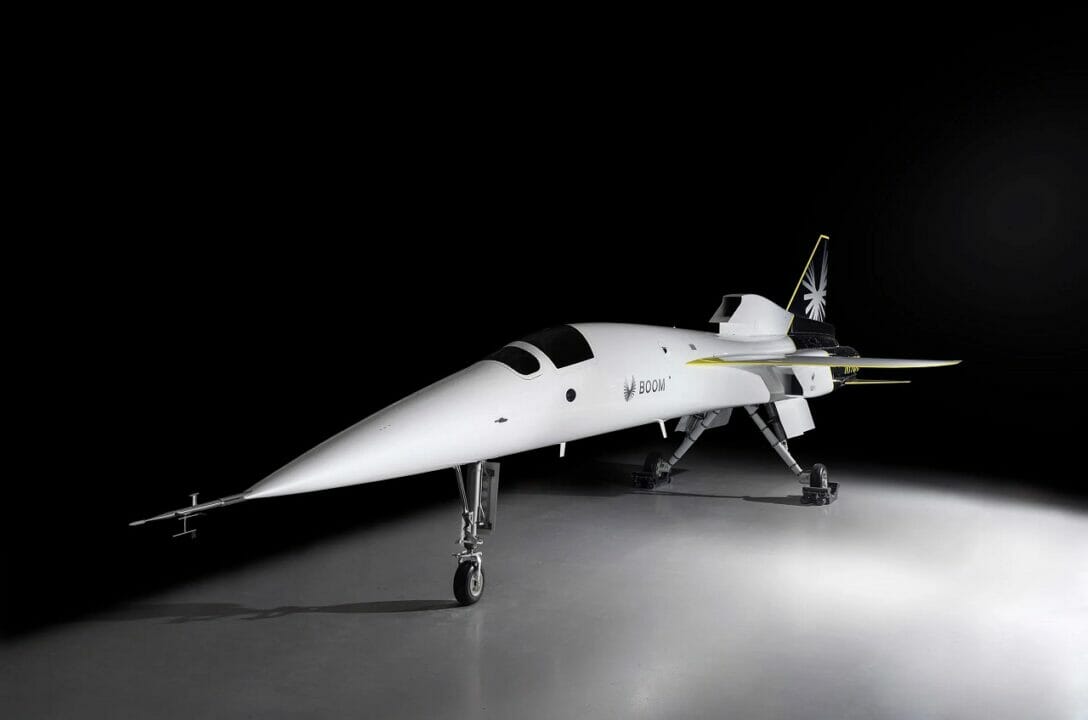
New Supersonic Jet With General Electric Engine Capable of Reaching Mach 1.7 Receives Airworthiness Certificate and Advances in Ground Testing.
Boom Supersonic, the aerospace company responsible for developing the world’s fastest and most sustainable supersonic jet with a General Electric engine, recently announced that its supersonic jet prototype has completed ground testing and received an experimental airworthiness certificate from the Federal Aviation Administration (FAA).
Ground Testing of the New Supersonic Jet Took Place in California
Several projects have been created focusing on reintroducing commercial supersonic flights, a scenario that was interrupted with the end of the Concorde in 2003. These projects are currently in various stages of development, or not development, as engineering advances await available funding.
However, one of the biggest challenges is developing fuselage and wing designs that can transform the sonic boom from a loud roar into a muffled sound, no louder than the closing of a car door.
-
Anti-tank mines appear near a missile base in Iran, causing fatalities and raising suspicion of a new move to block underground launchers.
-
Contaminated water from uranium threatens mining areas, and Chinese scientists have created a solar-powered living filter that could change environmental decontamination.

-
Archaeologists find in Mexico a sacrifice altar over 1,000 years old, surrounded by skulls, human bones, and signs of rituals from the Toltec Empire.

-
Goodbye to the traditional oven? IKEA draws attention with a 3-in-1 microwave that combines an air fryer, grill, and heating in the same compact, affordable appliance designed for small kitchens.


At the Mojave Air & Space Port, located in the city of Mojave, California, the company behind the new supersonic jet has been testing its one-third scale prototype called XB-1 as part of the development project for its supersonic commercial aircraft Overture.


The most recent phase of these tests included taxiing tests in preparation for the inaugural flight of the model with the General Electric engine.
In addition to the ground testing, the FAA granted the XB-1 an experimental airworthiness certificate that will allow the new supersonic test jet to make its first flight with Chief Test Pilot Bill “Doc” Showmaker and Test Pilot Tristan “Gepetto” Brandenburg. Besides simulator work, the pilots are training in a T-38, which will also act as a chase plane during the flight tests.
New Supersonic Jet Can Reach Mach 1.7
With a carbon and titanium composite fuselage and a modified delta wing with a wingspan of 5.2 meters, the new supersonic jet is powered by three General Electric J85 engines that burn Sustainable Aviation Fuel (SAF), providing a combined thrust of 12,300 pounds, equivalent to 5.6 tons, allowing the model to fly at Mach 1.7.
According to the Chief Test Pilot of Boom Supersonic, Bill Doc Shoemaker, it is fitting that the XB-1 is progressing toward its first flight at the Mojave Air & Space Port, home to more than 50 first flights and other important events in the aviation sector.
Bill is looking forward to flying the new supersonic jet, built upon the achievements of other talented engineers and pilots who inspire every day to make supersonic travel commonplace.
Supersonic Jet With General Electric Engine Focuses on Sustainability
Supersonic jets can drastically reduce intercontinental travel times, thus becoming a major bet for some airlines in the coming years. American Airlines has already ordered each for US$ 200 million, equivalent to R$ 1 billion.
The models acquired are 20 units of the Overture. According to Blake Scholl, founder and CEO of Boom Technology, what we are seeing is that supersonic is back and definitively.
Designed to accommodate up to 80 passengers, travelers will be able to fly from Los Angeles to Honolulu in just three hours, much faster than the 5 hours on conventional planes.
The company plans to reach more passengers than the former Concorde, which primarily served millionaires and celebrities. It is worth noting that the manufacturer intends to operate its aircraft with fully sustainable aviation fuel, with clean engines powering their aircraft.








Seja o primeiro a reagir!