





 Portuguese
  English
  Spanish
  3 min of reading
  0 comments


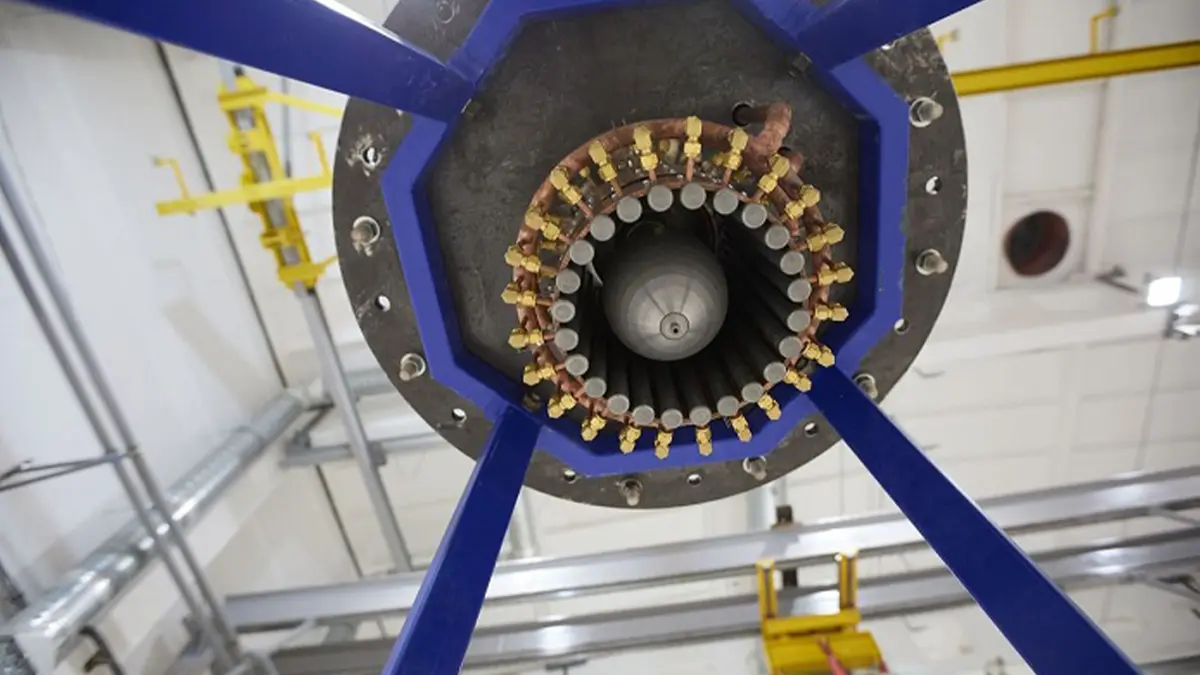
Scientists from Rosatom Develop Plasma Rocket Engine Promising to Speed Up Trips to Mars, Reducing Travel Time to Just One to Two Months
Scientists from Rosatom, one of the largest nuclear energy companies in Russia, have unveiled a revolutionary plasma rocket engine that could transform space travel.
The electric plasma engine can, according to experts, reduce the travel time to Mars to just one to two months, a significant advancement over current technologies. The news was revealed by the Russian newspaper Izvestia.
Unlike traditional rocket engines that rely on burning fuel to generate thrust, this innovative system uses a magnetic plasma accelerator.
-
China creates hypersonic engine that can make planes and missiles fly more than 6 times the speed of sound with less weight, more range, and without system change.

-
Mysterious object on Mars divides NASA and Harvard after Curiosity image reignites suspicions about what was really found on the planet.
-
Giant structures 14 meters beneath Egypt are revealed by satellites and expose a millennia-old secret buried in Buto.

-
Children have been making clay pieces for 15,000 years in Southwest Asia, and fingerprints preserved on 142 ornaments helped archaeologists prove this.

The main advantage of this engine is the impressive speed it can achieve, allowing for a trip to Mars in a fraction of the time currently required.
How The Plasma Engine Works
The plasma engine developed by Rosatom is a type of electric engine. According to Egor Biriulin, a junior researcher at the Rosatom Scientific Institute, the engine is based on two electrodes.
Provided particles, such as electrons and protons, are accelerated by a magnetic field generated by a high voltage applied across the electrodes. This process creates a directed motion in the plasma, generating thrust and consequently speed for the spacecraft.
“In traditional energy units, the maximum speed of the matter flow is about 4.5 km/s, which is limited by the combustion of fuel. In our engine, however, the charged particles are accelerated by an electromagnetic field, allowing for much greater speeds“, explained Alexei Voronov, First Deputy General Director for Science at the Troitsk Institute.
The engine accelerates the particles to an impressive speed of 100 km/s, much faster than conventional engines. This speed is essential to reduce interplanetary travel time, one of the greatest limitations of space exploration.
Speeding Up The Trip To Mars
One of the biggest challenges of long-duration space missions is the exposure of astronauts to cosmic radiation, which can be detrimental to health on lengthy journeys.
With the plasma engine, a trip to Mars would be shortened, reducing the risks associated with radiation and improving crew safety. Additionally, a faster trip would bring significant gains in efficiency and cost reduction.
Rosatom has already developed a laboratory prototype of the engine, which will undergo extensive ground testing in the coming years. The expectation is that the flight model will be ready by 2030.
“The engine operates in a pulse-periodic mode, with a power of around 300 kW. The engine’s duration, exceeding 2,400 hours, is sufficient for a transport operation to Mars“, stated Konstantin Gutorov, scientific advisor for the project.
The Challenge Of Testing
To ensure that the engine works under extreme space conditions, a specialized test chamber was built.
Measuring 4 meters in diameter and 14 meters in length, the chamber simulates the space environment, including disposable systems and heat removal.
Although the launch of the mission still depends on chemical rockets, the plasma engine will be activated as soon as the spacecraft reaches its designated orbit.
One of the advantages of the plasma engine is that it does not require excessive heating of the plasma, which avoids damage to the system’s parts and components.
This results in more efficient operation, where most of the electrical energy is converted directly into motion, with no significant losses.
More information about the new Russian plasma engine can be found at Interesting Engineering.






-

-

-

9 pessoas reagiram a isso.