





 Portuguese
  English
  Spanish
  4 min of reading
  0 comments


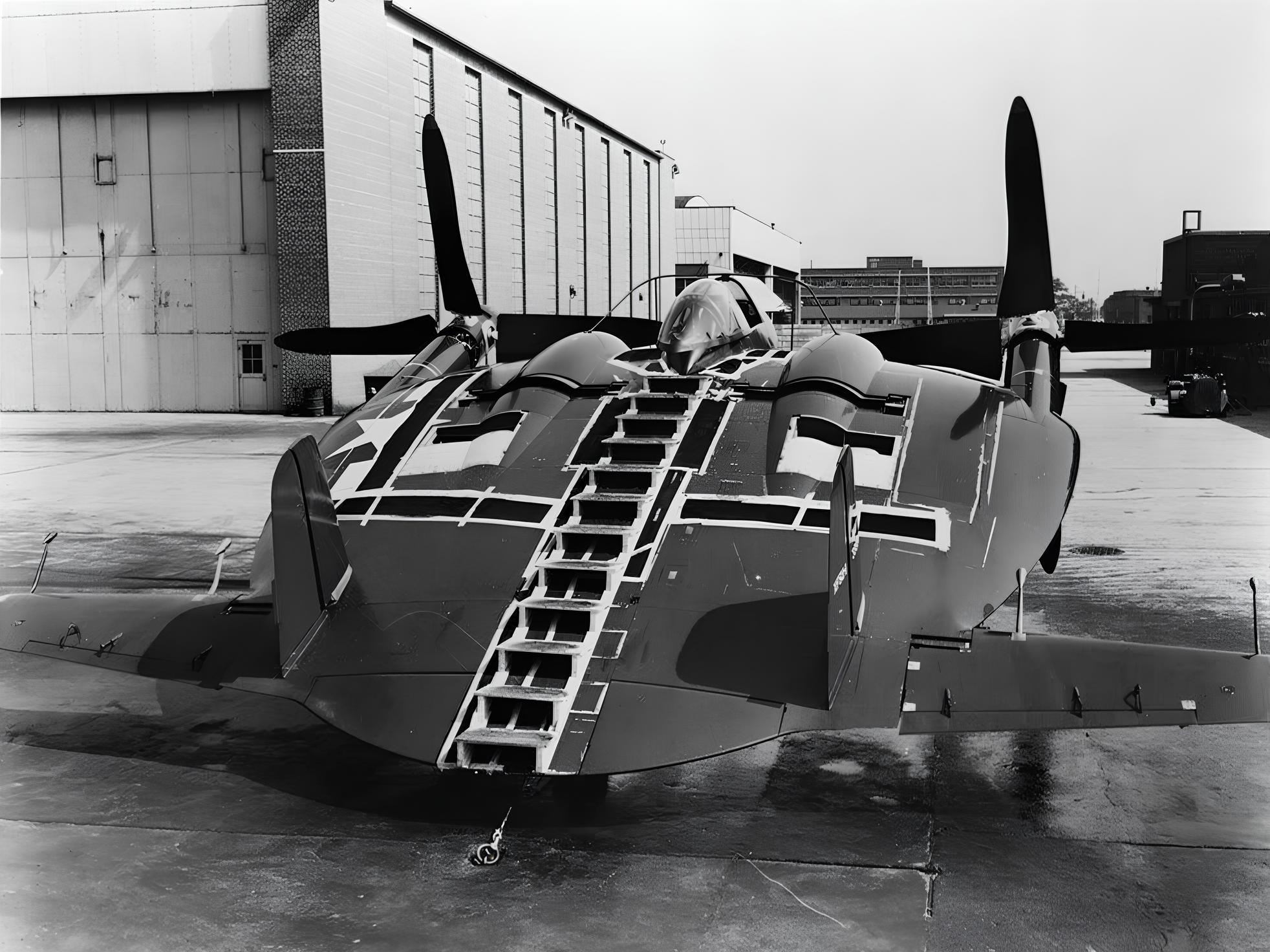
U.S. Navy Plane That Looked Like a Flying Saucer Seems to Have Come Straight Out of a Sci-Fi Movie. Meet the Flying Flapjack, a Unique U.S. Project That Never Participated in a War.
As researchers and military personnel raced to develop new aircraft and more efficient weapons at the height of World War II, an eccentric engineer had an idea that seemed straight out of a science fiction movie. The idea was a U.S. Navy plane that looked like a flying saucer. Called the Vought V-173 or Flying Flapjack, this is an experimental aircraft resembling a UFO that actually flew and surprised those who thought it would never leave the ground.
Flying Flapjack – U.S. Navy Plane That Looked Like a Flying Saucer Amazed Even Veteran Pilots


The American project was as strange as it was bold, and instead of a traditional fuselage and wings, it had a completely flattened body with large propellers at the tips of the wings. The goal was to develop an aircraft that could take off from short runways and maneuver like no other. The project succeeded, flying dozens of times, even surprising the most experienced pilots.
However, the success was short-lived. When the combat model, known as the XF5U-1, was finally ready, jets were already dominating the skies. The only remaining example is currently in a museum in Texas and still looks more like science fiction than reality.
-
These living root bridges and ladders are over 700 years old and help indigenous people survive in one of the rainiest regions in the world.

-
From sertanejo star to international investor: Ana Castela invests millions in a mansion in the USA, creates a themed accommodation in Orlando, and shows that the “boiadeira” also wants to grow away from the stage.

-
The 10 most stunning motorhomes in the world: a $3 million trailer with a rooftop nightclub and garage for a Ferrari, “palaces on wheels” with Italian marble, private cinema, and five-star hotel luxury for billionaires.

-
Trump wanted to spend $400 million on the White House, but the courts prohibited the million-dollar construction.


The project for the U.S. Navy plane that looked like a flying saucer was so innovative that it remained completely confidential during its development. It faced several technical obstacles and delays, especially when the United States entered the war. Even so, it kept moving forward amidst doubts and skepticism within the military forces themselves.
Despite the technical challenges, especially with the complex system that synchronized the engines with the propellers, the Flying Flapjack finally took off on November 23, 1942. Its lightweight structure, made of fabric and wood, surprised with its robustness. Against all odds, the flying saucer took to the skies.
Understand How and Why the U.S. Project Came to an End
Between 1942 and 1943, the U.S. Navy plane that looked like a flying saucer flew almost 200 times. It had impressive stability, took off in just 60 meters, and hardly ever entered a stall, a term used in aviation that indicates the separation of airflow from the upper surface of the wing.
With a headwind, it could even climb vertically. The Navy saw there a fighter that could operate even from makeshift decks, a unique feat for the time.
Although the project never solidified as a combat fighter, the Flying Flapjack paved the way for new ideas in flight control and aerodynamics. Its concept of short takeoff and stability at low speeds anticipated challenges that aviation would face for many years.
Today, advancements in vertical takeoff and landing (VTOL) aircraft and uniquely shaped drones echo the lessons of the V-173. Modern technologies explore the quest for agility and versatility in confined spaces, something the Flying Flapjack demonstrated over 60 years ago.
However, even without entering combat, this model inspired future generations, serving as proof that in aviation, courage and innovation to experiment are just as crucial as speed and firepower.
Aircraft Performance Numbers Impress Even Today
In many aspects, the model’s performance was impressive, with a stall speed of 32 km/h and able to take off from a runway just 61 m long. In case of strong winds, it could take off vertically.
In the air, it was capable of reaching a top speed of 222 km/h, a range of 322 km, and a service ceiling of 1,524 m. In addition, the circular wing made it ultramanoeuvrable, capable of making tight turns, which is quite attractive in a fighter.
It was also remarkably stable and controllable, even at speeds as low as 32 km/h, and was very difficult to stall, even intentionally.
The downside of the model is that the control surfaces needed many adjustments to correct various issues caused by the unusual wing shape and the airflow over it. Additionally, at low speeds, the pilot sometimes had to handle it like a helicopter, which is a bit challenging for those who have never seen one.








Seja o primeiro a reagir!