





 Portuguese
  English
  Spanish
  4 min of reading
  0 comments


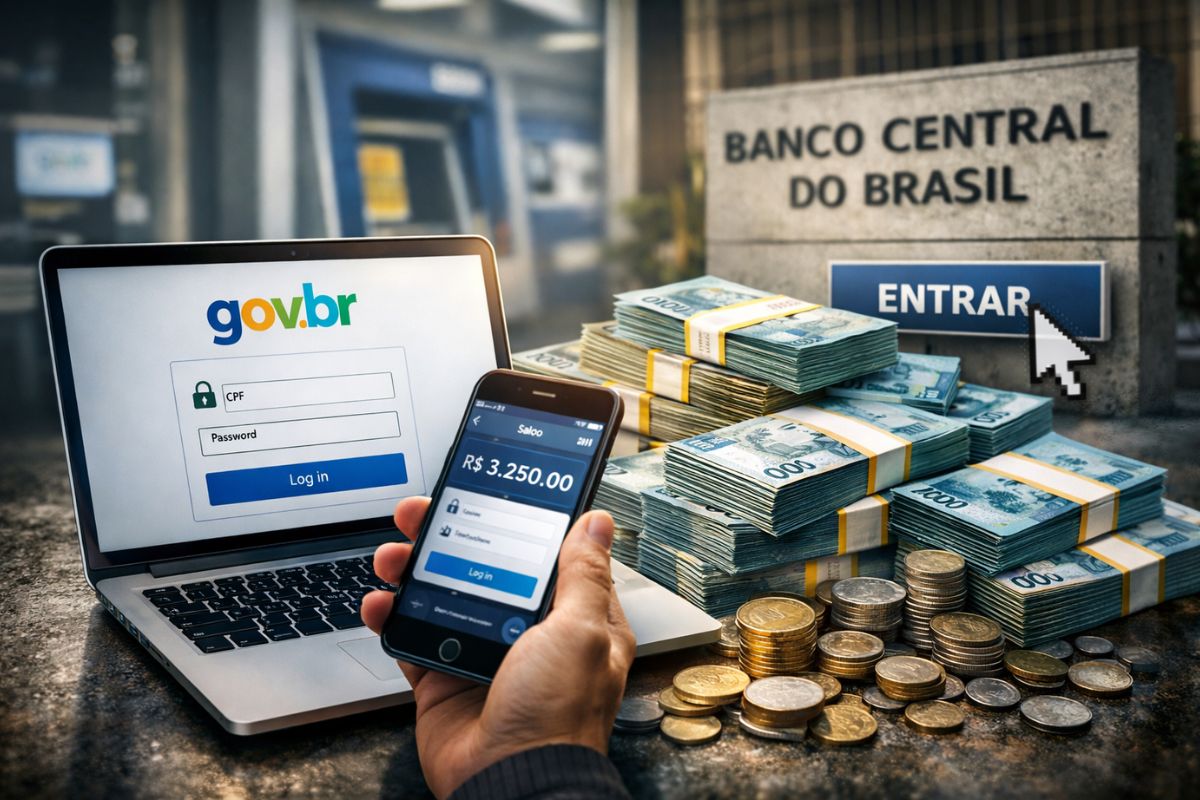
With R$ 7.8 Billion from Individuals and R$ 2.22 Billion from Companies, Central Bank Estimates 49.31 Million Brazilians and 4.96 Million CNPJs with Idle Money. Queries and Requests are Made at SVR, Only at valoresareceber.bcb.gov.br, with gov.br Silver or Gold Accounts and Secure Two-Step Verification
The Central Bank of Brazil reported that approximately R$ 10 billion remains forgotten as of January 2026 across various financial institutions in the country. The amount is linked to 49.31 million individuals and 4.96 million companies, who left funds in deactivated or unused accounts and can now request refunds from home.
To centralize the query and request for retrieval, the Central Bank maintains the System of Amounts to be Received (SVR), accessed exclusively online. The operation is done without queues and intermediaries, requiring a gov.br silver or gold account, activation of two-step verification, and registration of a PIX key for the money to be directly deposited into the account.
Where is the Money and Why Does the Central Bank Say it is Idle
The amounts indicated by the Central Bank remain in financial institutions due to common everyday situations that accumulate over time.
-
Larger than entire cities in Brazil: BYD is building a 4.6 km² complex in Bahia with a capacity for 600,000 vehicles per year, but the discovery of 163 workers in conditions analogous to slavery has shaken the entire project.

-
With an investment of R$ 612 million, a capacity to process 1.2 million liters of milk per day, Piracanjuba inaugurates a mega cheese factory that increases national production, reduces dependence on imports, and repositions Brazil on the global dairy map.

-
Brazilian city gains industrial hub for 85 companies that is equivalent to 55 football fields.

-
Peugeot and Citroën factory in Argentina cuts production by half and opens a layoff program for more than 2,000 employees after Brazil drastically reduced purchases of Argentine vehicles.


In many cases, the money does not “disappear”; it simply becomes linked to records that are no longer monitored by the account holder.
Among the reasons cited for the accumulation of these funds are old bank accounts that were not properly closed, outstanding bills that were not cleared, and inactive consortium shares.
In the case of companies, the lack of updated financial control also contributes to amounts remaining forgotten, especially during management changes, internal routines, and balance monitoring.
How Much Money is Available and Who Can Retrieve it Now
The Central Bank detailed that the total of approximately R$ 10 billion consists of R$ 7.8 billion linked to individuals and R$ 2.22 billion related to companies.
In terms of potential beneficiaries, this represents 49.31 million individuals and 4.96 million companies with amounts subject to query at SVR.
This distribution reinforces that the reach is national, spanning different profiles of citizens and businesses.
The central point is simple: if there is an amount in your name, it will show up in the system, and the refund can be requested according to the Central Bank’s rules and SVR’s operational procedures.
How the SVR of the Central Bank Works and Why Access is Only Online
The Central Bank structured the SVR to centralize queries and requests for refunds, reducing the need for travel and standardizing user verification.
Access is made exclusively through the address valoresareceber.bcb.gov.br, which means that any attempt to redirect to different pages is not part of the official flow.
Additionally, the Central Bank informs that the SVR has been updated to allow easier and more automated access to information.
In practice, this aims to simplify the search process, with the gov.br account functioning as the means of authentication to confirm who is accessing the data and requesting the retrieval.
Step by Step to Consult and Request a Refund at the Central Bank
The procedure described by the Central Bank follows a straightforward logic, with clear steps from start to finish.
The refund depends on the person identifying themselves in the system and indicating where the money should be sent.
Access valoresareceber.bcb.gov.br and log in with a gov.br silver or gold account.
Activate the two-step verification, required as an additional security factor.
Make the query: the SVR informs if there are amounts linked to your name.
If there are amounts, register a PIX key to receive the money directly into the indicated bank account.
This workflow is designed to operate without queues and without in-person service, with validation centralized in the digital environment.
If the system indicates available funds, the decisive step is the correct registration of the PIX key, as it is through this that the refund is directed.
Cases Requiring Extra Attention: Companies, Heirs, and Manual Requests
Although the standard path is automated, the Central Bank points out situations in which the process may require specific documentation or different procedures.
Companies and heirs of deceased account holders need to present specific documents, such as a statement of responsibility for heirs.
There are also situations where the request cannot be resolved just by registering the PIX.
Amounts linked to joint accounts or companies that do not yet use PIX may require manual requests, following the guidelines defined by each financial institution involved.
In these cases, the SVR remains the starting point, as it is where the existence of the amount is confirmed and the retrieval process is initiated.
Security and Scams: The Direct Alert from the Central Bank
The Central Bank emphasizes that it does not request personal data for refunds and that the entire operation must be performed directly through the official site valoresareceber.bcb.gov.br.
The alert is important because fraud messages circulate trying to induce the user to provide information or access links that are not part of the SVR environment.
The practical guidance is to keep the process restricted to the official channel and to authenticate via the gov.br account, adhering to the requirement for two-step verification.
If a “shortcut,” charge, promise of priority, or contact asking for data appears, the risk is high, because the Central Bank indicates that the retrieval must be made exclusively on the site.
Have you checked the Central Bank system to see if you have amounts to receive in your name?







Seja o primeiro a reagir!