





 English
  Francês
  Alemão
  Italiano
  Japonês
  Norueguês
  Portuguese
  Spanish
  2 min of reading


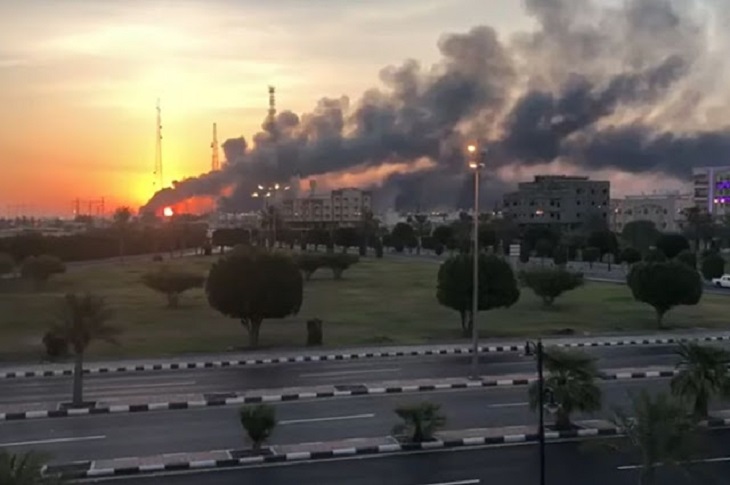
Rebel Attack Hits World’s Largest Oil Refinery, Taking Half of Saudi Production Offline and Creating Instabilities in Brazil
An attack around 4 AM on Saturday (10 PM Friday, Brasília time) on Saudi Arabia’s largest refinery not only caused a massive fire but also took half of the country’s oil production offline and nearly 6% of global production.
It is estimated that 5.7 million barrels per day will no longer be produced by Saudi Aramco, the state-owned Saudi company, which operated in Hijra Khurais, one of Saudi Arabia’s largest oil fields, and in Abqaiq, where the world’s largest oil refinery is located.
The attack, attributed to the Houthi rebel group based in Yemen and backed by Iran, was considered the largest ever carried out against Saudi oil infrastructure.
Other attacks had previously temporarily affected pipeline operations, ships, and refining facilities, but none had the magnitude of this attack on a refinery, which is expected to worsen relations between the U.S./Saudi Arabia and Iran.
-
Government unlocks R$ 554 million for a highway that has been requested for decades and accelerates the duplication of BR.
-
Without bricks, without cement, and without endless construction: the cardboard house that is assembled in modules and can be moved.

-
Billions of barrels on the equatorial margin could lead Amapá to double its oil production in Brazil — the state aims to enter the route of companies in the Campos Basin, attract investments, and boost jobs and businesses in the oil and gas sector.
-
Without bricks, without cement, and without endless construction: the cardboard house that is assembled in modules and can be moved.

The rebels claimed to have used 10 drones in the attack and promised further assaults, “We promise the Saudi regime that our future operations will expand and be more painful as long as the aggression and siege continue,” said a spokesperson for the rebels.
The Consequences
So far, the global consequences of the attack are not clear, but the Saudis will likely have to use their entire stock of around 188 million barrels stored to ensure that global supply is not disrupted, thus acting to keep prices from spiraling out of control.
In Brazil, two impacts may occur, one of them positively, as it might enhance the value of the pre-salt reserves, being a vast reserve that is outside the conflict zone and taking place just before the mega-auction of the onerous assignment, set for November 6, which could attract more foreign investors than already expected.
The other impact would be negative as a sharp increase in barrel prices would force Petrobras to pass the increase onto distributors, affecting pump prices.
Any political interference in prices, such as that which has recently occurred in the government, would also create problems for Petrobras’s divestment program.
This instability would generate issues with companies interested in acquiring the refineries that Petrobras is putting up for sale, as it would affect the valuation of the assets in the auction.









Seja o primeiro a reagir!