





 Portuguese
  English
  Spanish
  8 min of reading
  0 comments


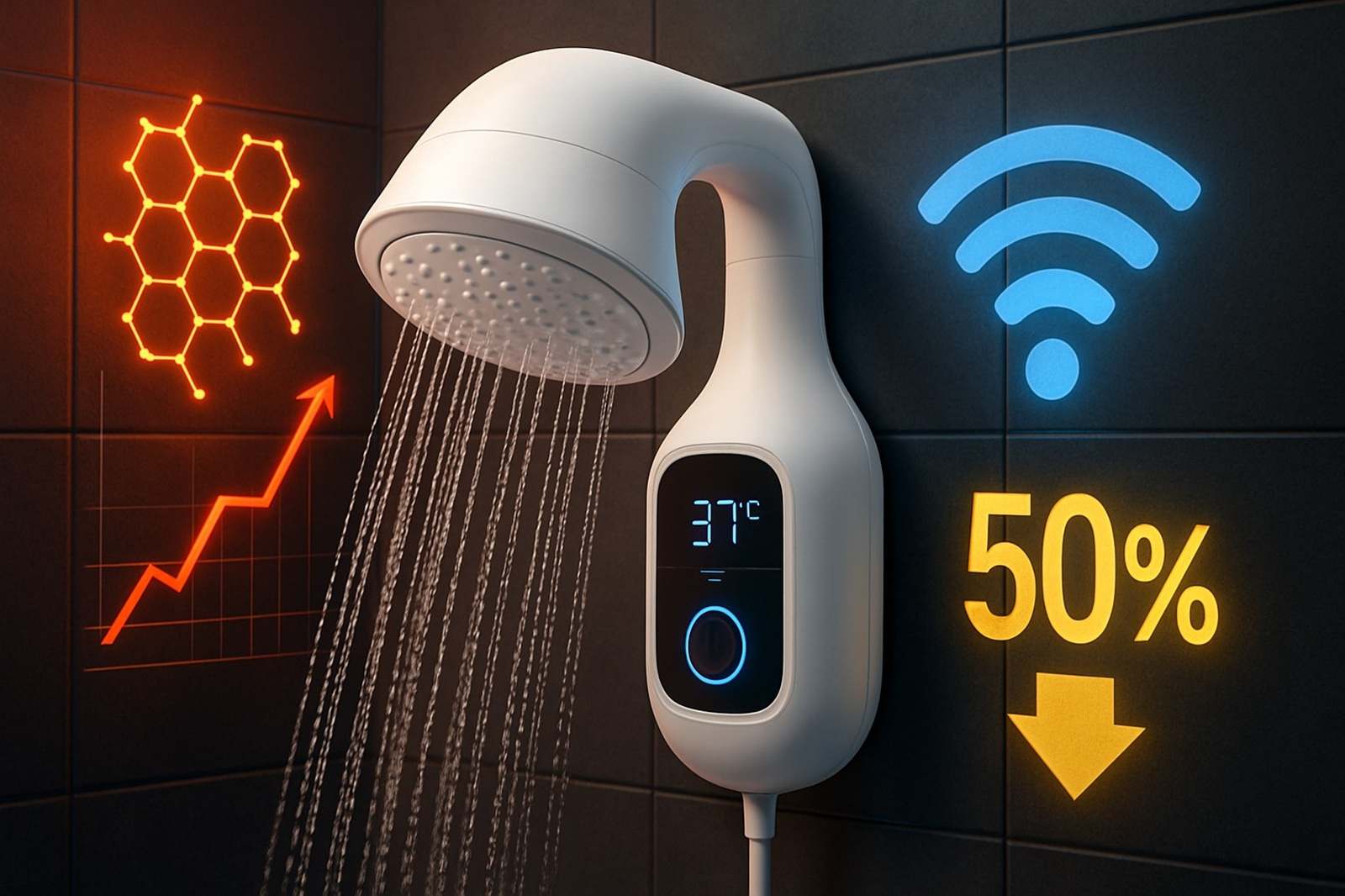
The Bath Revolution Has Begun: New Technologies Such as Graphene Heaters, AI Sensors, Micro-Misting, and Heat Recovery Promise to Reduce Energy Consumption by Up to 50% and Completely Transform the Electric Shower.
The electric shower is inexpensive, easy to install, and dominant in millions of bathrooms — especially in Brazil. But it still has three chronic issues: high energy consumption during peaks, thermal waste (heat going down the drain), and little control intelligence.
The good news: a set of innovations — from advanced materials to heat recovery, water atomization, solar + batteries, and automation with IoT/AI — is coming to tackle exactly these points.
What already works? What is in the lab? And what can scale? Below, we have prepared an overview based on peer-reviewed research, technical reports, and manufacturers.
-
An engineer designs a solar plane to fly on Mars at an altitude of 1,000 meters and a speed of 300 km/h, covering 16,000 kilometers in a Martian year, 900 times the distance traveled by the Ingenuity helicopter in three years on the planet before experiencing a rotor failure, and NASA is already funding the feasibility study.

-
A new phenomenon of contactless magnetic friction intrigues scientists and questions a theory that has been valid since the 17th century.
-
An impressive phenomenon in Northern Brazil causes rivers of different colors to flow side by side, revealing secrets about sediments, currents, and biodiversity.

-
While many schools are still struggling with the basics, a teacher in China went viral for having elementary school students build a two-stage rocket using plastic bottles, water, and pressurized air in a science class that caught the attention of the entire world.


Graphene Heaters and Carbon Nanotubes: Faster, Thinner, and More Durable Heating
The “heart” of the electric shower is the heating element. Replacing the metal wire with graphene or carbon nanotube (CNT) based conductive films opens up advantages: high conductivity, very fast thermal response, ultrathin (even transparent) shape, and good mechanical flexibility/durability.
Studies show graphene heating films with efficient heating through Joule effect, rapidly reaching target temperature at lower powers and maintaining performance after thousands of bends; applications range from de-icing surfaces to rapid thermal processing in ceramic matrices — a sign of robustness for household appliances exposed to moisture and thermal cycles.
In CNTs, research shows fast response elastic heaters, with good thermal and electrical stability, even as transparent films for fogging and de-icing — technologies that can migrate to “laminar” heaters inside the shower body, reducing “hot spots” and failures due to wire fatigue.
What’s missing? Specific testing in shower environments (mist, splashes, scaling) and electrical/safety certification.
But the advancement of Joule films made from graphene/CNT in severe applications indicates a viability pathway for longer-lasting and faster heaters, with the potential to reduce instantaneous power to achieve the same comfort.
Smart Control with IoT and AI: Safety, Comfort, and Consumption Management
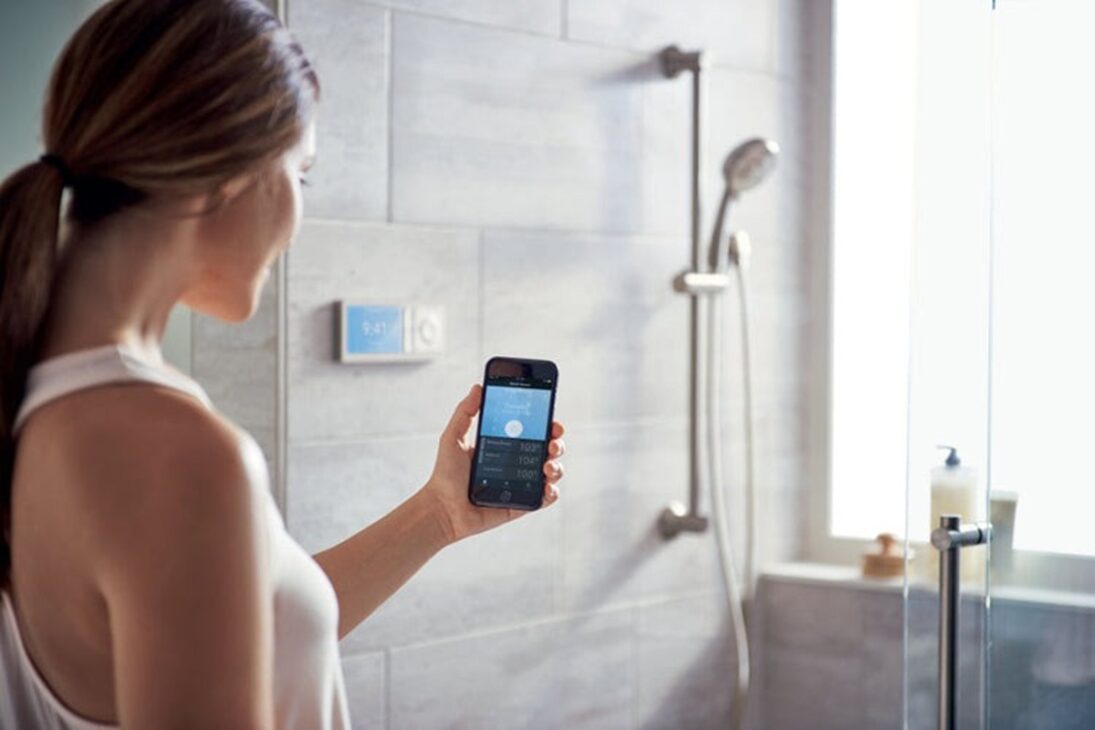
Digiitalization has already reached showers with controllers and apps: brands are already selling “smart shower” systems with precise temperature, personalized profiles, voice/cell activation, and monitoring. This is not futurism; it’s on the shelf.
IoT solutions (Internet of Things) are systems that connect physical objects — such as sensors, machines, vehicles, appliances, and industrial devices — to the internet and to each other, allowing them to collect, exchange, and process data in real-time without constant human intervention.
In the academic field, IoT solutions for electric showers measure temperature, voltage, current, and flow in real-time, generating data for safety alerts, real billing based on usage in accommodations, and consumption optimization — even in the Brazilian context, where the electric shower weighs heavily on the peak system. These prototypes show robust telemetry and low-cost architecture.
Beyond direct control, there are gains using forecasting/optimizing: predictive control techniques with machine learning (applied to residential water heating) have already delivered 4–8% savings compared to traditional controls, signaling that algorithms can learn showering habits and heat “just in time,” without standby waste.
Finally, “smart” showers that generate their own power (internal water turbine) to power Bluetooth and sensors, with an app that notifies the “point” of temperature and volume limit for conscious cutting. Although aimed at showers without built-in electric heating, the functions of consumption coaching and telemetry are converging with the digital electric shower.
Drain Heat Recovery: Save by Heating the Water That Enters
A large part of the energy used in the shower goes down the drain with warm water. Drain Water Heat Recovery (DWHR) systems capture some of this heat to preheat cold water that feeds the shower.
Public entities and universities have been measuring the thermal effectiveness of these heat exchangers (vertical, horizontal, coaxial tube, or plates).
Typical results vary from ~40% to 50% effectiveness in real configurations, with studies and standards proposing minimums of ~42% for recognition in efficiency codes.
A technical guide from the Canadian government explains the principle and benefits of DWHR to reduce heating energy for water in homes — a technology compatible with electric showers, as preheating reduces the temperature drop that the heater needs to overcome, relieving instantaneous power.
The literature provides assessments in different geometries and scenarios (Canada, Europe), with measurements of pressure, heat transfer, and payback.
In general, the technology is passive (no motor/pump), low maintenance, and has the potential to scale in new buildings; there are also solutions for retrofitting.
Recent studies evaluate the synergy of DWHR with heat pump water heaters — also useful when the electric shower is supplemented by a domestic boiler — registering effectiveness between ~45% and 85% depending on flow rates and temperatures.
The message: drain heat is a “fuel” we have already paid for; recovering it reduces kWh per shower.
Integration with Solar Thermal (and Batteries): Pre-Heating That Reduces the Bill
Another mature avenue is solar pre-heating. The U.S. Department of Energy points out that solar water heaters can supply 40% to 70% of the annual demand in well-designed projects, and reduce water heating bills by 50%–80% — with the tank/exchanger delivering already warm water to the shower, which only “fine-tunes” the electric heating. This softens peaks and reduces kWh per shower.
Guides from Energy Saver and ENERGY STAR detail architectures (direct, indirect/closed, thermosiphon, forced circulation) and ideal conditions (climate, frost, consumption profile). In sunny regions, solar thermal pairs very well with electric showers, especially where gas is expensive/unavailable. In cold climates, indirect systems with antifreeze fluid and exchangers maintain performance.
And where do batteries fit in? They don’t “heat water”; they shift the electric shower consumption to off-peak hours, when combined with time-of-use pricing or residential photovoltaics (PV).
Although the benefits depend on the tariff and the house profile, the physics of pre-heating (solar/boiler) + time management (batteries/automation) address power and energy — two different issues with electric showers. (Note: the economic-regulatory feasibility varies by country and distributor; here we address the proven technical part.)
Micro-Misting and Ultrafine Atomization: Comfort with Less Water
The idea here is to transform the jet into a cloud of micro-drops that increase the area of contact with the skin while maintaining the feeling of coverage/full shower with less flow.
The most well-known case is the Nebia (now under Moen) line, which promoted in the market the claim of up to ~45% water savings and flow rates of 1.35 GPM in some models — well below the 2.0 GPM typical in the U.S.
Independent tests praised the finish and coverage, but also pointed out challenges of “felt heat” in cold climates and splashes outside the shower with careful adjustments — a reminder that water savings need to preserve real thermal comfort.
The manufacturer describes the proprietary nozzle (H₂Micro) and the gain of “double coverage” with almost half the water — a clear direction to enhance comfort through fluid design, not through more flow.
Other manufacturers are already incorporating high-efficiency nozzles with a good shower feel. For application in an electric shower, less water at the same temperature means less instantaneous energy — something especially relevant in limited circuit breakers.
Four Scenarios That Show What the Bath of the Future Will Be Like
The transformation of the electric shower does not rely on a single miraculous technology, but on the combination of solutions adapted to different residential profiles.
Experts point to four practical scenarios — from simple updates to cutting-edge systems — that indicate how bathing can become more efficient, economical, and intelligent in the coming years.
Scenario A: Accessible Retrofit for Apartments
In small properties, modernization can begin with simple measures. Installing a micro-misting shower that reduces flow without compromising the feeling of coverage, combined with a digital control system that allows defining temperature profiles and volume limits per person, already represents an advancement.
Telemetry via app, with data on shower time and estimated consumption in kWh, raises awareness about spending. The result is a significant decrease in water usage, constant comfort thanks to precise control, and education on family consumption — all without the need for complex renovations.
Scenario B: Single-Story Houses with Space for Improvements
In residences with easy access to plumbing, installing a vertical heat recovery system (DWHR) integrated into an efficient shower proves to be a high-impact solution.
This technology uses the heat from drain water to preheat the cold water that reaches the shower, achieving average efficiency between 40% and 50%.
In practice, the electric heater works less to reach the ideal temperature, reducing energy consumption. In colder regions, performance often improves, as the temperature difference between the wastewater and incoming water is greater.
Scenario C: Homes with High Solar Potential
For houses in regions with high sunlight exposure, combining thermal systems with the electric shower creates a model of even greater efficiency.
The solar heater preheats the water in a reservoir, while the electric shower acts solely as a “fine-tuner” for temperature. Digital control prevents overheating and ensures comfort.
If the system is paired with domestic batteries, it’s possible to schedule use during lower tariff hours or take advantage of excess from photovoltaic generation. This setup reduces hot water bills between 50% and 80% and decreases electric demand during peak times.
Scenario D: The New Generation of Smart Showers
The most advanced step involves creating entirely new products. Prototyping is already considering laminated heating elements encapsulated with graphene or carbon nanotubes, which heat quickly and avoid overheating spots.
Sensors monitor temperature, flow, and grounding, while predictive control systems adjust heating by detecting the presence of the user.
Telemetry also allows identifying the end of the lifespan of the heating element or the buildup of encrustations.
This integration of advanced materials with IoT and artificial intelligence represents a viable path toward longer-lasting, economical, and personalized showers.
The Electric Shower “2.0”
The next generation is not a single miraculous technology but rather the combination of four pillars:
- Better materials (graphene/CNT) for faster and more durable heating elements;
- Heat recovery from the drain to avoid wasting expensive energy;
- Efficient hydraulics (atomization/micro-misting) to deliver comfort with less water;
- Digitalization with IoT/AI for fine control, safety, and data.
Together with solar preheating (where feasible), they promise more comfortable showers with less kWh and liters, lower peak demand, and longer lifespan — a systemic upgrade that fits both retrofitting and new projects.






Seja o primeiro a reagir!