





 Portuguese
  English
  Spanish
  5 min of reading
  0 comments


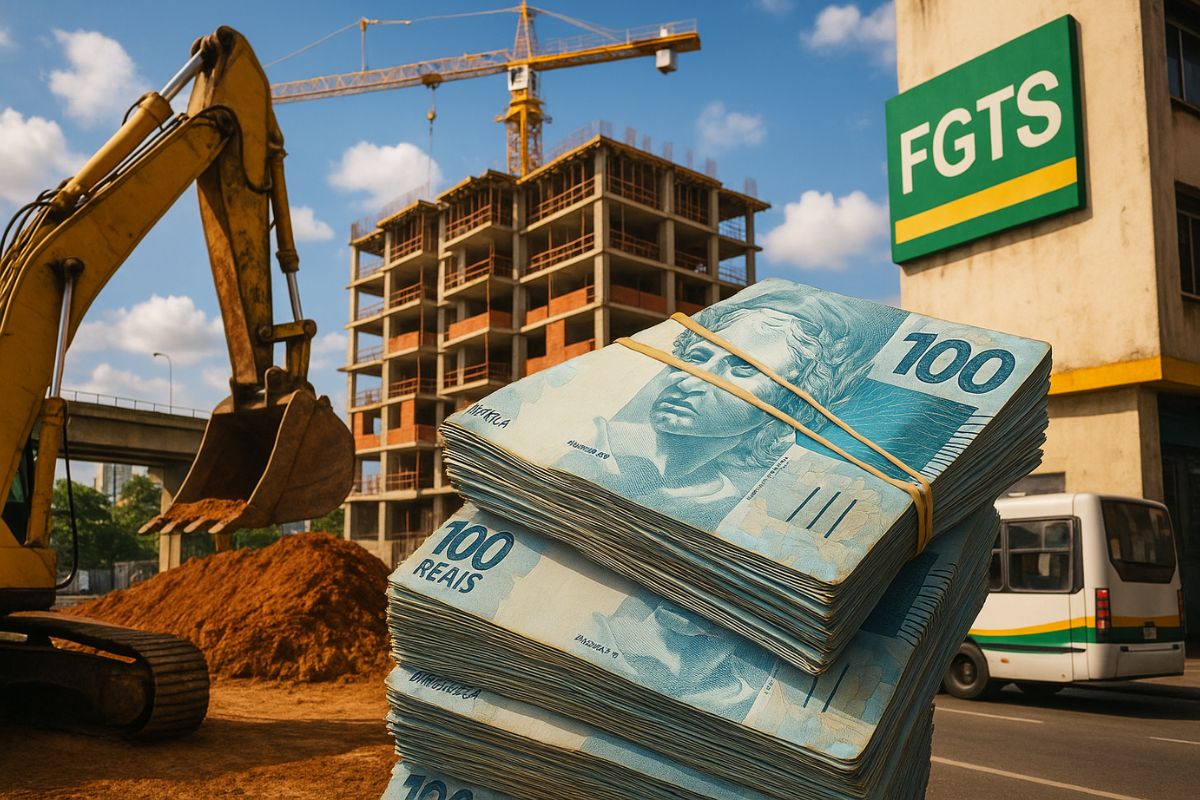
Money From FGTS Does Not Stay Put: It Is Directed to Large Housing and Sanitation Projects, While the Worker’s Account Remains Yielding.
The FGTS is more than a reserve for moments of dismissal or buying a home: the fund channels resources into projects that expand dignified housing and urban infrastructure, especially for low-income families. Meanwhile, the worker’s balance continues to yield through annual interest and profit distribution, preserving part of the purchasing power of the account over time.
In practice, FGTS helps unlock public and private investments. According to the Gov portal, in various recent cycles, up to this year billions of reais have been allocated to housing, sanitation, and urban infrastructure, with a direct impact on jobs, health, and quality of life. It is the workers’ money nourishing long-term policies, without failing to fulfill its individual function.
How FGTS Finances Essential Works
FGTS directs resources to housing programs (such as construction, purchase, and renovation of popular housing) and basic sanitation projects (water, sewage, and treatment networks).
-
Oil surged to $115 a barrel due to the war in the Middle East, and diesel in Brazil has already risen to R$ 7.45 per liter, while the United States…

-
Brazilian city bets on the business environment to generate jobs and attract investments in the energy sector — secretary reveals strategy at Macaé Energy 2026.

-
50 viaducts, 4 tunnels, 28 bridges, and 40 kilometers of bike paths: BR-262 in Espírito Santo will receive 8.6 billion reais for the largest engineering project in the state’s history, inspired by the Immigrant Highway in São Paulo.

-
Brazil produces too much clean energy and doesn’t know what to do with it: over 20% of solar and wind capacity was wasted in 2025 while investors flee and 509 renewable generation projects were abandoned in the last year.

The logic is counter-cyclical: when private credit tightens, FGTS sustains the pace of works, reducing historical bottlenecks in housing and infrastructure.
This financing is not limited to large enterprises. There are lines that allow construction or renovation on owned land and others that make it possible to purchase the first property.
The multiplier effect is significant: every real invested tends to generate income, jobs, and revenue, with positive externalities for public health by increasing access to treated water and sewage collection.
Where the Money Goes: Volumes and Priorities
In recent cycles, FGTS has allocated significant amounts to its social purposes: R$ 142 billion in 2025 for housing, sanitation, and urban infrastructure; R$ 75.1 billion in 2023 for housing and sanitation; and up to R$ 19.7 billion projected for sanitation between 2022 and 2025.
From 2021 to 2025, up to R$ 326 billion have been made available for these strategic areas.
In addition to contributions to projects, the fund’s revenue has also grown: in 2024, the FGTS surpassed R$ 192 billion in revenue, an increase of over 9% compared to 2023.
These numbers show FGTS as a driver of social investment, maintaining financing capacity even in periods of restricted credit.
How Your FGTS Yields While Financing Projects
The profitability of FGTS accounts is composed of 3% per year + TR (Reference Rate).
Every year, part of the fund’s profit is distributed to workers, proportionally to the balance as of December 31. In 2024, for example, the profit was R$ 13.6 billion, and about R$ 12.9 billion were distributed, resulting in 6.05% profitability for the year.
It is important to keep realistic expectations: in some periods, FGTS may yield less than inflation, reducing real gains.
Even so, the model aims to balance security, liquidity for specific purposes, and social impact and profit distribution improves the final outcome for participants.
What the Worker Can Do With FGTS
FGTS can be used to finance, amortize, or pay installments of the property, provided that rules such as having at least three years of contributions, not having another active financing in SFH, and not owning another property in the same city or metropolitan area are met.
Properties bought with FGTS in the last three years also require attention, as there is a waiting period for new use for the same purpose.
In practice, using FGTS to reduce outstanding debt is usually financially advantageous, as mortgage financing rates generally exceed the fund’s remuneration.
Each amortization anticipates the reduction of total interest on the contract, shortening the term or reducing the installment—a relief felt in the pocket month by month.
Sanitation: Why This Destination Matters So Much
FGTS investments in sanitation have a high social return: fewer hospitalizations due to waterborne diseases, greater productivity, and property appreciation in served areas.
Expanding water and sewage networks is not just a project: it is a preventive health policy, especially in medium-sized cities and urban peripheries.
For the worker-participant, there is a double benefit: the balance continues to yield and, at the same time, the infrastructure of the city they live in grows, with gains in quality of life and potential appreciation of their own property.
Anniversary Withdrawal: New Rules and Impacts from 2025

Starting in November 2025, the anniversary withdrawal will have a limit of R$ 500 per withdrawal.
Those who choose this modality will remain two years without access to the total balance in case of dismissal without just cause, retaining the severance fine of 40%.
Before joining, evaluate: anticipating now may reduce your margin for using FGTS in financing or as a cushion against unforeseen events.
Practical strategy: if your goal is to buy or amortize a property, prioritize accumulating balance in FGTS.
If immediate liquidity is needed, compare the effective cost of anticipation with credit alternatives the final rate may be higher than it seems.
Benefits and Criticisms: The Balance Between Social Function and Profitability
There are recurring criticisms of FGTS’s profitability, regarded as conservative when compared to market investments.
On the other hand, the social purpose of the fund to enable housing and sanitation with resource stability requires less volatility and a long-term horizon.
This design explains the moderate remuneration, partially compensated by annual profit distributions and the strategic use of the balance in financing a home.
For those planning the family budget, the secret is to combine objectives: use FGTS where it has the greatest financial impact (amortization) and maintain document discipline to take advantage of the rules in your favor.
Planning wins over improvisation, especially in decades-long commitments like a mortgage.
Conclusion: Your FGTS Works for the Country and Can Work for You
FGTS is a social investment tool that facilitates housing and sanitation while yielding the worker’s balance.
When well planned, it reduces financing interest, accelerates the achievement of home ownership, and supports structural works in cities.
Do you think FGTS fulfills this social role well? In your experience, is it better to use the balance to amortize or let it yield in the fund? Share in the comments how you utilize FGTS and whether the current rules help or hinder; real accounts enrich the debate and guide other readers.










-

Uma pessoa reagiu a isso.