





 Portuguese
  English
  Spanish
  4 min of reading
  1 comment


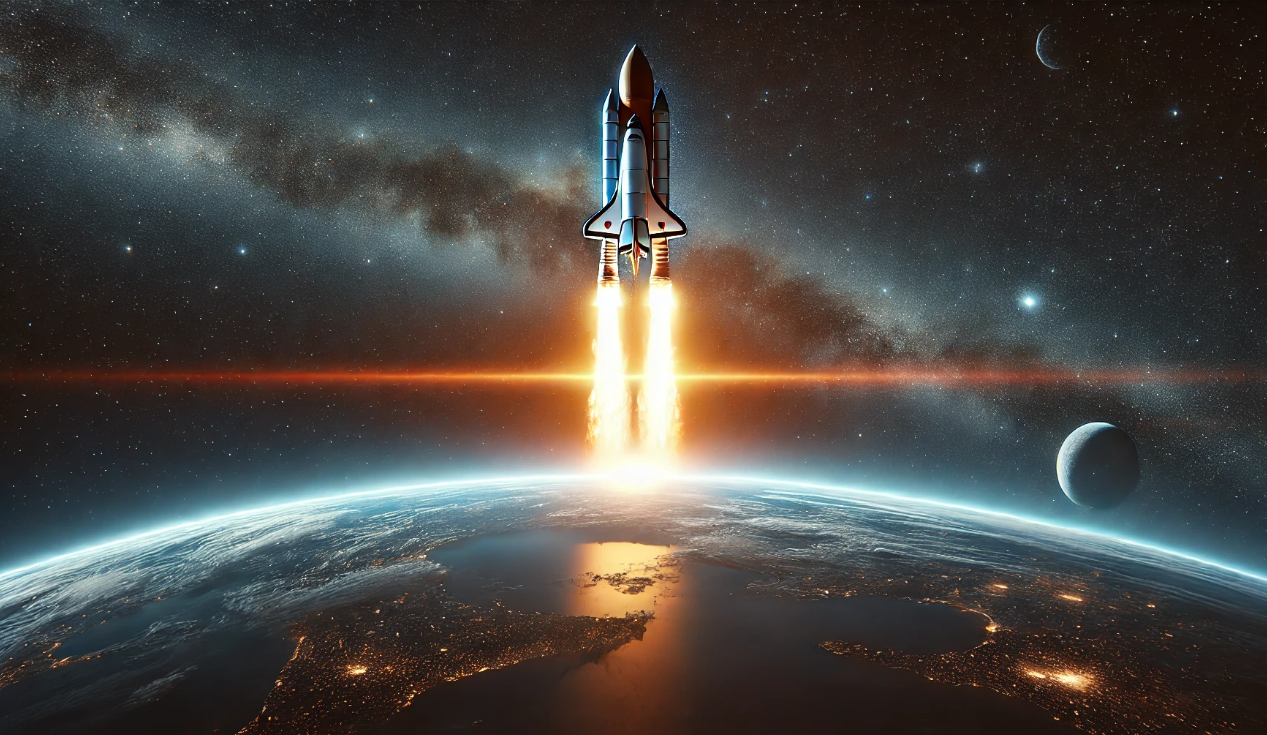


Scientists Explore One of the Greatest Questions of the Universe: Does Outer Space Have Defined Limits or Does It Extend Infinitely? Understand What We Know So Far.
Outer space has always sparked human curiosity, with its seemingly endless vastness and mysteries yet to be unraveled. One of the most intriguing questions is whether it has an end or continues indefinitely.
Well above you is the sky, known by scientists as the atmosphere. This layer of gases surrounds the Earth and extends for thousands of kilometers.
Most of the Earth’s atmosphere is concentrated within the first 32 kilometers of altitude, encompassing the layers of the troposphere and stratosphere, where air density is much greater.
-
Expedition 501: Scientists drill into the ocean floor and discover a giant reserve of fresh water hidden beneath the sea, extracting nearly 50,000 liters and revealing an invisible system that could reshape the map of water scarcity.

-
Archaeologists find an intact tomb over 2,500 years old, with more than 100 preserved objects, weapons, jewelry, and human remains never touched.

-
Volcanic lava transforms into threads as fine as human hair that travel over 30 kilometers by wind and fall like cutting rain on roofs and backyards in Hawaii and Iceland.
-
NASA issues a warning for the feared Godzilla El Niño that could change the planet’s climate in 2026 with extreme warming of the Pacific capable of causing devastating droughts in some regions and historic floods in others simultaneously.

However, the atmosphere extends well beyond that, reaching the exosphere, the outermost layer, which can reach about 10,000 kilometers in altitude.
In this region, particles are so sparse that the transition to interplanetary space becomes almost imperceptible.
It is in the exosphere that Earth’s gravitational influence still retains traces of particles, but their interaction is minimal, marking the threshold of deep space.
The great mystery begins exactly after this subtle boundary between atmosphere and space. What exists beyond what we know?
What Would You Find Traveling Through Space?
If you have ever wondered what it would be like to traverse outer space and move forward, what would be beyond? Scientists have some answers based on observations and studies, but the big question remains: Is space infinite or is there a limit to it?
Planets, Stars, and Galaxies: An Initial Tour
At the start of your journey, the landscapes would be familiar. Our planet is part of a system that orbits the Sun, a common star surrounded by planets, asteroids, and comets. The Sun, being closer, appears larger and brighter than other stars.

To reach the nearest star to the Sun, known as Proxima Centauri, you would need to travel 4.24 light-years, or approximately 40 trillion kilometers.
Even using the fastest spacecraft ever created, like the Parker Solar Probe, which reaches 700,000 km/h, it would take us more than 6,300 years to get there.
Expanding the view further, stars can be compared to houses, while galaxies function as cities filled with stars.
In our galaxy, the Milky Way, it is estimated that there are between 100 billion and 400 billion stars. Viewed from afar, it would appear as a luminous tangle, much like the lights of buildings seen from an airplane at night.
Recent discoveries have revolutionized our view of the cosmos. More than 5,000 exoplanets, or planets that orbit stars outside the Solar System, have already been confirmed.
Many of them are rocky, like Earth, and some are located in the “habitable zone,” where life as we know it could exist.
The Vastness of Galaxies and Dark Matter
Traveling to another galaxy would be even more impressive. The closest galaxy to the Milky Way, Andromeda, is 2.5 million light-years away. It would take millions of years to get there, even with the most advanced technology.
A significant portion of the universe we observe is composed of dark matter and dark energy, mysterious forces that together account for about 95% of the cosmos.
Dark matter does not emit light, but we know it is there because it gravitationally influences galaxies. Dark energy, on the other hand, is responsible for accelerating the expansion of the universe.
The James Webb Space Telescope has allowed us to observe galaxies formed shortly after the Big Bang, over 13 billion years ago. Meanwhile, the recently launched Euclid telescope is mapping the distribution of dark matter, helping to better understand how the universe formed.
If we could observe for millions of years, we would notice that the universe is expanding. This expansion is likened to a balloon being inflated: as it grows, the points on its surface move away from each other. In the case of the universe, it is the space between galaxies that increases.
Does the Universe Have an End?
As we move forward, the inevitable question arises: is the universe infinite? Or is there a point where it ends? Scientists do not yet have a definitive answer.
One hypothesis suggests that the universe is infinite, continuing in all directions, with galaxies extending endlessly.
Another theory is that the universe is curved, like the surface of a globe. In that case, traveling in a straight line for long enough would bring you back to your starting point, never encountering an “end.”
Data obtained from cosmic background radiation, the “echo” of the Big Bang, indicates that the universe is flat on a large scale. However, there is still room for the idea of a curved universe or even multiple universes coexisting.
In either case, it is unlikely that there exists a “barrier” or a point where space simply stops. The universe may be finite, but so vast that its extent surpasses any attempt at human understanding.
Exploring the Limits of Knowledge
Increasingly advanced technologies, such as space telescopes and interplanetary missions, are helping scientists unravel these mysteries.
Recent observations point to new questions, such as the composition of dark matter and the possibility that the laws of physics may differ in other parts of the cosmos.
Regardless of the answers, the universe continues to inspire us. Knowing whether it ends or continues forever will be one of the greatest scientific challenges of the coming generations. Until then, it remains a reminder of how small we are in the face of something so vast and mysterious.








Vejamos:
Teoricamente o universo teve seu começo a aproximadamente 15 bilhões de anos. Logo, se teve um começo em determinado ‘momento’ e, desde então, se encontra em constante evolução então, pela lógica, tem um limite; ainda que este seja desconhecido.
Desta forma, é razoável imaginar que,como tempo e espaço, existem dentro do universo, a sua expansão, acontece na própria eternidade.
Este entendimento nos forçará a ir além do material, além daquilo que se vê; nos forçará a ver um propósito em tudo o que existe.