





 Portuguese
  English
  Spanish
  6 min of reading
  0 comments


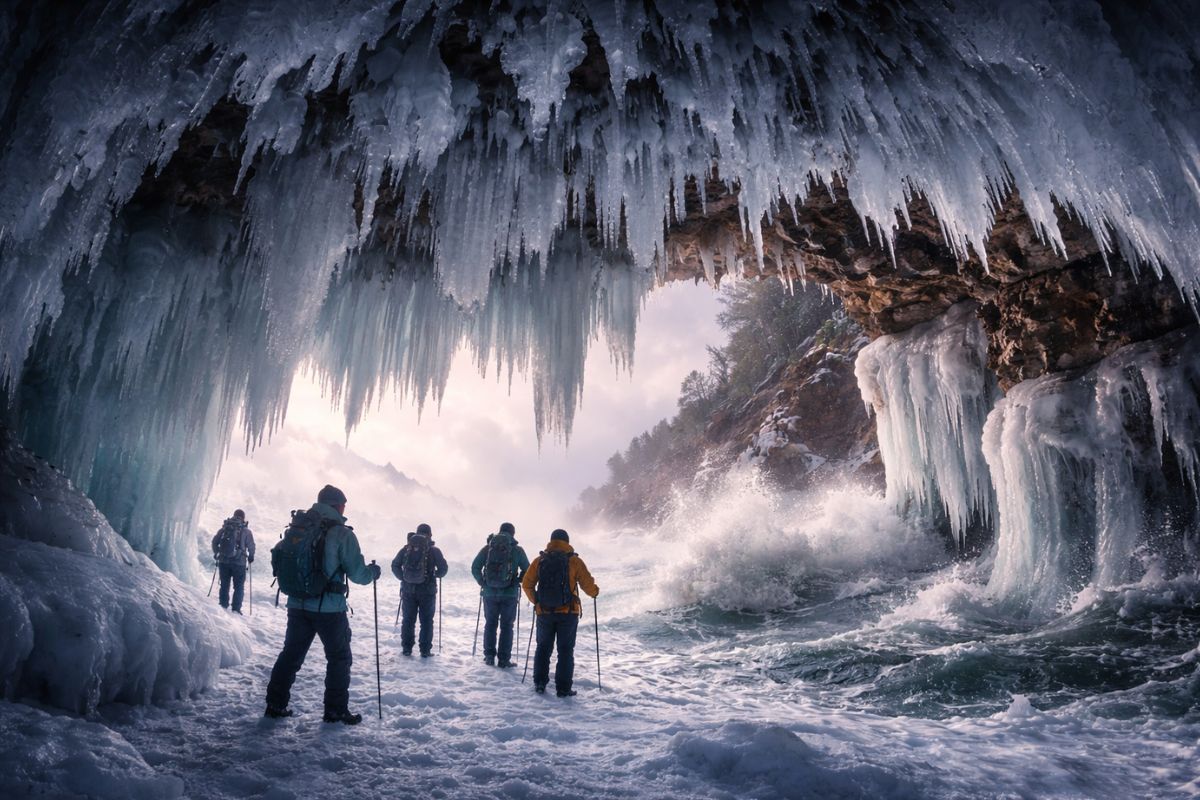
Announced by the National Park Service, the ice caves of the Apostle Islands will be opened to the public on the morning of February 16, 2026, requiring a walk of 3 to 10 km over Lake Superior. The rarest winter spectacle depends on cold and little wind and may close without notice.
The rarest winter spectacle will put people on Lake Superior in Wisconsin on the morning of February 16, 2026, when the ice caves of the Apostle Islands are opened to the public for the first time in over a decade for US$ 5 per person. The beauty, here, comes with a ticking clock: the route may start safe and disappear in a matter of hours.
Access requires walking 3 to 10 km over the frozen lake from the Meyers Beach parking lot, and this only works when the ice platform extends for miles to block open water waves. The National Park Service has not promised how many days it will keep the opening, and the community in northern Wisconsin already treats the rarest winter spectacle as a daily reassessed event.
Why February 16 Became the Critical Date in Wisconsin

The date did not arise from tradition but from physical conditions. The National Park Service announced on Saturday the intention to open the ice caves of the Apostle Islands on the morning of Monday, February 16, 2026, because the ice coverage on Lake Superior has grown quickly: from 39% to 53% in a week, according to the National Oceanic and Atmospheric Administration (NOAA).
-
With over 14 million baskets of earth moved, an ancient North American metropolis built a monumental pyramid of 30 meters and established a city with 20,000 inhabitants nearly a thousand years ago.
-
A 1,900-year-old treasure emerges from a Roman house destroyed by fire and sealed since antiquity in Romania, with coins and metals fused among the ashes.
-
The Brazilian colonial city that stopped in time and shares territory with a rocket launch base.
-
79-year-old woman challenges limits, visits 193 countries in the world after 56 years of planning and reveals the behind-the-scenes of a global journey that few have managed to accomplish.

This jump is what creates the protective shelf needed to walk relatively safely.
The problem is that the same system that allows visitation is also fragile. Wind and waves can break the ice within hours, and that is why no one offers a guarantee on the calendar.
The rarest winter spectacle depends on extreme and sustained cold, as well as little wind, and any change in that equation turns a planned outing into a closed route in Wisconsin.
The Crossing to the Ice Caves of the Apostle Islands Requires More Than Courage

The walk of 3 to 10 km over Lake Superior is not a detail; it is the heart of the risk. To reach the ice caves, visitors need to traverse the frozen surface, exposed to temperature variations, gusts, and areas with irregular ice.
The scenery may seem solid, but the lake remains a lake, and the margin between firm and dangerous can be narrow.
The National Park Service explains that safety depends on the ice platform extending for miles from the shore, forming a barrier against open water waves.
If that barrier breaks, the waves will start working the surface and can open fissures quickly.
This is where the rarest winter spectacle demands its price: the same route that supports thousands of steps in the morning may become impractical by the end of the day on Lake Superior.
A Rarest Winter Spectacle with a History of Openings Counted on Fingers
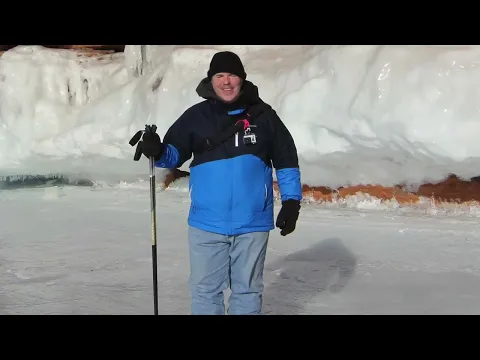

Since the turn of the century, the ice caves of the Apostle Islands have only been opened to the public in 2004, 2008, 2009, 2014, and 2015, totaling 210 days.
This helps explain why the opening on February 16, 2026 is already being treated as a milestone. It is not every winter; it is when Lake Superior agrees to stay calm and frozen long enough.
Visitation numbers show the strength of curiosity and the weight of logistics.
In 2014, the ice caves were open for two months and received 138,000 people, a record partly linked to the boost from social media, according to Mary Motiff, tourism director of Bayfield County in Wisconsin.
In 2015, the window was nine days, yet over 38,000 people still made the crossing. In other words: even when it lasts a short time, the rarest winter spectacle attracts crowds in the Apostle Islands.
Climate, Warming, and the Math That Makes Lake Superior Unpredictable
The rarity is not just geographical; it is climatic. Lake Superior is described by the National Park Service as the second fastest warming lake on the planet, with water temperatures rising twice as fast as air temperatures.
Between 1973 and 2010, average ice coverage would have dropped by almost 80%. When ice becomes the exception, every opening becomes news, especially in Wisconsin.
Ice coverage rising from 39% to 53% in a week is both hope and a warning.
It is hope because it creates the chance for access to the ice caves; it is a warning because this gain may be temporary. Mary Motiff noted that the forecast indicates warming at the weekend, with the possibility of cold returning afterward.
The rarest winter spectacle, in this scenario, becomes a game of short windows, where the public calendar is always chasing the weather on Lake Superior.
Cornucopia, Meyers Beach, and the Gear That Tries to Prevent Access Collapse
The region does not rely solely on ice; it depends on organization to avoid gridlock. To handle the flow, shuttle buses will be leaving from the town of Cornucopia, just west of the ice caves, approximately every 30 minutes, departing from two parking lots: Cornucopia Beach and city hall. The idea is to reduce pressure on Meyers Beach and decrease last-minute chaos in northern Wisconsin.
The management of transportation itself is already provisional. Mary Motiff described the operation as a major endeavor that requires daily checks of conditions to keep the service running.
This shows how the rarest winter spectacle is not just a landscape; it is a decision chain that mixes public safety, tourism, meteorology, and minimal infrastructure, because the ice caves of the Apostle Islands can open and close without notice.
The Invisible Side of the Rarest Winter Spectacle: Risk, Economy, and Real-Time Decision Making
When the ice caves open, there is an immediate effect on the local economy, described as a boost for an area that typically has a weak winter in tourism. A nonprofit group dedicated to protecting the Apostle Islands National Lakeshore has already pointed out that past openings served as bonuses in low months.
However, the same bonus comes with operational stress, because the volume of people grows faster than the capacity of roads and parking in Wisconsin.
And there is the physical risk that does not appear well in the picture. Jeff Rennicke, executive director of the Friends of the Apostle Islands National Lakeshore, recalls decades when he pulled his children in sleds over the ice and had lunch viewing icicles on the sandstone cliffs, a ritual repeated in the 1990s.
Today, he states that conditions need to align perfectly to support thousands of people. The rarest winter spectacle, therefore, is not just seeing ice; it depends on ice that can withstand the crowd and the weather turning in a matter of hours.
The opening of the ice caves of the Apostle Islands on February 16, 2026, puts Wisconsin in front of a simple and hard dilemma: enjoying the rarest winter spectacle without pretending it is stable.
Lake Superior may offer a safe route today and deny it tomorrow because wind and waves have the power to dismantle the crossing in hours, and no one promises how many days the access will exist.
For those leaving the Twin Cities on a trip of about four hours, or from Duluth in about 90 minutes, what weighs more in the decision: the risk of the route closing suddenly, the cost of US$ 5, or the unique chance to see the rarest winter spectacle on Lake Superior? And, in your experience, do social media help inform about safety or just push more people onto the ice?








Seja o primeiro a reagir!