





 Portuguese
  English
  Spanish
  3 min of reading
  0 comments



Willis Carrier Invented Air Conditioning to Solve an Industrial Problem and Ended Up Transforming Cities, Industries, and Human Comfort Around the World.
At the beginning of the 20th century, heat and humidity were not just uncomfortable — they limited industrial production, made certain processes unfeasible, and shaped where people could live and work. It was in this context that Willis Haviland Carrier, a young American engineer, created a technical solution to a specific problem and ended up fundamentally changing humanity’s relationship with the climate.
Air conditioning was not invented for home comfort. It emerged as an industrial tool, and its invention paved the way for denser cities, more precise factories, and a standard of living that today seems basic, but was previously impossible.
The Problem That Gave Rise to Modern Air Conditioning
In 1902, Willis Carrier was called to solve a problem at a printing company in Brooklyn, New York. The variation in air humidity caused the paper to expand and contract, misaligning the colors of the prints and causing constant losses. It was no use adjusting the machines: the problem was in the air.
-
Long before we imagined: the first humans were already doing heavy mining in South Africa over 200,000 years ago!
-
Few people know, but the most used pencil in the world is manufactured using extreme heat, the extraction of graphite from deposits millions of years old, a mixture of clay and water, followed by extrusion under nearly 10 tons of pressure and drying in an oven at 120 degrees.

-
European country ‘darling of Brazilians’ will need 1.3 million workers by 2030 to avoid collapse, and immigration has become the only way to save the economy.

-
The government allows the new ID to be requested on a mobile phone and delivered at home.

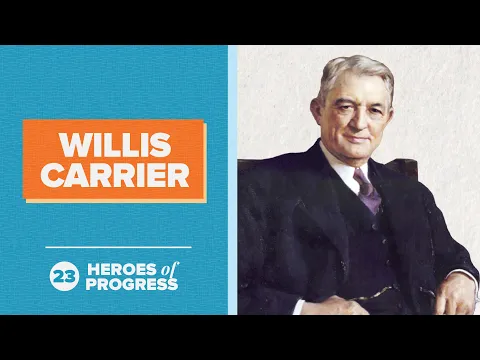

Carrier understood that cooling the environment alone was not enough. It was necessary to control humidity precisely. From this technical necessity, he developed a system capable of continuously and predictably regulating temperature and humidity — something unprecedented at that time.
The Invention That Controlled Air for the First Time
The solution created by Carrier used cold coils to condense the moisture in the air and stabilize the environment. In 1906, he filed a patent for a system that, in practice, gave rise to the modern air conditioning.
More than just cooling, the system allowed for the creation of controlled environments, which was revolutionary for industries such as printing, textiles, pharmaceuticals, and food. For the first time, the climate ceased to be an uncontrollable factor within factories.
From Industry to the Daily Life of Cities
For years, air conditioning remained limited to industrial uses. Only later did it begin to be installed in theaters, offices, and large buildings. When this happened, the effects were immediate.
Hot cities began to grow vertically. Offices could operate year-round with consistent productivity. Areas previously avoided due to the climate began to turn into major urban centers.

Without air conditioning, metropolises like Miami, Dubai, Las Vegas, or extremely dense tropical cities would hardly have developed in the way we know today.
The Invisible Impact on Architecture and Urban Planning
The invention of Willis Carrier also changed the way buildings were constructed. Buildings began to have glass facades, enclosed environments, and less natural ventilation, something unfeasible before artificial climate control.
Air conditioning allowed for:
- greater urban density,
- taller buildings,
- standardized indoor environments,
- expansion of financial centers in hot regions,
- continuous operation of hospitals and data centers.
A significant portion of modern architecture directly depends on this technology.
Human Comfort and Transformation of Work
In addition to its urban and industrial impact, air conditioning redefined human comfort. It reduced thermal stress, increased productivity at work, and allowed for safer conditions in hospitals, laboratories, and surgical centers.
Climate-controlled environments also expanded access to heat-sensitive technologies like computers, servers, and electronic equipment, which simply would not function stably without thermal control.
The Legacy of Willis Carrier
Willis Carrier did not just invent a machine. He created a new industry and altered the course of human development. His company, Carrier Corporation, became a global reference in climate control, and his work is considered one of the most influential of the 20th century.
Today, billions of people live, work, and sleep in climate-controlled environments without realizing that this is only possible thanks to a solution created to save a printing company over 120 years ago.
Willis Carrier taught the world to cool when heat still set physical limits on modern life. By controlling air, he gave humanity the capability to challenge the climate, expand cities, accelerate industry, and redefine human comfort. Few inventions have had such a profound, silent, and lasting impact as air conditioning.








-

-

3 pessoas reagiram a isso.