





 Portuguese
  English
  Spanish
  6 min of reading
  1 comment


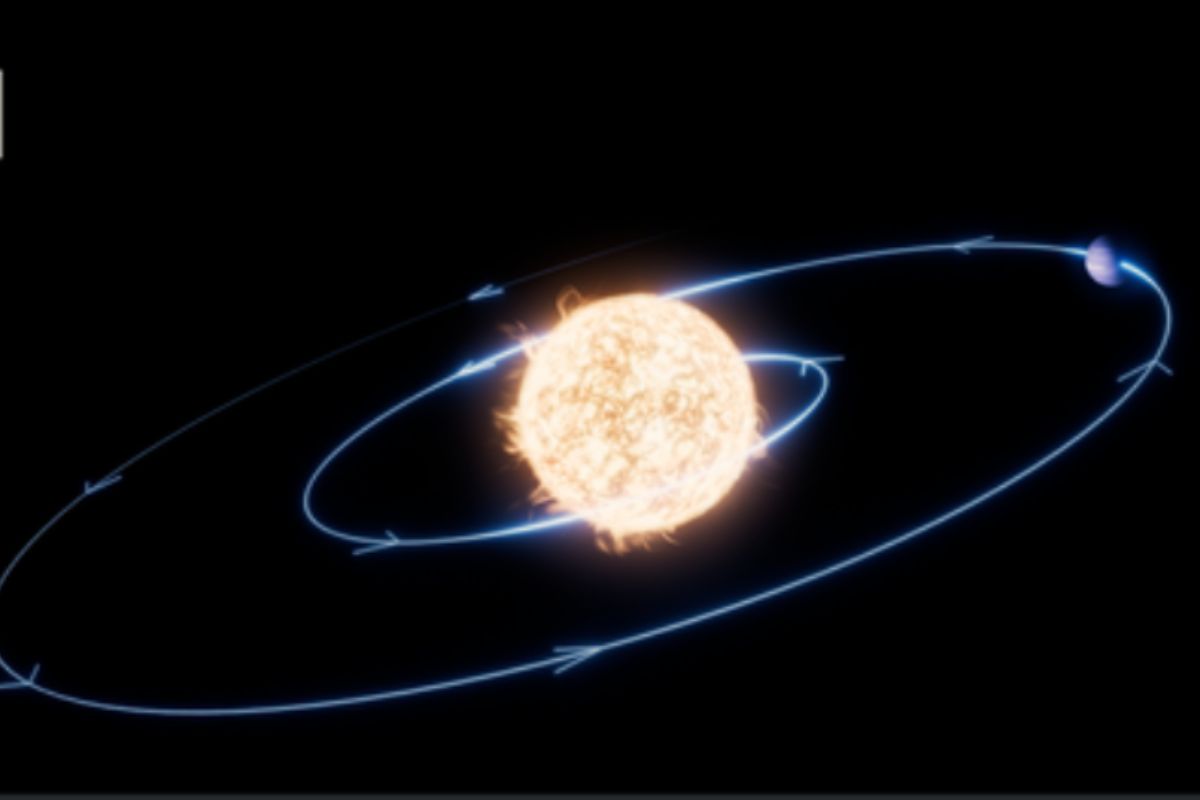


In The Event Observed About Twelve Thousand Light-Years Away, The Planet Does Not Seem To Have Been Swallowed By A Red Giant Star At Once, But Dragged Little By Little By A Collapsing Orbit Leaving Cold Dust, Hot Disk, And An Entire Astronomical Narrative Completely Rewritten By The James Webb Space Telescope.
The planet observed by the James Webb Space Telescope has become the center of a rare cosmic autopsy because a case that seemed settled changed form when infrared data showed that the star did not swell enough to swallow it. The final destruction happened, but the script was wrong.
Instead of a rapid engulfment caused by the star’s expansion, signals now point to a slower and more disturbing scenario. This world, approximately the size of Jupiter and orbiting tighter than Mercury around the Sun, would have lost distance over millions of years until it touched the stellar atmosphere and plunged into an irreversible process of falling.
The First Reading Seemed Simple And Ended Up Dismantled

The flash linked to the ZTF SLRN-2020 event was first detected in visible light by the Zwicky Transient Facility at the Palomar Observatory of Caltech in San Diego.
-
Something is happening around the Earth: Inside the huge explosion of fireballs in 2026

-
A hot air bubble coming from Argentina expands over Brazil, causing thermometers to exceed 38 degrees with a thermal sensation of 40 degrees in late March, affecting 6 states at once.

-
The radish leaf that almost everyone throws away has more polyphenols, flavonoids, and fiber than the consumed root, and a 2025 study showed that the leaf contains compounds that protect the intestine, combat inflammation, and may inhibit the growth of cancer cells.

-
A planet that seemed to defy the laws of physics has intrigued scientists for decades, until the James Webb revealed what is really affecting Saturn’s rotation.
Later, NEOWISE data showed that the star had already shone in infrared a year earlier, a sign that there was dust in the scene before the visible flash.
The initial interpretation, published in 2023, followed a logical path: the star, similar to the Sun, would be aging to become a red giant over hundreds of thousands of years and, in this process, would have swallowed the planet.
This hypothesis seemed coherent, but the James Webb dismantled the centerpiece of the narrative. With the MIRI instrument, researchers were able to measure the star’s emission and its neighborhood more accurately even in a crowded spatial region.
The result was decisive: the star was not bright enough to have expanded like a red giant to the degree necessary to capture the surrounding world. The engulfment happened, but not by the mechanism that seemed most intuitive at the beginning.
The Planet Fell Slowly Until It Touched The Star’s Atmosphere
The reconstruction proposed by the team suggests that the planet was approximately the size of Jupiter, but orbited very close to the star, even closer than Mercury orbits the Sun.
Over millions of years, this orbit would have gradually shrunk, pushing the world into an increasingly dangerous proximity.
It was not a sudden death caused by a suddenly inflated star, but a slow and fatal approach.
When this body began to graze the stellar atmosphere, the situation got out of control. According to the team, that was when an uncontrolled fall began, increasingly rapid, until the final plunge.
During this process, the planet began to spread around the star and expelled gas from the outer layers of the star.
Then, as this material expanded and cooled, the heavy elements present in the gas condensed and formed cold dust over the following year.
The final scene was violent, but the path to it was too slow to fit the previous hypothesis.
The Remnants Of The Dive Revealed More Than Cold Dust
Researchers already expected to find a growing cloud of cold dust around the star, and this cloud does indeed appear in the new reading.
But NIRSpec, the other instrument used in the investigation, showed something beyond what was expected: a hot circumstellar disk of molecular gas closer to the star.
This detail altered the picture of what remained after the destruction of the planet, because it indicated the presence of hot material organized in a more inner region.
The high spectral resolution of Webb allowed the detection of specific molecules in this accretion disk, including carbon monoxide.
What emerged, therefore, was not just the image of a missing body, but of a system with hot and cold remnants coexisting on different scales.
The surprise lies not only in the end of the planet but in the type of vestige that this end left behind.
Colette Salyk, one of the researchers involved, noted that the result has characteristics reminiscent of a region of planet formation, although no planet is currently being born there.
MIRI And NIRSpec Transformed The Case Into A Starting Point
Two instruments were essential for this turnaround. MIRI helped to narrow down the mechanism of destruction by showing that the star had not become the red giant expected.
NIRSpec allowed inspection of the remaining material with sufficient resolution to identify the composition of the gaseous disk.
It was a two-pronged investigation, one aimed at correcting the cause of the event and the other focused on the remnants left by it.
This explains why the team treats the case as a starting point rather than a closed enigma.
Ryan Lau, the lead author of the new paper, emphasized that this is the only event of its kind observed in action so far and also the best detection ever made of the consequences after everything seems to have calmed down.
Instead of closing the story, Webb opened a new phase of study on how planetary systems end when the relationship between the star and the planet irreversibly breaks.
What This Planetary Death Teaches About The Future Of Stellar Systems
The observed star is located in the Milky Way, about twelve thousand light-years from Earth, and the case is of interest far beyond curiosity about a distant disaster.
By showing that a planet‘s orbit can shrink to cause a final plunge, Webb provides a concrete clue about extreme outcomes for planetary systems.
The scientific importance of the case lies in transforming a rare episode into an observable model, even though the sample is minimal for now.
The observations were conducted under the Guaranteed Time Observation program 1240, designed to investigate sudden and mysterious infrared brightness events.
The team hopes to expand this set of cases in the future with the Vera C. Rubin Observatory and the Nancy Grace Roman Space Telescope, both equipped to monitor large areas of the sky repeatedly and track changes over time.
The conclusions were published on April 10, 2025, in The Astrophysical Journal.
The more similar events emerge, the less this planetary death will seem like an isolated exception, and the more it may help explain the final fate of other worlds.
The James Webb not only observed the destruction of a planet. It rewrote the logic of that destruction.
What seemed to be a rapid engulfment by a star swelling too much now makes more sense as a prolonged fall, with shrinking orbit, contact with the stellar atmosphere, gas expulsion, cold dust formation, and the survival of a hot disk of molecular material.
The scene became more complex, more physical, and much more interesting than the initial version.
If a planet can spend millions of years in a silent fall before the final plunge, what impresses you more about this case: the violence of the end or the almost invisible slowness of the process that led to it? And when such a discovery changes the entire narrative of a rare event, do you see it as a natural correction of science or as proof that we still understand very little about how worlds end?







Isso vai acontecer com nossa terra,vai ser o Apocalipse.