





 Portuguese
  English
  Spanish
  5 min of reading
  0 comments


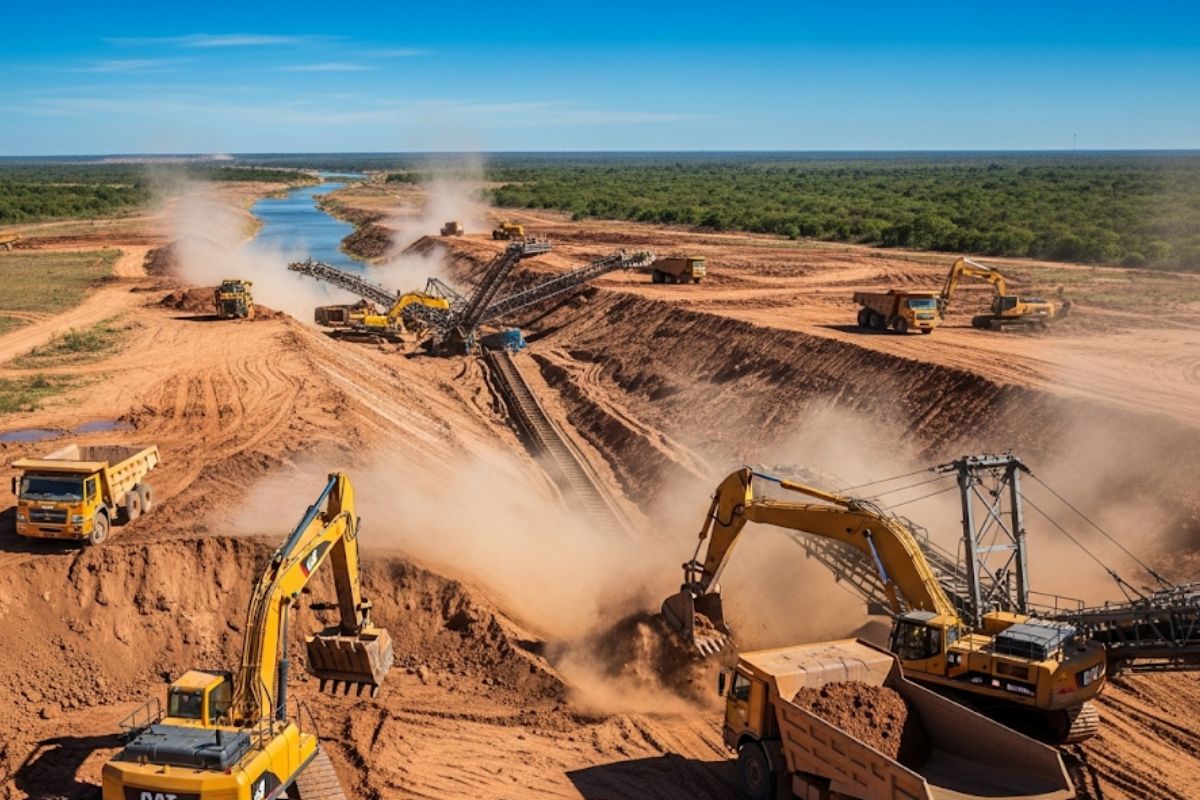
The South-North Water Transfer Project Aims to Carry 44.8 Billion Cubic Meters of Water Annually from the Rainy Rivers of the South to Its Arid North. Learn in Detail About This Which Is Considered the Largest Water Diversion Project Ever Undertaken in History and the Debates Surrounding It.
China faces a monumental water challenge: a critical disparity between the water-abundant south and the arid, densely populated north. To address this vital issue, the country embarked on the South-North Water Transfer Project (SNWDP), recognized as the largest water diversion project in history.
Conceived in the mid-20th century with a planned completion for 2050, this megaproject involves the construction of three massive routes to convey vast amounts of water. This article analyzes the complex engineering, the socioeconomic and environmental impacts, expert opinions, and the intense debates surrounding this truly monumental engineering feat.
China’s Fight Against Water Scarcity in the North
The idea for the South-North Water Transfer Project dates back to 1952. At that time, the then-Chinese leader Mao Zedong, during a visit to the Yellow River, observed the water disparity in the country and expressed the need for the north to “borrow a little” water from the south. The main justification for this colossal initiative is the severe water scarcity affecting Northern China. This region, which includes megacities like Beijing and Tianjin, is a crucial hub for the country’s agriculture and industry.
-
Inside an active volcano in Africa, residents use volcanic rocks to build houses in an impressive setting.
-
After 14 years of waiting, a rammed earth mansion built in 1702 in the North Zone of São Paulo will become a park with leisure facilities and green areas, with a million-dollar investment.
-
With 2 unfinished nuclear reactors, up to 25 billion in costs, and proven fraud, the Nukegate case has left 800,000 consumers still paying today for energy that will never be produced.
-
The household appliance that consumes the most energy in Brazilian homes is not the air conditioner; it is located in the smallest room of the house, is used daily, and can account for up to 25% of the electricity bill, while an alternative in the same outlet can reduce this cost by up to 75%.


Scientists warned that the over-exploitation of underground water resources in the north, which sustains a population of approximately 200 million people, could lead to the depletion of aquifers in a few decades, resulting in serious problems such as land subsidence, especially in Beijing. After nearly half a century of meticulous planning and studies, the project was officially launched in December 2002, aimed at optimizing water resource allocation and supporting sustainable socioeconomic development.
The Three Major Routes: A New Hydrological Map for China
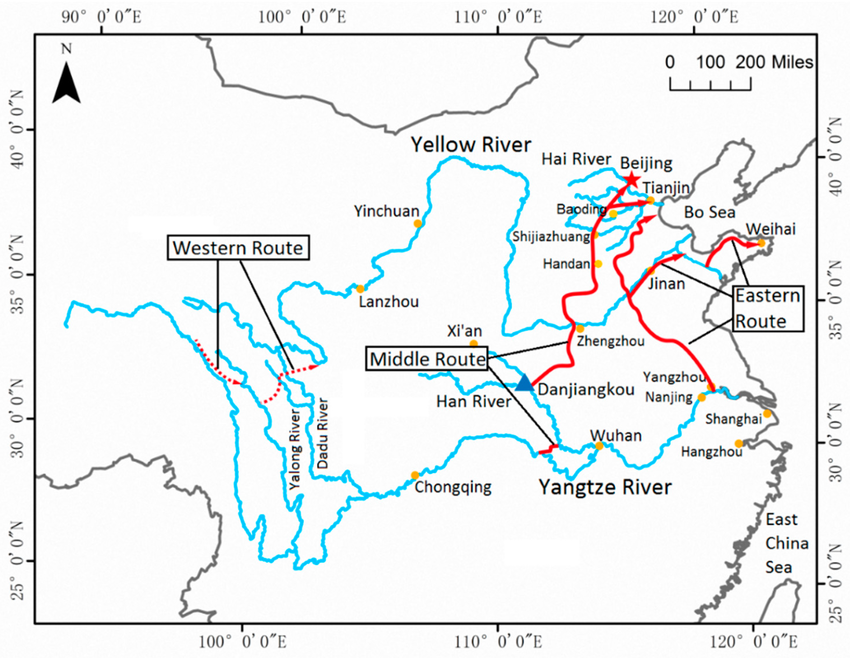
The SNWDP consists of three extensive diversion routes that interconnect the four major rivers of China – the Yangtze, Yellow, Huaihe, and Haihe – forming a new and complex national hydrological network.
The Eastern Route (ERP) draws water from the lower reaches of the Yangtze River in Jiangsu province and largely utilizes the historic Grand Canal Beijing-Hangzhou, in addition to a system of 34 major pumping stations to elevate the water. Phase I of this route has been operational since November 2013 and has an annual capacity of 8.8 billion cubic meters (BCM).
The Central Route (MRP) diverts water from the Danjiangkou Reservoir, located on the Han River (a major tributary of the Yangtze River), which had its dam significantly raised to allow for gravity flow. From this point, the water travels through a newly excavated canal and an impressive tunnel under the Yellow River, supplying Beijing, Tianjin, and other cities since December 2014. By the end of 2024, the Eastern and Central Routes together had diverted over 76.7 BCM of water, directly benefiting 185 million people in 45 major cities.
The Western Route (WRP) is the most ambitious, complex, and controversial, still in the planning stage. It proposes diverting water from the upper reaches of the Yangtze River in the Qinghai-Tibet Plateau to the Yellow River, facing extreme high-altitude challenges (3,000 to 5,000 meters), complex geology, and seismicity. Its completion is projected for around 2050.
The Technology Behind the Largest Water Diversion Project
The SNWDP is a testament to the capabilities of Chinese engineering in overcoming complex challenges. Among its notable feats are raising the concrete dam of the Danjiangkou Reservoir without interrupting its normal operation, constructing large-diameter tunnels using shield technology to cross the Yellow River, and designing and building massive prestressed concrete aqueducts, such as the Shahe Aqueduct, regarded as one of the largest in the world by its parameters, according to technical project information.
Innovations in channel lining materials for leakage control have been developed and applied, specialized Tunnel Boring Machines (TBMs) for hard rock and deep conditions (as in the Yinjiangbuhan project, which complements the Central Route, using CREG TBMs with smart systems), and the construction of large-scale pumping stations on the Eastern Route. Additionally, the largest water diversion project in the world features robust systems for monitoring and protecting water quality, utilizing technologies such as satellites, drones, 5G-enabled smart sensors, and advanced algorithms for operational control of water flows.
Impacts of a Colossus
The SNWDP, due to its scale, carries profound consequences. In the receiving regions of Northern China, the benefits are visible: relief from water scarcity, recovery of underground aquifer levels (combating land subsidence), improvement in drinking water quality for millions of people, and support for agricultural and industrial development. Ecosystems such as Lake Baiyangdian in Hebei province have been revitalized with the influx of water.
However, the social costs are high. The resettlement of hundreds of thousands of people, especially for the construction of the Central Route (the expansion of the Danjiangkou Reservoir displaced about 330,000 people), has led to reports of inadequate compensation and challenges in socioeconomic reintegration for those affected. The donor regions in the south also face development restrictions to protect water quality and suffer from reduced flows in the Yangtze and Han rivers. Environmentally, there are risks of pollution along the routes and potential impacts on biodiversity, such as the introduction of invasive species (like the golden mussel). The project’s financial costs are also astronomical, with estimates exceeding $79 billion.
Expert Opinion: The Debate on Sustainability and Challenges of the SNWDP
The South-North Water Transfer Project is the subject of intense debate among experts. Scientists and planners have recognized the severity of the water crisis in Northern China, which has driven the search for a large-scale solution like the SNWDP, with warnings that the region’s aquifers could run dry in a few decades if nothing is done.
However, many critics and environmentalists point to the high socioeconomic and environmental costs and the long-term impacts of the project. There are questions about whether alternatives such as large-scale desalination, massive water recycling, and more aggressive conservation and water efficiency programs were sufficiently explored or prioritized before opting for such a vast intervention in the country’s hydrology. A notable warning, attributed to a Chinese ministry official, suggested that the water diversion project, while solving some problems, could create new ecological challenges. The debate over financial sustainability, equity in the distribution of costs and benefits among regions, and the ability of the massive system to adapt to climate change remains heated.






-

Uma pessoa reagiu a isso.