





 Portuguese
  English
  Spanish
  3 min of reading
  0 comments


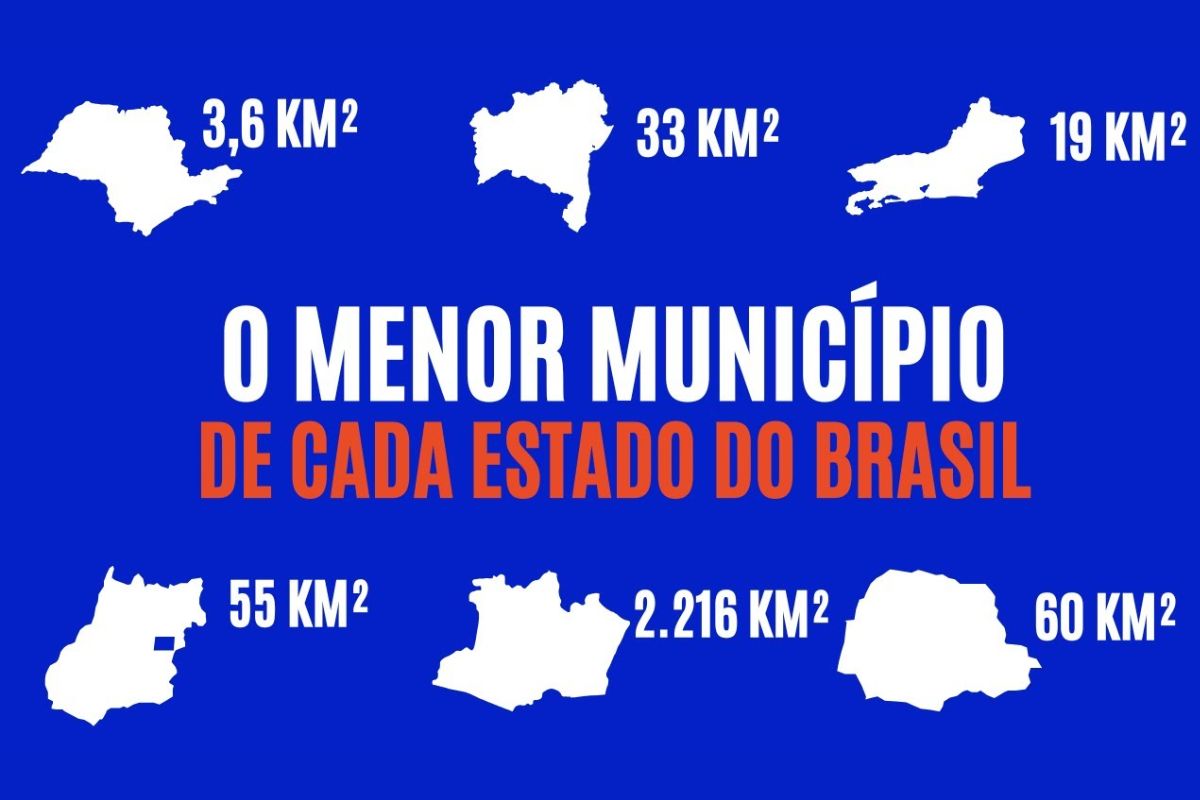
From Santa Cruz de Minas, with only 3.5 km², to Marituba, in Pará, with over 100 thousand inhabitants, the survey on the smallest municipality in each Brazilian state reveals impressive contrasts between territorial extent, population density, and the strength of metropolitan areas.
The smallest municipality in each Brazilian state reveals a geography of extremes: cities so small they could fit within urban neighborhoods, and others that, while tiny in area, support populations larger than entire capitals. The combination of territorial extent, urban occupation, and economic dynamics helps explain why Brazil, with over 5,500 municipalities, is a mosaic of demographic and administrative contrasts.
In states like Minas Gerais and São Paulo, territorial size is negligible, but urbanization and infrastructure elevate population density. In the North and the Midwest, even the “smallest” municipalities occupy areas equivalent to entire medium-sized cities, reflecting the impact of late colonization and the abundant availability of land.
Small Cities That House Giant Populations
Among the most curious cases is Marituba, in Pará, the smallest municipality in the North Region with only 103 km² but over 111 thousand inhabitants.
-
These living root bridges and ladders are over 700 years old and help indigenous people survive in one of the rainiest regions in the world.

-
From sertanejo star to international investor: Ana Castela invests millions in a mansion in the USA, creates a themed accommodation in Orlando, and shows that the “boiadeira” also wants to grow away from the stage.

-
The 10 most stunning motorhomes in the world: a $3 million trailer with a rooftop nightclub and garage for a Ferrari, “palaces on wheels” with Italian marble, private cinema, and five-star hotel luxury for billionaires.

-
Trump wanted to spend $400 million on the White House, but the courts prohibited the million-dollar construction.


The city is part of the Metropolitan Region of Belém and represents a typical example of conurbation — when one city grows to the point of merging with another.
A similar phenomenon occurs with Nilópolis (RJ) and Pinhais (PR), both small in area but with populations of 146 thousand and 127 thousand inhabitants, respectively.
These cities demonstrate that proximity to capitals and concentration of public services and industries make the limited territory an intensely occupied space.
They are economic and housing hubs that, despite their small size, exert regional influence.
Minimal Extents and Unique Stories
At the extreme opposite, there are municipalities that seem symbolic for their size but notable for their history.
Santa Cruz de Minas (MG) is officially the smallest municipality in Brazil, with only 3.5 km², followed by Águas de São Pedro (SP), with 3.6 km².
Both are urbanized, well-planned, and have high levels of human development.
On the other hand, Anhanguera (GO) and Santo Antônio dos Milagres (PI) are small in every aspect: area, population, and economy.
The case of Santo Antônio dos Milagres draws attention for having the lowest GDP in the country, with just over R$ 18 million annually.
This difference highlights how territorial size little explains the economic relevance of a municipality, which depends much more on logistical and productive factors.
Regional Differences and the Role of Metropolises
The smallest municipalities in the Northeast Region are concentrated in metropolitan areas, such as Madre de Deus (BA) and Raposa (MA), near Salvador and São Luís.
In the South, Esteio (RS) and Bombinhas (SC) maintain the pattern of compact cities, with high population density and tourist or industrial activity.
Meanwhile, in the North and Midwest, the scale changes completely.
The “smallest” municipality in Roraima, São Luís do Anauá, has 1,527 km² — nearly 500 times larger than Santa Cruz de Minas.
The difference shows how territorial distribution in the country follows distinct geographical and historical logics, marked by processes of occupation, agricultural frontiers, and indigenous presence.
When the Smallest Is, in Fact, Gigantic
Cases such as Epitaciolândia (AC) and Teixeirópolis (RO) reveal that even the “smallest” municipalities in the North region exceed one thousand square kilometers.
The contrast becomes even more evident when we remember that the largest municipality in Brazil, Altamira (PA), has more than 100 thousand km², an area larger than entire countries like Portugal or South Korea.
These differences make Brazil a rare case of administrative and territorial diversity, where a municipality’s physical extent may not reflect its economic or social complexity.
Small territories host great stories, and large areas hide cities almost invisible on the map.
The portrait of the smallest municipality in each Brazilian state shows a country of extreme contrasts, where geographic size does little to define a city’s relevance.
Among tourist islands, industrial regions, and almost rural municipalities, the Brazilian map is a mosaic of miniature realities.
Do you know any of these municipalities or live in one of the cities listed among the smallest in Brazil?








Seja o primeiro a reagir!