





 Portuguese
  English
  Spanish
  3 min of reading
  0 comments


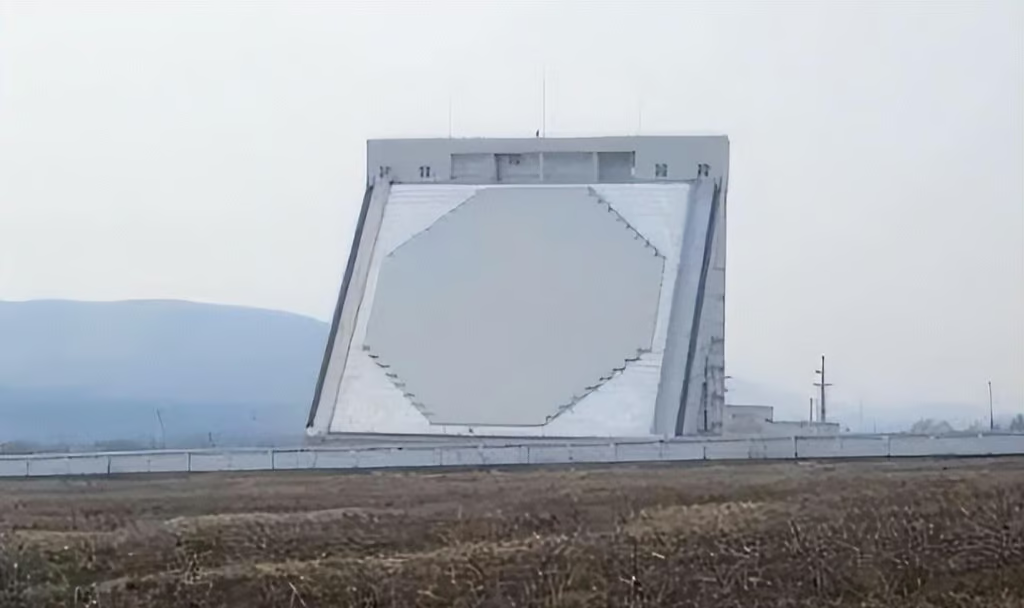
China Developed A Colossal Radar, Equivalent To A Six-Story Building, That Can Monitor Threats At Impressive Distances.
China has been heavily investing in military technology and strategic defense, and one of the most impressive recent innovations was the revelation of a gigantic long-range radar.
This system, with a structure of approximately six stories in height, promises to revolutionize the detection capability of threats thousands of kilometers away. But what makes this radar so special? And what are its geopolitical implications?
An Imposing And Highly Technological Structure
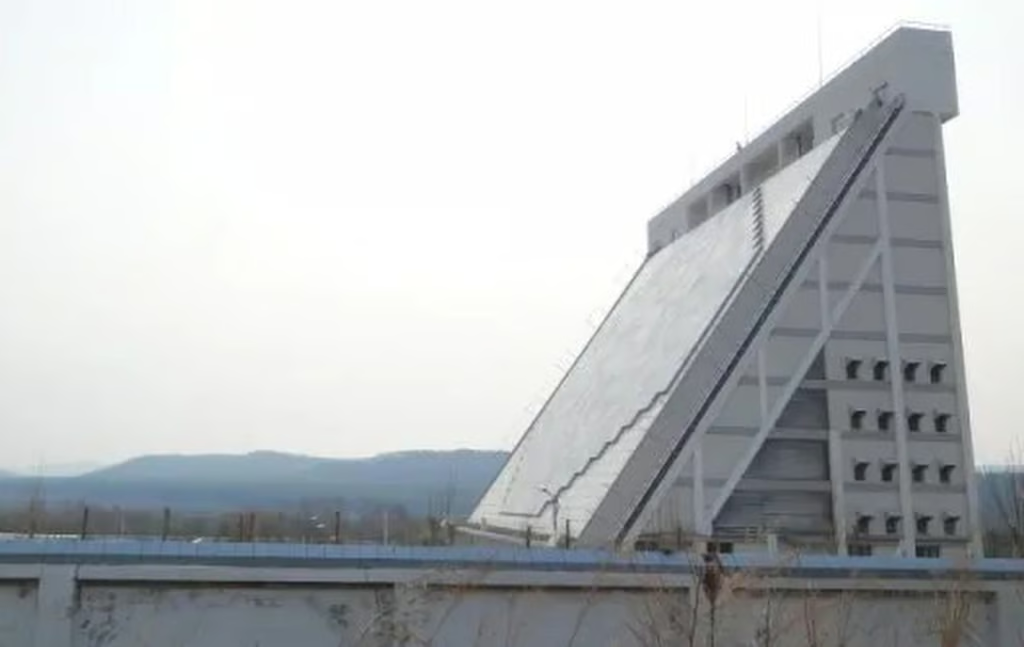
Images released by the Chinese state broadcaster CCTV show an impressive radar structure with dozens of antennas organized in an octagonal shape.
-
What the James Webb telescope found on the planet K2-18b is raising alarms in the scientific community: gases that on Earth only exist because of living organisms have been detected in the atmosphere of an oceanic world 124 light-years away from us.

-
Divers found a nearly intact 23-meter Greek ship on the bottom of the Black Sea, so well preserved that it seems to have been frozen in time for 2,400 years.
-
The blood of astronauts is undergoing mutations in space, coagulating too much when it shouldn’t and too little when it needs to: three recent discoveries reveal that our bodies were simply not made to live outside of Earth.

-
A startup sends robotic gloves for users to wear at home while washing dishes, folding clothes, and making coffee; every finger movement is recorded and sent back to train a domestic robot that has already learned 10 million real tasks without ever having entered a kitchen.

According to military analysts, this system is part of China’s early warning strategy against missile threats.
Song Zhongping, a former instructor of the People’s Liberation Army (PLA), told the South China Morning Post that this is a strategic and active phased-array radar capable of identifying missiles within a radius of thousands of kilometers.
Phased-array radars are highly advanced, as they offer superior scanning speeds and greater accuracy compared to traditional systems.
Instead of physically moving its structure, this type of radar uses a computer-controlled array to scan different directions electronically. This allows for a quicker response to emerging threats and significantly increases the country’s defensive capability.
The Role Of The Radar In China’s Defense Strategy
The presence of this radar in a Lunar New Year message sent by President Xi Jinping to the military highlights its importance within China’s national security strategy.
During the broadcast, representatives of the early warning forces declared their mission to rigorously monitor the battlefield to ensure immediate responses to any threat.
Additionally, Xi Jinping emphasized the need to maintain a constant state of readiness, even during festivities.
This radar system is part of a larger effort by China to develop a robust missile defense. The combination of this long-range radar with new defense systems, such as the HQ-19 – compared to the American THAAD (Terminal High-Altitude Area Defense) system – demonstrates a significant advancement in the country’s military development.
The HQ-19 is capable of intercepting targets at an altitude of up to 200 km, further enhancing the protection capacity against ballistic attacks.
A Threat To Adversaries?
The development of this radar and other Chinese military technologies has drawn the attention of experts and foreign governments.
The U.S. Department of Defense, for example, mentioned in its annual report on the Chinese military that Beijing has invested in large land-based radars similar to the American PAVE PAWS, a system designed to detect intercontinental ballistic missiles up to 5,000 km away.
This technological advancement represents a challenge for other military powers, as it significantly improves China’s ability to detect and respond to attacks before they materialize.
Additionally, the country is reportedly developing a “seabed radar” capable of detecting aircraft and submarines up to 1,000 meters deep.
If confirmed, this project could transform naval warfare dynamics, making enemy submarines more vulnerable to detection.
Geopolitical Implications And Future Advances
China’s military modernization strengthens its position as one of the leading global powers. Investment in advanced radars, missile defense, and aerospace monitoring demonstrates Beijing’s intent to solidify itself as a leader in the military technology race.
Furthermore, these innovations raise concerns in countries like the United States and its allies in the Indo-Pacific region.
As a result, experts believe this type of development could intensify the global arms race.
With increasingly sophisticated systems, major powers will be forced to invest even more in military technology to balance the strategic landscape.
Thus, the question remains: how far can Chinese military technology go? If the six-story radar already impresses with its range and sophistication, future advances could completely redefine the balance of power in the international arena.







-

Uma pessoa reagiu a isso.