





 Portuguese
  English
  Spanish
  7 min of reading
  0 comments


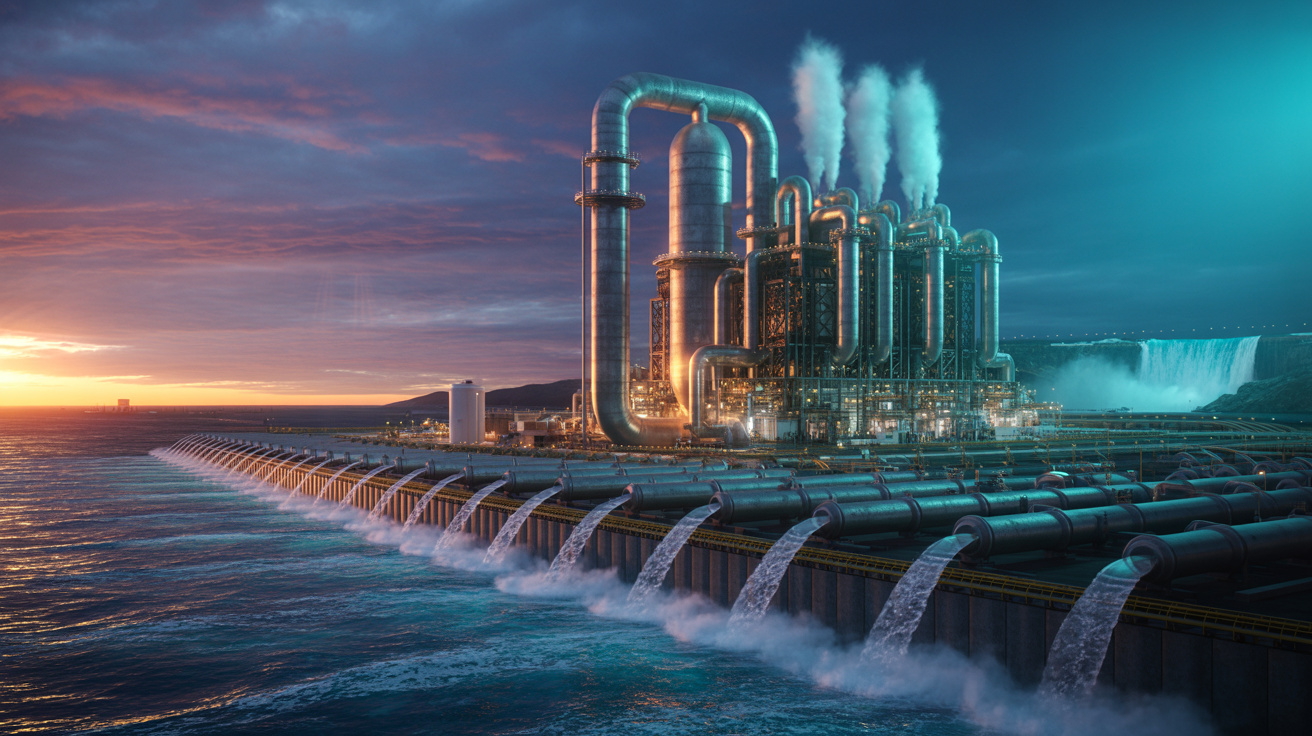
Almost 16 Thousand Desalination Plants Produce 95 Million m³ of Water Per Day in 177 Countries. Middle East Leads Global Capacity and Relies on Technology to Supply More Than 300 Million People.
Almost 16 thousand desalination plants operate in 177 countries, producing 95 million cubic meters of freshwater per day. This volume is equivalent to half the average flow of Niagara Falls and supplies more than 300 million people. For nations like the Bahamas, Maldives, Malta, Kuwait, Qatar, and Bahrain, desalination is not an alternative – it is the only source of drinking water that keeps entire populations alive. The Middle East accounts for 48% of global desalination capacity, with Saudi Arabia alone producing 15.5% of the world total. The country operates 25 large plants generating 5.25 million cubic meters per day, meeting 70% of national water needs. In the United Arab Emirates, the dependence reaches 95%, with 35 plants in operation that received investments of $40 billion in 2009.
Technology has become a matter of survival in arid regions with natural freshwater scarcity. Israel obtains 80% of its drinking water through desalination, while Kuwait and Oman depend on this source for 90% and 86%, respectively. These nations have turned seawater into a strategic resource as vital as oil, creating a massive infrastructure of pipelines that spans hundreds of kilometers through the desert.
Reverse Osmosis Dominated the Global Market and Drastically Reduced Costs
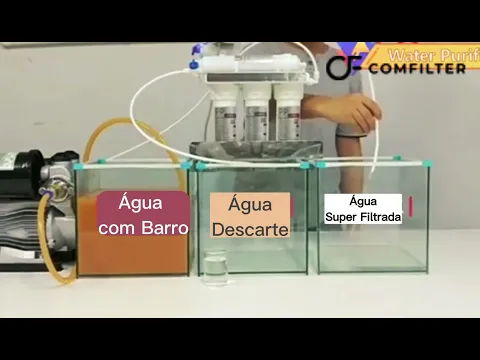
Reverse osmosis has captured 66% of global desalination capacity in the last twenty years. The process forces seawater through semi-permeable membranes under pressures exceeding 60 bar, retaining salts and impurities. The result is freshwater on one side and concentrated brine on the other, with energy efficiency far superior to traditional thermal methods.
-
In Mexico, a 3,000-year-old Maya site with the dimensions of an entire city may have been built as a colossal map of the cosmos, created to represent the order of the universe and reveal how this people organized space, time, and rituals.
-
Japan wants to build a solar ring of 10,900 kilometers on the Moon to continuously send energy to Earth.

-
Weighing almost 1 ton, with temperatures of up to 3,000°C, the ability to launch 10,000 fragments within a radius of 1 km, capable of penetrating concrete and melting steel, Turkey’s terrifying bomb emerges as one of the most destructive non-nuclear weapons ever presented.

-
After a submarine disappeared beneath the “Doomsday Glacier,” scientists announce a new monstrous machine capable of operating at 3,000 meters depth to return to the heart of the ice and investigate a threat that could raise sea levels worldwide.


The largest plants in the world utilize this technology on a massive scale. The Taweelah plant in Abu Dhabi, recently inaugurated, produces 909,200 cubic meters per day with a capacity of 200 million imperial gallons daily. The facility is equipped with 70-megawatt solar panels and represents the largest reverse osmosis plant in operation on the planet, three times larger than the Three Gorges in production volume.

Costs have fallen by 90% since 1970, making desalination economically viable. Israel has managed to reduce the cost to 58 cents per cubic meter at the Sorek plant, which processes 624,000 cubic meters daily. Modern plants integrated with industrial complexes or power plants make use of waste heat and existing infrastructure, further reducing the energy costs of the process.
China Entered Late but Rapidly Advanced with Its Own Technology
China inaugurated in December 2024 the country’s largest desalination project at the Tianjin Nangang Industrial Park. The plant processes 300 thousand tons of water per day in its initial phase, using domestically developed dual membrane technology. The system expanded the desalination capacity of a single membrane module to 30 thousand tons daily, representing the first application of this scale in the world.

The investment of 1.2 billion yuan brought complete nationalization of construction and total control over technology. The plant provides industrial water for large enterprises, including the ethylene production complex of 1.2 million tons annually from China Petroleum & Chemical Corporation. The production replaces up to 50 million tons of freshwater that would be extracted from already pressured land sources.
The Asian giant represents 7.5% of global desalination, concentrating plants in highly industrialized coastal areas. Chinese researchers observe changes in benthic fauna and changes in the chemical composition of marine sediments in areas near the submarine outfalls.
The rapid growth of the sector in China reflects the water urgency of a nation with 1.4 billion inhabitants and unprecedented industrial expansion.
Saudi Arabia Leads Global Production with 20% of Global Installed Capacity
Saudi Arabia currently operates 31 desalination plants distributed across 17 strategic points, employing more than 10 thousand people. The total capacity of 5.25 million cubic meters daily represents 25.9% of global desalination. The country has invested more than $24 billion in expansion and construction of new plants since 2009.
Riyadh, the Saudi capital, is located 400 kilometers from the coast and relies entirely on water transported through 3,722 kilometers of pipelines.
The city receives more than 65% of the production from the eastern coast, while Jeddah consumes over 50% of the production from the western coast. This large-scale water transport system represents one of the largest engineering works in the Middle East.

The first Saudi plant was inaugurated in 1907, marking the beginning of a long-term strategy without which the kingdom would not have prospered. New plants under construction include projects in Rabigh, Shuqaiq, Jubail, and Jazan, with individual volumes in the hundreds of thousands of cubic meters daily. The Saudi Water Partnership Company publishes detailed plans with lists of future deliveries and capacities.
Brine Generated Daily Exceeds Water Production by 50% and Creates Environmental Liability
For every liter of drinking water produced, the plants generate 1.5 liters of concentrated brine. This waste contains double the natural salinity of seawater, often exceeding 70 grams of salt per liter. Globally, 142 million cubic meters of brine are discarded every day, enough volume to cover the entire state of Florida in almost a meter of height per year.
Brine is not just salty water – it carries chemical residues from the industrial process including antifoams, membrane cleaning agents, chlorine, copper, and biocides.
When discharged into the sea, this denser solution sinks, forming a layer close to the bottom. This reduces oxygenation, alters local pH, and creates hostile environments for benthic organisms such as mollusks, crustaceans, and algae.
Four Middle Eastern countries concentrate 55% of global brine production. Saudi Arabia accounts for 22%, United Arab Emirates for 20.2%, Kuwait for 6.6%, and Qatar for 5.8%. Gulf plants, which mainly operate with thermal seawater technologies, produce four times more brine per cubic meter of clean water than American plants based on membrane processes.
The Persian Gulf Suffers Measurable Impacts from Increased Salinity and Dead Zones
The Persian Gulf is a relatively shallow body of water with slow renewal. The concentration of desalination plants in the region is so large that the cumulative impact of brine is already measurable. Regional studies point to a gradual increase in the average salinity of the Gulf, reduced dissolved oxygen, and thermal stress in coral reefs, mangroves, and fish communities.
In areas near submarine outfalls, local salinity can increase more than 10% compared to the natural level. Researchers have observed the formation of “dead zones” where very few marine animals can survive. The increase in salinity and temperature causes a decrease in dissolved oxygen content and contributes to degraded marine environments that affect the entire food chain.
The geography exacerbates the problem dramatically. Unlike open oceans where brine dilutes quickly, the Persian Gulf tends to accumulate waste.
Benthic organisms near discharge points experience osmotic stress caused by the excess salts in the external environment, affecting metabolism and growth. Small changes in salinity from 34 to 35 grams per liter represent significant modifications for most marine species.
Australia Invested in Renewable Energies but the Brine Problem Persists Even with Strict Regulations
Australia built large desalination plants after long periods of severe drought in the early 2000s. Cities like Perth, Melbourne, Sydney, and Adelaide secured water security even in years of minimal precipitation. The Perth plant accounts for a significant portion of the city’s supply and is frequently cited as a model for integration with renewable energies.
A significant part of the electricity used in Perth comes from wind sources. The Melbourne plant, the second largest reverse osmosis facility in the world with 450,000 cubic meters daily, operates alongside a wind farm built specifically to power it.

This integration has drastically reduced the carbon footprint of the process, which consumes from 3 to 10 kilowatt-hours per cubic meter produced.
Even with strict environmental regulations, the continuous discharge of hypersaline waste in sensitive coastal areas raises concerns. Long-term impacts on local marine ecosystems, especially in regions of high biodiversity, remain under observation. About 80% of the world’s brine is produced within 10 kilometers of the coast and is generally discharged untreated back into the marine environment.
Solutions Include Mineral Extraction but Technologies Are Not Yet Operating at Commercial Scale
Researchers and companies are testing pathways to reduce or repurpose brine. Among the approaches studied are the extraction of economically valuable minerals such as magnesium, lithium, and potassium, use in aquaculture of halotolerant species, and controlled crystallization for industrial salt production. The circular economy of brine exploring valuable minerals before disposal represents the most promising future.
Mitigation strategies include diluting brine with treated effluents or mixing it with seawater before discharge. Some plants have managed to extract salt for other purposes such as road deicing. Evaporation ponds can collect metals like uranium found in brine and safely dispose of them, but they require space in arid areas.
Technologies for more efficient brine dispersion improve dilution to reduce immediate harm caused by direct exposure. Zero-liquid discharge disposal systems are being developed but face prohibitive costs. The United Nations Environment Programme warns that cumulative impacts of brine are still underestimated, especially in regions where dozens of plants operate simultaneously.
The Problem Grows Faster Than Solutions Because Water Urgency Outweighs Environmental Concerns
Unlike oil spills or plastic pollution, the effects of brine are gradual, submersed, and difficult to observe with the naked eye. Many plants operate far from large urban centers, reducing the direct perception of the impact. This combination of extreme need and diffuse impacts creates a scenario where the problem grows faster than solutions.
For regions threatened by water scarcity, desalination is seen as an indispensable solution. Questioning its environmental effects often sounds politically like putting the supply of millions of people at risk.
Globally, 80% of wastewater ends up in seas, rivers, lakes, and swamps without proper treatment, including the toxic brine generated by desalination.
The urgency increases with climate projections. The UN warns of a possible deficit of 40% in global water supply by 2030, while the population is projected to reach 9.7 billion by 2050. Countries that rely heavily on desalination were already arid, but the initiative has become common among nations that previously relied solely on freshwater as a natural resource. The sector is advancing over 10% per year globally.







-

-

-

3 pessoas reagiram a isso.