





 Portuguese
  English
  Spanish
  6 min of reading
  0 comments


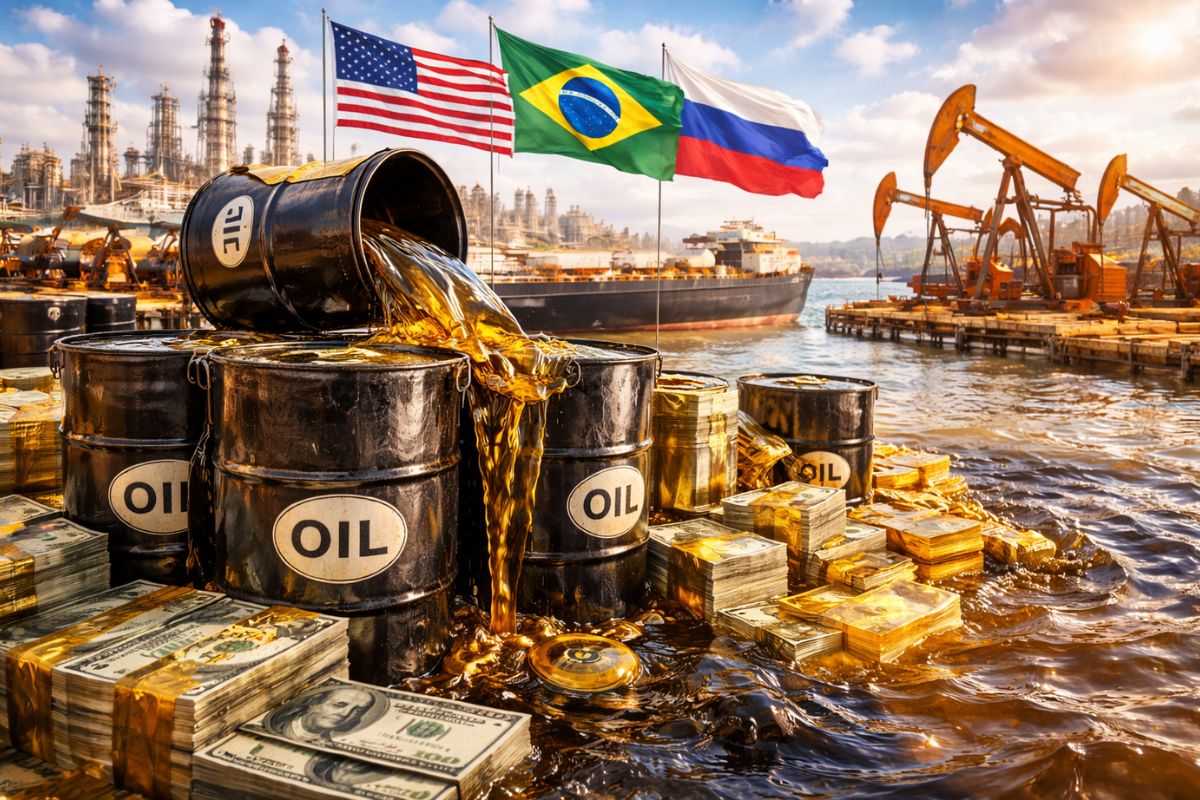
In The Midst of Middle East Shocks, Sanctions on Russia, Rising US Exports, and New Fields in Guyana and Brazil, the Planet Faces an Era of Cheap Oil, With Daily Barrel Surpluses, Pressure on OPEC+ and Budgets of Oil-Dependent Countries, and Greater Global Economic Uncertainty
In recent years, the energy market has been pushed into a scenario where cheap oil has ceased to be an exception during crises and has become the result of a structural combination of factors. Global supply has surged, the OPEC+ alliance has altered its strategy, the United States has transitioned from a major importer to a relevant exporter, and new producers like Guyana and Argentina have begun to add significant volumes to international flows. At the same time, sanctions, wars, and diplomatic disputes that historically produced scarcity and price spikes now coexist with a situation of excess barrels available.
For governments that rely on oil to balance their budgets and for consumers feeling the weight of fuel costs on inflation, this new phase is ambiguous. The same logic that has driven the value of a barrel down to around $70 after flirting with $140 in 2022 due to the impact of the war in Ukraine also threatens public budgets in OPEC countries that require prices well above $100 to maintain spending programs. The flood of supply transforms the classic “oil shock” into something different: there is no shortage, there is a surplus.
How The Surplus of Supply Became the New Rule of The Game
The first piece to understand the era of cheap oil is the supply side. The International Energy Agency estimates that global production will exceed demand by about 4 million barrels per day, equivalent to two supertankers arriving daily at sea with no immediate use.
-
Lula reveals a masterstroke by Petrobras to undo a deal made by Bolsonaro, which involves the return of an important refinery that currently produces less than half of what was expected and makes Brazil dependent on international diesel.

-
A study confirms that the natural gas sector will reduce greenhouse gas emissions in Brazil by 0.5% and accelerate the energy transition by 2026.

-
Petrobras implements a severe adjustment and confirms a 55% increase in the price of aviation kerosene with a proposal for installment payments for the companies.

-
The rise in oil prices could ensure an extra revenue of R$ 100 billion for the Federal Government, indicates a recent economic study.


This excess volume does not come from a single country, but from the sum of several movements.
The United States, which for decades imported up to 14 million barrels per day to cover its deficit, has started to export four to five million barrels per day thanks to the shale boom.
At the same time, countries like Brazil, Canada, and the small Guyana have significantly increased their production, while Argentina is developing its own “mini” shale frontier.
The result is simple and uncomfortable for those who depend on selling oil: there are too many barrels competing for buyers, at a rate faster than demand can absorb.
OPEC+ Abandons The Price Insurance Role and Enters The Market Fight
For decades, the automatic reading of the market was almost mechanical: a crisis in the Middle East meant an immediate spike in oil prices.
OPEC, led by Saudi Arabia, operated as a kind of “central bank” of oil, reducing production to sustain prices when necessary. In recent years, part of this logic has been broken.
The OPEC+ alliance, which includes Russia, has begun to open the taps in times of excess, in a strategy to regain market share even at the cost of sustaining cheap oil. This option is risky: countries like Saudi Arabia, Kazakhstan, Algeria, and Iran need much higher prices to balance their budgets.
However, in the face of competition from producers outside the cartel and pressure from new sources, the political reading has been that defending price at the cost of losing customers would be even worse in the medium term. Instead of cutting to protect prices, the bet is to endure lower revenues today to try to expel competitors tomorrow.
New Producers, Dark Fleet, and Geopolitics of Excess

The second piece is geopolitical. Sanctions on Russia, Iran, and Venezuela have created a parallel oil economy, shifted to the so-called “Global South,” outside traditional pricing centers.
Part of this oil travels on a “dark fleet” of old tankers, lacking conventional insurance, that shut down transponders, change flags, and sell shipments at a discount in markets willing to pay less and accept more risk.
China, for instance, has taken advantage of the situation to fill its strategic reserves, absorbing millions of barrels throughout 2025.
Even so, indicators of “oil in the water,” which count barrels in transit or in floating storage, have been increasing, signaling difficulties in draining all production, including from sanctioned countries.
When conflicts lessen in intensity or sanctions are adjusted, part of these barrels is likely to return to more transparent markets, further reinforcing the picture of abundance.
Who Benefits and Who Loses With Cheap Oil
In the short term, cheap oil relieves inflation and reduces transportation costs, impacting everything from airfares to ocean freight and the price of products made with derivatives like plastics and fertilizers.
In importing economies, this translates into less pressure on central banks, lower risks of aggressive interest rate hikes, and some room for less tight fiscal policies.
On the other hand, countries whose public revenue heavily depends on oil exports face a less visible but profound shock.
OPEC members who calculate their budgets based on prices above $100 per barrel see a gap opening between spending plans and actual revenue, forcing cuts, indebtedness, or accelerated use of reserves.
The longer the period of depressed prices lasts, the greater the risk of political and social instability in economies that have not diversified their productive base.
Volatility, Climate Risk, and Contradictions of Energy Transition
Even in a scenario of cheap oil, volatility remains high. In just a few years, the market saw the barrel fall to negative values during the pandemic, spike to nearly $140 after the invasion of Ukraine, and then retreat again to around $70, with annual declines of up to 18% in Brent at certain periods.
Events in the Strait of Hormuz, decisions by Washington regarding Iran or Venezuela, and internal changes in Russia continue to be capable of generating temporary spikes.
The central contradiction is that climate risks are intensifying at the same time that the system finds reasons to produce more.
Low prices tend to stimulate fossil fuel consumption and delay investments in non-polluting alternatives, especially in countries with less fiscal capacity to subsidize renewables.
Every dollar less at the pump can mean a few more years of dependence on a fuel that the climate can no longer “afford.”
What This New Era Signals For The Future Of The Energy Market
The combination of abundant supply, new producers, OPEC+ in market defense disputes, and geopolitics of excess suggests that the world may coexist for a prolonged period with cheap oil, alternating periods of stability with spikes of tension.
For companies in the sector, this means reassessing portfolios, reducing high-cost projects, and seeking efficiency in every barrel produced.
For governments, the message is harsher: betting that oil will once again solely support national budgets is becoming increasingly risky. The logic of abundance pressures for fiscal reforms, economic diversification, and the design of policies that consider both the price cycle and the need to reduce emissions.
The barrel remains central to the global economy, but it has ceased to be a guarantee of automatic income for those who depend on it.
Debate That Leaves The Stock Markets And Enters Everyday Life
Ultimately, the era of cheap oil is not just a topic for traders and energy ministers.
It affects the cost of living, influences investment decisions in public transportation, renewable energy, and infrastructure, and defines the speed with which different countries will or will not enter a more aggressive decarbonization path.
In a world where oil is in surplus and time is short to address the climate crisis, the discussion is shifting from just how much it costs to fuel up today to what kind of energy matrix each society wants to sustain tomorrow.
In your view, prolonged periods of cheap oil will push your country to hold back on the energy transition, or can they be used precisely to comfortably finance the organized exit from fossil fuels?










Seja o primeiro a reagir!