





 Portuguese
  English
  Spanish
  3 min of reading
  14 comments




With an Impressive Range of 600 km, the ‘Monster Missile’ Was Designed to Destroy North Korean Bunkers
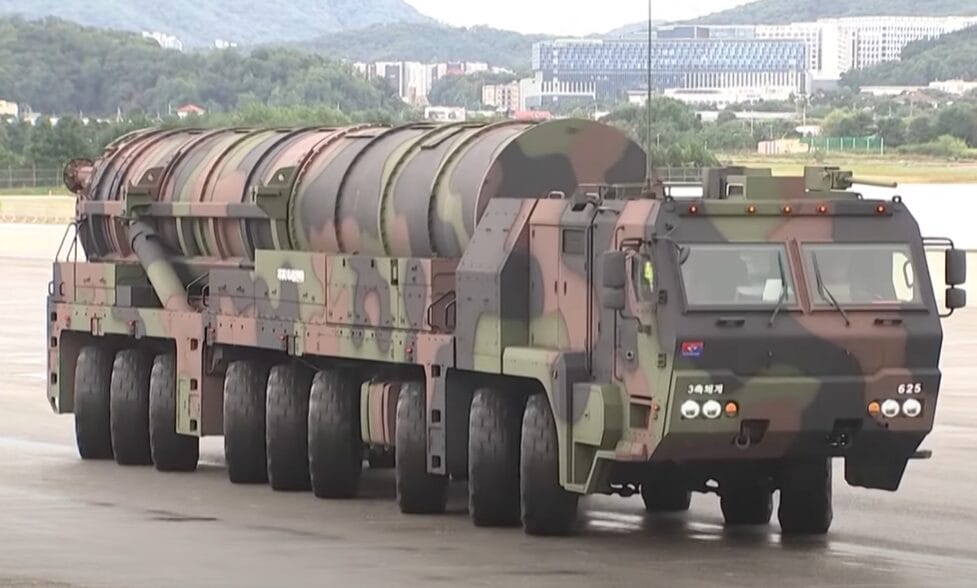
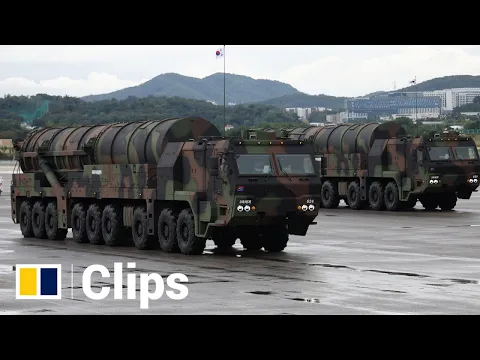
South Korea revealed its most powerful ballistic missile, the Hyunmoo-5, for the first time at an annual military parade, in direct response to increasing threats from North Korea.
The presentation took place during the Armed Forces Day ceremony in Seoul, where about 5,300 soldiers participated, along with displays of 340 types of military equipment and flyovers of aircraft.
As expected, the centerpiece of the parade was the Hyunmoo-5 missile, a missile capable of carrying a warhead of up to 8 tons, designed to penetrate deep into underground bunkers in North Korea.
-
Scientists manage to correct genes in human embryos before birth with unprecedented precision, and the discovery reignites the debate on hereditary diseases, the future of babies, and the limits of genetics.

-
China manufactured so many solar panels that the world cannot absorb them, and now sees its own industry collapsing: 1,000 GW of capacity, more than 40 companies bankrupt, and modules sold below cost expose the paradox of cheap clean energy.

-
The giant reservoir that São Paulo needs to avoid collapse is surrounded by sewage, microplastics, and illegal settlements, while nearly 22 million people live in the region that depends on urgent water solutions.
-
São Paulo reaches a new level and will draw seawater to supply a tourist city: an unprecedented R$ 56.4 million plant will use reverse osmosis, deliver 20 liters per second, and expand the water supply.


South Korean President Yoon Suk Yeol took the opportunity to reinforce his government’s firm stance toward North Korea, issuing a clear warning about the consequences of any nuclear weapon use by the Pyongyang regime.
“If North Korea attempts to use nuclear weapons, it will face the resolute and overwhelming response of our military and the South Korea-United States alliance“, declared Yoon to thousands of troops gathered at the parade.
He emphasized that such action could mark the end of the North Korean regime, making it clear that Seoul is ready to act decisively.
In addition to the South Korean ballistic missile, the parade featured a flyover by a U.S. B-1B strategic bomber as a demonstration of ongoing support from the military alliance between the two countries.
The Hyunmoo-5 missile, nicknamed “monster missile” by the South Korean media, was successfully tested last year and plays a central role in South Korea’s “three-axis” defense system, which aims to neutralize nuclear threats from North Korea.
Increasing Tensions on the Korean Peninsula

Tensions between the two Koreas continue to escalate, especially after the recent revelation of North Korea’s uranium enrichment facility and the frequent missile tests conducted by Kim Jong Un’s regime.
The North’s actions are seen as attempts to increase pressure on the international community and challenge the sanctions imposed on the country.
The Hyunmoo-5 is a crucial strategic response for South Korea, being part of its “three-axis” defense system, which includes the ability to carry out preemptive strikes if necessary. Although the missile is short-range, when equipped with a one-ton warhead, its range can exceed 5,000 km, making it a significant threat to the North.
The Hyunmoo-5 missile’s ability to penetrate underground bunkers reinforces the “peace through strength” posture adopted by Yoon Suk Yeol’s government, which advocates for a closer military alliance with the United States and greater cooperation with Japan.
Despite South Korea’s show of force, North Korea has not refrained from continuing its provocations. Before the parade, North Korea’s Deputy Defense Minister, Kim Kang Il, criticized the B-1B flyover and accused the United States of conducting a “reckless military bluff.” Furthermore, the North Korean regime continued to test weapons, ignoring international sanctions.
This year’s parade, showcasing the Hyunmoo-5 and the participation of U.S. military forces, highlighted South Korea’s readiness to respond firmly to any provocation.
With rising tensions in the region, security on the Korean Peninsula remains a major concern for the world, especially with the active participation of global powers such as the United States and China in the geopolitical landscape of the area.





이 북한 사람들은 왜 남한으로 갔는가?
Mísseis menores fazem 400, 500 km, como sempre os USA ajudando seus aliados a construir lixo kkkk.
Por mim, o general Douglas já teria resolvido isso em 1953: BUMMM. Ué, cadê a Coreia dos comunas?