





 Portuguese
  English
  Spanish
  4 min of reading
  0 comments


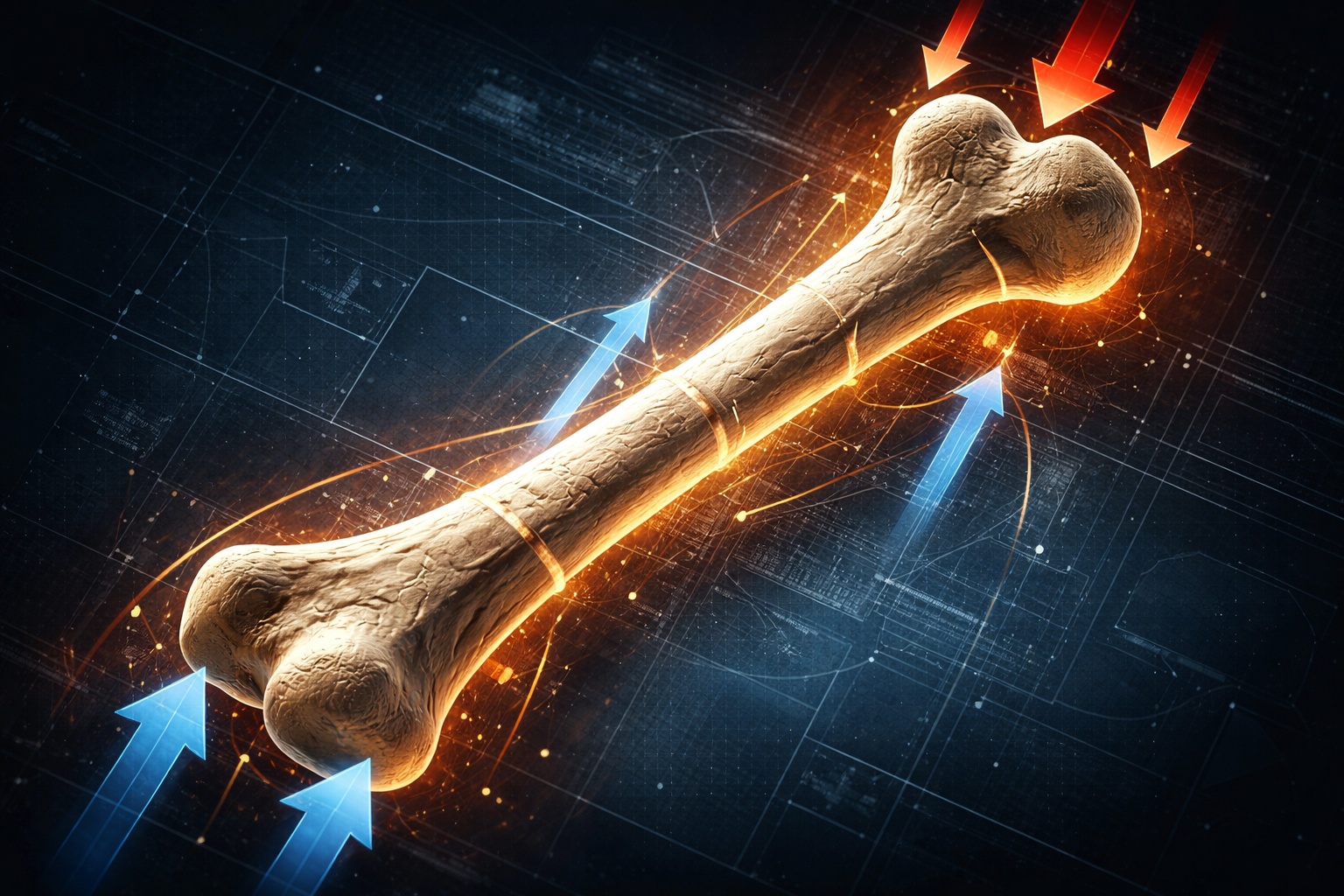
The Femur Is the Strongest Bone in the Human Body, Capable of Withstanding Up to 30 Times Body Weight. Understand How Its Structure Rivals Modern Engineering Materials.
The femur is not only the largest bone in the human body, but also the most structurally resilient. Located in the thigh, it connects the hip to the knee and acts as the main weight-bearing support column during basic activities like walking, running, jumping, or simply standing. In adults, the femur measures on average 45 to 50 centimeters in length and can withstand compressive forces exceeding 3,000 kg, equivalent to up to 30 times one’s own body weight in extreme situations such as running, landing, or impacts.
This impressive capability leads to the femur often being compared to steel beams used in construction, but with a crucial advantage: it is lighter, self-repairing, and biologically adaptable.
Why Is the Femur So Resistant?
The strength of the femur lies not only in its size but in the biological engineering behind its composition. It combines two main types of bone tissue:
-
Scientists use artificial intelligence to create nearly indestructible steel that does not rust and could change the way industrial energy and oil parts are produced.
-
Instead of buying new electric trucks, India is removing the diesel engines from old vehicles and installing electric propulsion for 40% of the price, and this simple idea could be the solution that polluted megacities around the world have been waiting for.

-
Circles in the Sahara plantations: ISS reveals Sharq El Owainat, in Egypt, irrigated by a center pivot with water from the Nubian Sandstone Aquifer, growing between 1998 and 2019, 290 km from the nearest city.

-
40% still call it a fraud: Soviets monitored Apollo, mirrors on the Moon still return lasers today and rocks confirm it; in 2026, 4 astronauts will return to lunar orbit and the race restarts against China.

Cortical Bone (Compact):
Forms the outer layer of the femur and accounts for most of the mechanical strength. It is extremely dense, hard, and structured to withstand compression and bending.
Trabecular Bone (Spongy):
Located mainly at the bone’s ends, near the hip and knee. It distributes impact forces and reduces the risk of fractures, functioning as an internal shock-absorbing system.
This combination creates a structure that resists compression, tension, torsion, and bending, something that few artificial materials can do simultaneously with such efficiency.
Comparison with Modern Engineering Materials

When compared to materials used by human engineering, the femur impresses even more.
In terms of strength-to-weight ratio, human bone is more efficient than steel. While steel is extremely strong, it is also heavy and rigid. The femur, on the other hand, offers:
- High mechanical strength
- Low relative weight
- Impact absorption capacity
- Controlled flexibility
- Continuous self-regeneration
Biomechanical studies show that if the femur were made of steel with the same strength, it would need to be significantly thicker and heavier, which would make human movement unfeasible.
How Much Weight Can the Femur Really Withstand?
Under normal conditions, during a simple walk, the femur bears about 2 to 3 times body weight. In more intense activities, the numbers rise quickly:
- Walking: 2 to 3 times body weight
- Running: 6 to 8 times body weight
- Jumping and landing: up to 10 times
- Extreme impacts: can exceed 30 times body weight
In laboratory tests, it has been demonstrated that the femur only fractures when subjected to forces equivalent to over 3 tons, something that rarely occurs outside serious high-energy accidents.
Why Does the Femur Break in Elderly People?
Despite its extraordinary strength, the femur can become vulnerable with aging. The main factor is osteoporosis, a condition that reduces bone mineral density and compromises the structural integrity of the bone.

With the loss of calcium and collagen, the cortical bone becomes thinner and the trabecular bone loses its internal organization, making the femur more susceptible to fractures, especially at the neck of the femur, a critical area near the hip.
This explains why seemingly simple falls can cause severe fractures in elderly individuals, even in a bone designed to withstand extreme forces.
The Femur as Inspiration for Engineering and Medicine
The structure of the femur is studied by engineers, doctors, and materials scientists around the world. Its design inspires:
- Advanced orthopedic prosthetics
- Titanium implants with biomimetic geometries
- Lightweight and strong structures in civil engineering
- Composite materials with optimized load distribution
The femur’s slightly curved shape, for example, is not a defect but an adaptation that dissipates forces better and reduces the risk of fatigue fractures over a lifetime.
A Living Beam That Adapts to Use
Unlike any artificial structure, the femur adapts to use. Physically active individuals tend to develop denser and stronger bones, while the lack of mechanical load — such as during long periods of immobilization — leads to loss of bone mass.
This principle, known as the Wolff’s Law, demonstrates that bone remodels itself according to the stresses it experiences, reinforcing areas under greater demand and conserving material where it is not needed.
A Silent Achievement of Human Evolution
The femur is an impressive example of how evolution solved one of the greatest biomechanical challenges of terrestrial life: supporting an upright, mobile body that is resistant to impact without compromising agility.
While bridges, buildings, and machines require constant maintenance, the femur performs its job silently for decades, bearing tons of force accumulated over a human life.
And all this without screws, welds, or concrete — just biology taken to the limit of efficiency.









-

-

-

-

-

19 pessoas reagiram a isso.