





 Portuguese
  English
  Spanish
  4 min of reading
  13 comments


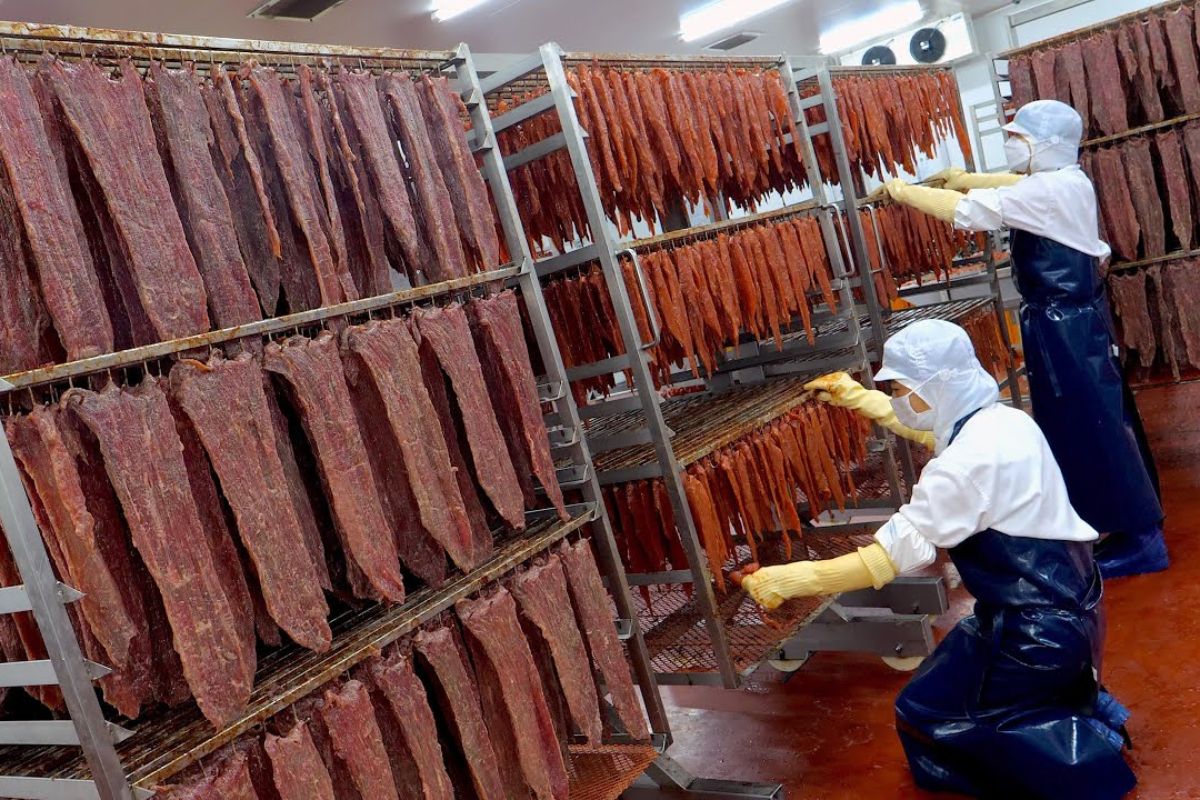


The Korean Factory Controls The Thawing And Selection Stage To Cutting, Curing And Maturation: Seasoning Enters Through Injector, The Tank Spins To Marinate, The Meat Rests For 2 Days In Cold, Dries For At Least 100 Minutes On High Heat And Passes Through A Metal Detector Before Weight And Sealing.
The Korean factory in Incheon operates with a metric that catches attention right at the entrance: 3 tons of production per day of dried meat. The volume only sustains itself because the process is segmented into short, repeatable, and traceable steps, focusing on standardizing cutting, curing time, and high-intensity drying.
Throughout the line, the logic becomes evident: it is not enough to season and dry, it is necessary to control marinade absorption, reduce humidity variations, avoid overlap on the hook, and, in the end, prove that the product came out clean of physical contaminants. That is why injectors, the 2 days of cold marinade, and the metal detector appear before the final packaging.
Controlled Entry And Hygiene As The First Barrier

The first filter is human: the Korean factory requires hygiene from workers before entering the production area.
-
He started running at 66 years old, broke records at 82, and is now a subject of study for having a metabolic age comparable to that of a 20-year-old, in a case that is intriguing scientists and inspiring the world.

-
Oldest tree on the planet reappears after 130 years of searches: Wattieza, 385 million years old, was 10 meters tall and had no leaves or seeds; Gilboa fossils in New York solved the mystery in 2007.

-
A 48-square-meter house assembled in hours with 4,000 bricks made of recycled plastic that does not absorb moisture, has natural thermal insulation, and costs less than 90,000 reais in a complete kit.

-
Luciano Hang revealed that Havan’s air fleet has already accumulated more than 20,000 landings, 10,000 flight hours, and 6 million kilometers traveled, and he says that without the planes, the company would never have grown so quickly.

In food operations, this type of ritual is not a formality, it is a basic barrier against cross-contamination, especially when there is direct handling in selection and initial preparation.
In practice, what is attempted to be avoided here is that the risk “travels” with those who operate the line.
When the daily volume is high, small failures become repeated on a large scale, and the cost of rework or disposal increases faster than the speed gain.
Thawing And Selection Define The Raw Material Standard

When the meat is received, it goes through thawing and then selection.
The Korean factory includes a physical cleaning of what is not of interest to the final product: removal of fat and fascia, first manually and then with a machine, reinforcing standardization.
This double step has a direct effect on quality and efficiency.
Fat and fascia alter texture, drying time, and uniformity, and can also create points where the marinade does not distribute predictably.
By removing these components beforehand, the line reduces the variability that would complicate the subsequent steps.
Marinade Under Pressure: Injector And Tank To Reduce Variation
The technical shift begins with seasoning and curing.
The prepared seasoning enters the machine, and the meat is cured, with the injector soaking the seasoning inside the piece, rather than relying solely on superficial contact.
Next, the meat is cut to a defined size and goes into the tank, which spins to marinate more homogeneously.
This set points to an operational goal: consistency.
Injecting marinade reduces the “tasteless center” and accelerates uniformity, while the rotating tank helps to distribute the seasoning and control the friction between pieces. For a Korean factory that promises tons daily, predictability is what keeps production from collapsing into irregular batches.
Two Days In Cold: Maturation As A Stability Step

After curing, the meat is covered with film and marinates for 2 days at low temperature.
This interval serves as a maturation and stabilization step, allowing the seasoning to diffuse and the piece to “settle” before facing the thermal stress of drying.
There is also a process reason: time in cold creates a control window, reducing improvised decisions.
When the schedule dictates 2 days, production becomes an organized queue, which facilitates planning of hooks, dryer capacity, and cut sequence.
Molding, Hooks And Strong Drying For At Least 100 Minutes
After maturation, the meat goes through molding and is spread on the hook without overlap.
Then, it enters drying with an explicit requirement: at least 100 minutes on high heat.
The message is clear: the line prioritizes a quick and intense removal of moisture, seeking a “well-dried” point before fragmentation.
The rule of not overlapping on the hook also has a direct effect on the result.
Overlap creates pockets of moisture, delaying drying and leaving parts with different texture and durability.
For a Korean factory, uniform airflow is as important as time and temperature.
Cutting Into Portions And Double Check: Metal, Weight, And Oxygen
After drying, the meat is separated from the rings, cut into small pieces, and passes through a metal detector to check for the presence of foreign fragments.
Next comes the packaging by weight portions, with product sealing alongside an oxygen eliminator, before another inspection by the weight checker and metal detector once again.
This chain reveals the priority of control at the exit.
The metal detector before and after reduces the chance of a point failure becoming a recall, and the weight checker avoids portion discrepancies that could generate complaints and commercial inconsistency.
Meanwhile, the oxygen eliminator indicates an attempt to preserve quality and stability of the sealed product until consumption.
In the end, the Korean factory combines scale with a process that attempts to reduce surprises: injector for standardizing marinade, 2 days in cold to stabilize curing, strong drying with minimum time to control moisture, and metal detector at multiple points to safeguard the final stage.
It is a line designed to repeat, measure, and deliver the same result many times a day.
If you had to bet, which step most decides the perceived quality of the dried meat: the 2 days of cold marinade, the strong drying of 100 minutes, or the packaging with an oxygen eliminator? And, in your experience, do you trust more in a “rigid process” or in “artisan production” when it comes to safety and consistency?








Vivo na Coreia a 5 anos e gosto muito do produto. É um snack como outro qualquer. E sim, aqui as regras existem e são cumpridas. Já vimos político perder cargo, confiança e o respeito por uma **** no chão. E vira pária da sociedade
No Brasil jamais uma fábrica desta vai funcionar começa pela carne sem qualidade e depois os empresários na ganância para a produção não esperaria o tempo necessário do processo e por último nos governantes finge que fiscalizar então o produto sairia uma grande **** como já diversas no nosso país.
Será que e carne de ****?