





 Portuguese
  English
  Spanish
  6 min of reading
  5 comments


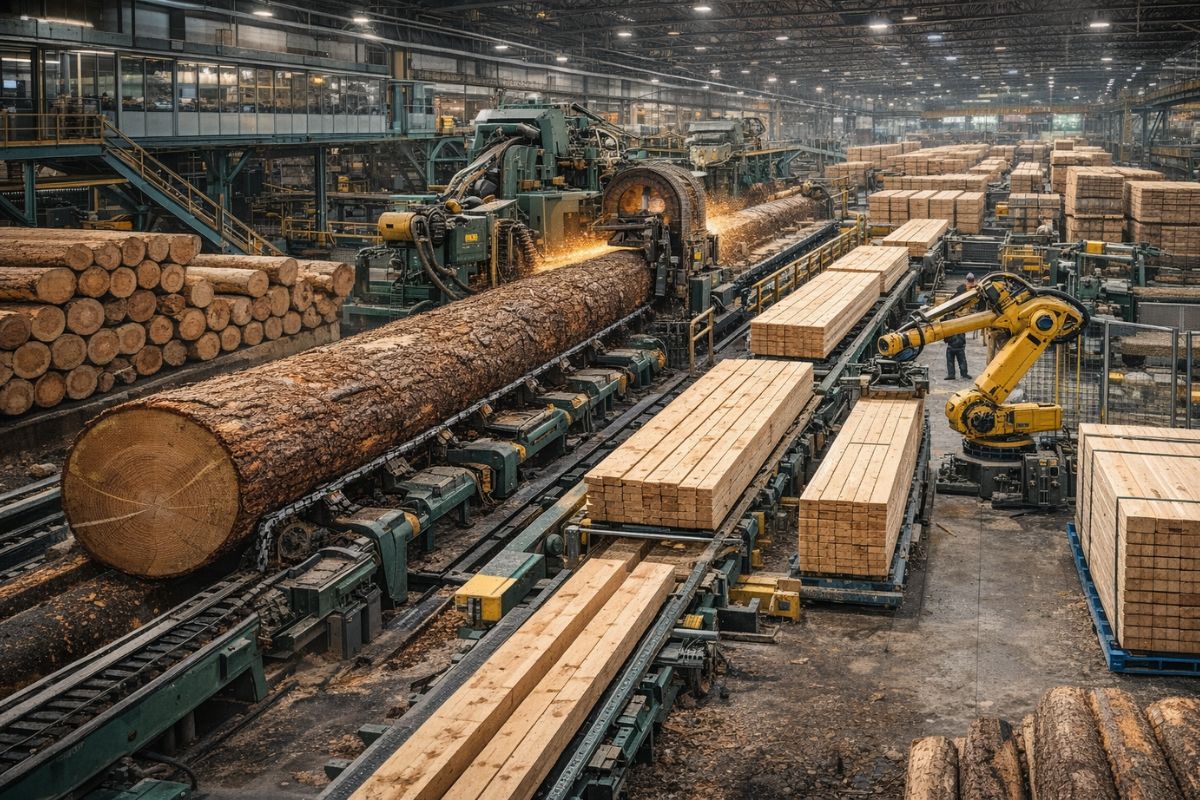


With An Investment of US$ 525 Million and A Reported Valuation of US$ 1.2 Billion, The Sawmill Accelerates From Cutting in The Forest to Finishing, Using Scanners, Software, and Giant Saws to Sort Logs, Dry Wood in Ovens and Turn Offcuts into Panels, Biomass, and Traceable Cellulose on An Industrial Scale, Far From Guesswork.
The sawmill presented as a reference for high technology in the United States combines brute force and continuous measurement to turn logs into wood with repeatable quality standards. What stands out is not just the size of the machines, but how data and automation enter the cutting decision, reducing variations that previously depended on the human eye.
In the described chain, efficiency means better utilization of every tree, tracking every batch and fitting production and logistics as a single line. At the same time, the idea of “nearly zero waste” coexists with an inevitable reality of offcuts, defects, and physical limits of wood, which need to be handled methodically, not promised.
From The Forest to The Yard: The Chain That Becomes A Sawmill Inside

It all begins outside the sawmill, during the harvest.
-
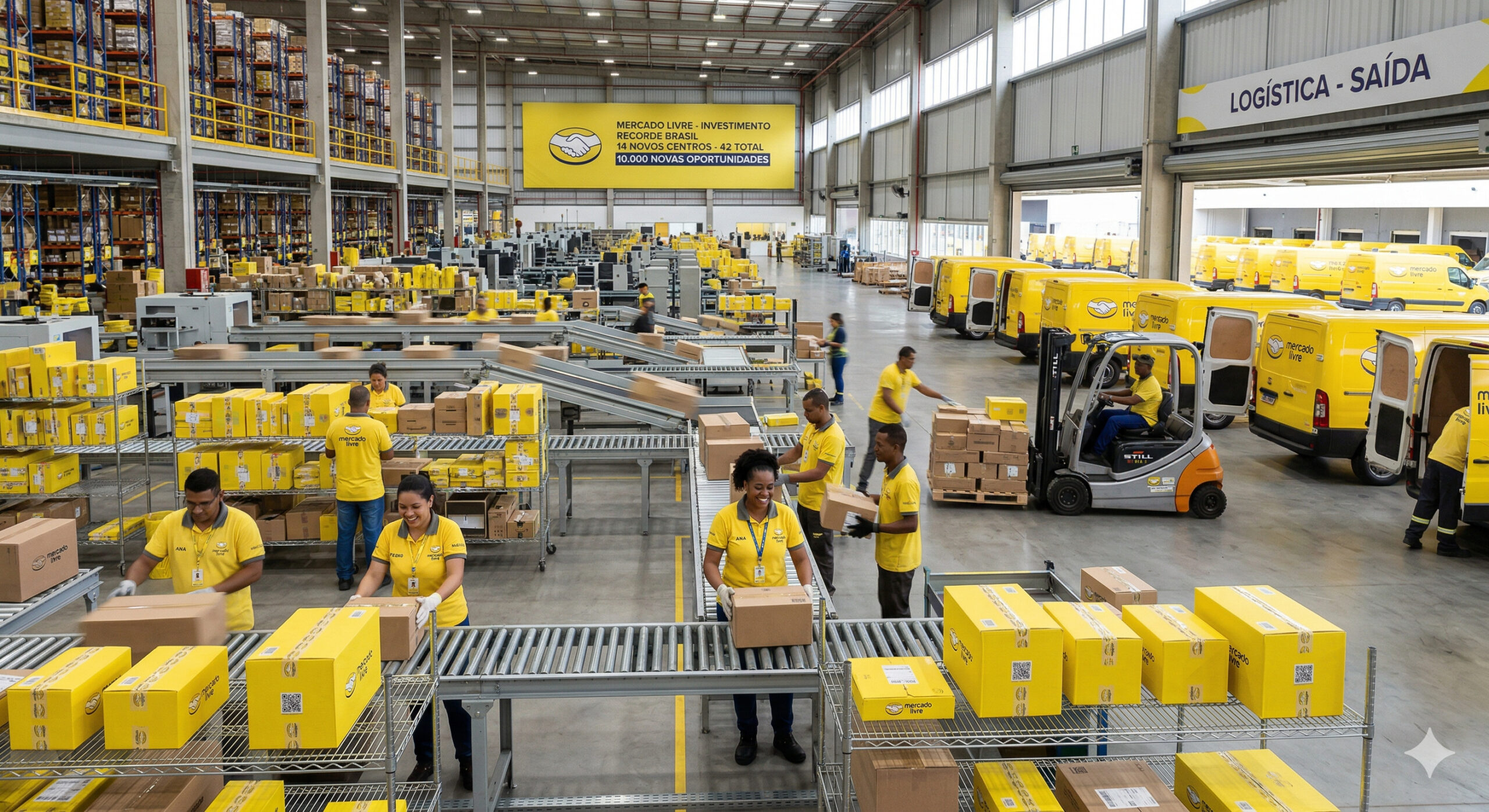
Mercado Livre “opens the vault” and announces a record investment of R$ 57 billion in Brazil in 2026, a value 50% higher than the previous year, with an expansion plan that includes 14 new logistics centers, totaling 42 units in the country and hiring an additional 10,000 employees.
-
How investment in technology can revolutionize the national economy and enhance industrial gains, according to a study that highlights the direct impact on productivity, innovation, and wealth retention within Brazil.

-
The largest food company on the planet, JBS, has just opened a 4,000 square meter laboratory in Florianópolis to develop customized proteins that modulate muscle mass gain, immune response, and metabolic performance.

-
After nearly 30 bids and competition among industry giants, a Spanish company purchases one of the largest airports in Brazil for almost R$ 3 billion and takes over the management of Galeão in a concession that will last until 2039.

The account describes a Tigercat harvester valued at US$ 1.2 million capable of grabbing, cutting, and processing a tree in seconds, while onboard computers measure the diameter and length of the logs as they are prepared for transport.
Next comes the forwarder, cited as a US$ 600 thousand piece of equipment, which replaces dragging with lifting.
The logic is to lift and stack logs with a hydraulic grapple, reducing contact with the soil and preventing damage that compromises yield, using low-pressure tires to limit impact on the terrain.
At the roadside, a loader described at around US$ 300 thousand organizes the logs for the trailers.
The journey to the sawmill is assigned to trucks from traditional brands in the sector, such as Kenworth and Western Star, and the logs arrive with weight, measurements, and species recorded to feed traceability and production planning.
The question of “how much” arises in practice: larger logs tend to become structural wood, while smaller pieces are directed toward cellulose or engineered wood, and the bark is repurposed as fuel or mulch.
The calculation is not emotional; it is industrial, and it depends on quick classification.
Scanners, AI, and Cutting Decisions When Mistakes Are Costly

Upon arriving at the yard, the logs enter the debarking stage.
The described model works with high-speed debarkers that remove bark in seconds and direct this material for repurposing, protecting blades and reducing downtime due to operational damage.
Then comes the digitization. Scanners measure the diameter, length, and curvature of the logs, and the system automatically classifies each batch before the first heavy cut.
The sawmill begins to operate as an optimization problem, and AI enters as the “brain” to map knots and imperfections and suggest a cutting plan that maximizes value, not necessarily beauty.
In the main stage, the log is rotated and framed for a precise cut.
The described flow includes initial cuts, transfer of offcuts via conveyor belts, and an edging stage to turn pieces into usable boards, with the declared aim of reducing waste without relying on guesswork.
The most striking equipment is the reference to giant band saws with 2,000 horsepower each, cutting with blades capable of following natural curves to improve yield.
The critical point is not just speed; it is repeatability, and this requires calibration, maintenance, and data quality; otherwise, AI becomes just another layer of error.
Ovens, Moisture, and The Invisible Part That Defines Quality
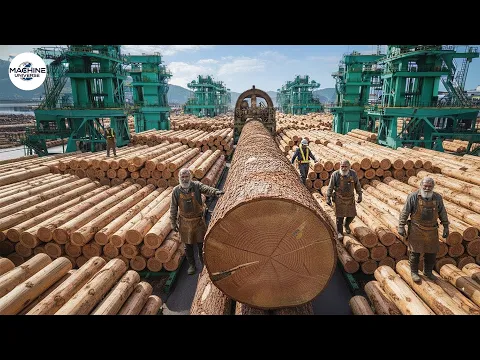

Cutting quickly is not enough. The process described treats drying as the divider between stable wood and wood that warps, cracks, or changes dimension.
The boards are stacked with spacers for air circulation and sent to ovens that reduce moisture with heat control.
The logic of “why” becomes clear here.
Ovens do not just serve to accelerate, they serve to stabilize.
By removing moisture in a controlled manner, the sawmill attempts to minimize deformations and prepare the wood for finishing, joints, and structural use without surprises post-construction.
Before and after drying, AI reappears in inspections: reading grains, identifying knots, and sorting by length and quality.
The goal is not to “erase” defects, but to separate what becomes premium product, what becomes standard product, and what becomes input for other processes.
In the end, traceability closes the loop. The batches are labeled and bundled, with the idea of maintaining a link between the forest, logs, wood, and final destination, something that weighs in logistics, auditing, and inventory control.
Panels and Engineered Wood When Offcuts Become The Main Product
The described chain includes a finishing and aesthetic area, producing higher value boards and, in parallel, items like panels and engineered wood components.
The goal is to transform what would be offcuts into traceable products, without breaking industrial rhythm.
The account mentions boards aligned and dried to about 10% moisture, and an eight-head molder guided by a Cognex system to maintain profile consistency.
Here, AI appears not only in cutting but also in continuous inspection, attempting to reduce variation from batch to batch.
In the planer, the reference is high-speed planing, reaching up to 600 meters per minute, followed by scanning, trimming, and bundling for shipment.
This section summarizes the central dilemma: high throughput only works if the wood enters stable and classified; otherwise, speed amplifies defects.
The account also opens a second industrial map outside North America.
In Germany, the company Polemeer is cited for transforming logs into 3.5 mm veneers for laminated wood, pressed with glue under heat and pressure to become beams and panels.
In another phase, the production of ultrathin veneers reaches about 1 mm, with logs steamed to soften fibers before unrolling.
Tradition, Scale, and The Practical Limit of Automation
The historical anchor is Freeman Lumber, founded in 1832 in Nova Scotia.
The contrast is used to show the leap of centuries: from axes, horses, and river transport to joysticks, sensors, and digital tracking of logs.
The narrative points to a regulatory turning point after a 19th century marked by deforestation, with replanting laws and the assertion that Canada and the United States grow more wood than they harvest annually, used as an argument for renewability.
Even without entering audits, the intent is clear: to place sustainability as a design variable, not as a footnote.
To contrast with the “super sawmill,” a medium-sized sawmill in Austria, Lean Hartsburger, is described as a model of constant efficiency, with less extravagant machines and greater dependence on human operators who adjust angles and study fibers to decide cuts.
This contrast answers “who” and “where” in a less obvious way. At one end, the sawmill bets on AI, scanners, and automation to standardize.
At the other end, the sawmill maintains quality with routine, experience, and deliberate rhythm, suggesting that technology can support people without eliminating human decision-making at all points.
The promise of a billion-dollar sawmill lies not only in the size of the yard but in the chain linking logs, AI, ovens, wood, and panels, with traceability and utilization as central metrics.
When this works, the wood comes out more uniform, logistics becomes predictable and the offcuts gain an industrial destination rather than becoming a liability.
Would you trust AI more to decide the cutting of logs or the experienced operator of the sawmill, and why? And in your region, what weighs more on the quality of wood and panels, the drying in ovens or transportation to the sawmill?









Once the local supply of material has been exhausted they just close the mill anyway. Hard to justify that kind of expense to build it
Folks, 1776 > 1970’s vast mointains of forest stripped bare. Then ‘reforestation’ began.Those mountains of trees are back. It’s a ‘growth’ industry. Every year 30>40 year trees meet the demand. Why does USA still wood for telephone poles. In Asia there all made with reinforced rebar in concrete. Never rot.
You can’t beat sawmill experience