





 Portuguese
  English
  Spanish
  5 min of reading
  0 comments


Understand What an SUV Is Before Buying Your Car: Know the Main Difference Between SUV and CUV and How Body Types Impact Daily Driving.
When choosing a new car, many consumers go beyond the brand or model and start considering aspects such as comfort, interior space, performance, and, mainly, the type of body style. Terms like SUV, CUV, and other formats have gained traction in the automotive market and, although they are increasingly present at dealerships, they still raise questions among drivers. After all, what do the acronyms SUV, CUV, SAV mean? How do these acronyms influence drivability, fuel consumption, and the daily use of the vehicle? These details make all the difference when choosing the ideal car, especially for those looking for a model that meets daily needs, whether in urban routes or long trips. What Do the Acronyms RS, R-Line, GTS, GT-Line Mean in Sports Cars?
Moreover, many manufacturers use their own nomenclatures to highlight their vehicles within these segments, which can further confuse those who are not familiar with technical terms or design trends. Keeping that in mind, this article will clearly explain what the main modern body types mean, the characteristics that differentiate an SUV from a CUV, and how these choices directly impact the driver’s experience.
Understand What an SUV Is and How It Performs Daily
To start, we have the SUV category, which is the best-selling in the current Brazilian market. To give you an idea, between January and August 2024, these models registered nearly 575,000 units and accounted for 48% market share. Once you understand what the acronyms SUV, CUV, SAV mean, everything becomes simpler.
-
A Japanese mason transforms raw granite into small cups and handcrafted utensils, collects giant stones, cuts with precision, and impresses with detailed manufacturing and finishing.

-
With 1,066 acrylic panels, the building known as the friendly alien is supported by a steel skeleton, has a façade that functions as a giant screen, and impresses the world without any internal columns.

-
Scientists warn that a comet about 1 km in size that has started to release gases may actually change direction in space. It was spotted by NASA and surprises with potential impacts near Earth.

-
These living root bridges and ladders are over 700 years old and help indigenous people survive in one of the rainiest regions in the world.


This means that almost half of the cars sold in the country feature these body types. Within this category, there are subdivisions that differ in size, purpose, and capacity. Understanding the differences between classifications helps to better comprehend the market and the needs of consumers.
Generally speaking, the concept of what an SUV is can be summarized as a vehicle that combines characteristics of sport utility vehicles with the comfort of sedans, offering higher ground clearance and an elevated driving position. The Brazilian market is undergoing a silent revolution, with SUVs dominating the streets and pushing hatchbacks to the brink of extinction in the process.
The shift in preference has practical and emotional reasons, as these body types convey a greater sense of security due to their height and more robust build. They also provide better utilization of interior space and more comfort in suspension. Additionally, the ground clearance offers greater ease of navigation on streets with potholes and obstacles.
Understand Why SUVs Are Gaining Ground in the Brazilian Market
Now that we know what an SUV is, it’s important to mention why they are so popular. However, we need to take a step back in history. In the 2000s, Ford developed one of the most influential models in the national market: the EcoSport.
It was nothing more than an adventurous Fiesta, but the idea of a taller, robust car with an imposing design won over consumers. This raised the first question in the buyer’s mind about whether to select a well-equipped hatch or a basic SUV.
Since then, models with these body types have diversified and gained ground where hatchbacks and midsize sedans once dominated. Data shows that consumers prefer entry-level SUVs over high-end hatchbacks.
One of the main justifications for the growth of SUVs lies in price equivalency. In many cases, high-end hatchbacks cost the same or even more than an entry-level SUV.
SAV in the Automotive Market
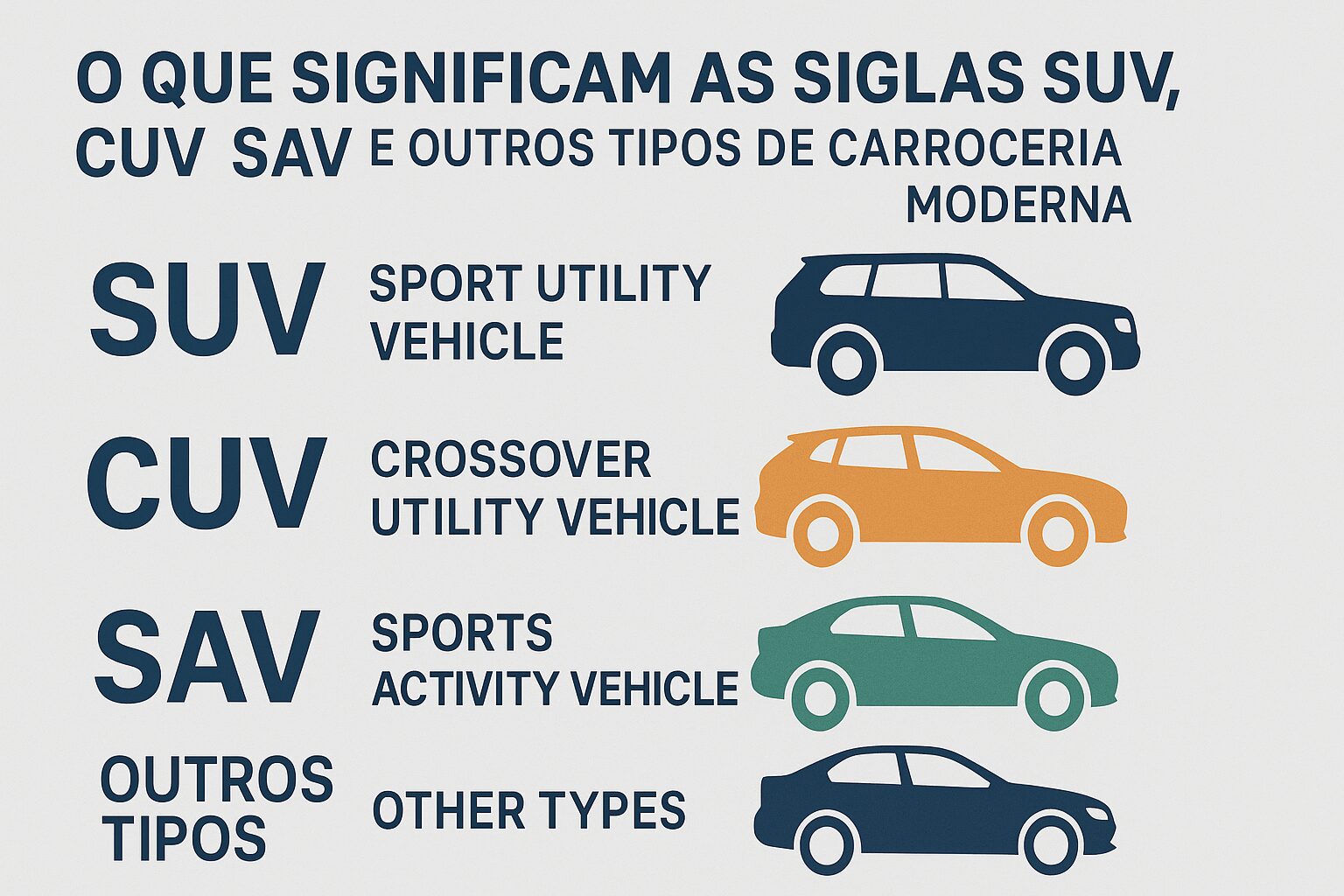
In the automotive market, SAV is short for Sports Activity Vehicle, or Sports Activity Vehicle, in free translation. What do the acronyms SUV, CUV, and SAV mean?
This term was originally created by BMW as a way to differentiate its models with utility characteristics, like SUVs, but with a greater focus on sporty performance and dynamic driving experience, rather than traditional off-road capability.
While the SUV (Sport Utility Vehicle) prioritizes versatility, interior space, and often four-wheel drive for uneven terrains, the SAV is more refined in purpose and focused on urban and highway use with a sporty flair, all while maintaining a higher and robust body structure.
For example:
- BMW X5 and BMW X6 are considered SAVs, focusing on performance, luxury, and sporty drivability.
- The SAV tends to have a lower center of gravity, stiffer suspension, and more powerful engines than traditional SUVs.
Understand the Difference Between SUV and CUV
When BMW launched the X5 in 1999, they identified it as a SAV, a vehicle that has sporty details but is not advised for off-road adventures since its ground clearance is slightly lower than traditional SUVs.
In this type of vehicle, there’s also the SAC category. Where, in more sporty body versions, other brands may opt for coupes classification, BMW maintains the differentiating rule and features its X6 as an example of what the brand designates as SAC.
Finally, we also have the vehicles known as CUVs, which are often confused with SUVs, but there are differences.
The main difference between SUV and CUV is that models with this body style are based on a passenger car platform, generally allowing for better handling, more comfort, and greater fuel efficiency, as it is a vehicle of lower height, shorter length, and lighter weight than an SUV.
The driving experience of a crossover utility is similar to that of a hatch or sedan, with the advantage of a higher driving position, providing better visibility and control of the vehicle.







Seja o primeiro a reagir!