





 Portuguese
  English
  Spanish
  4 min of reading
  1 comment


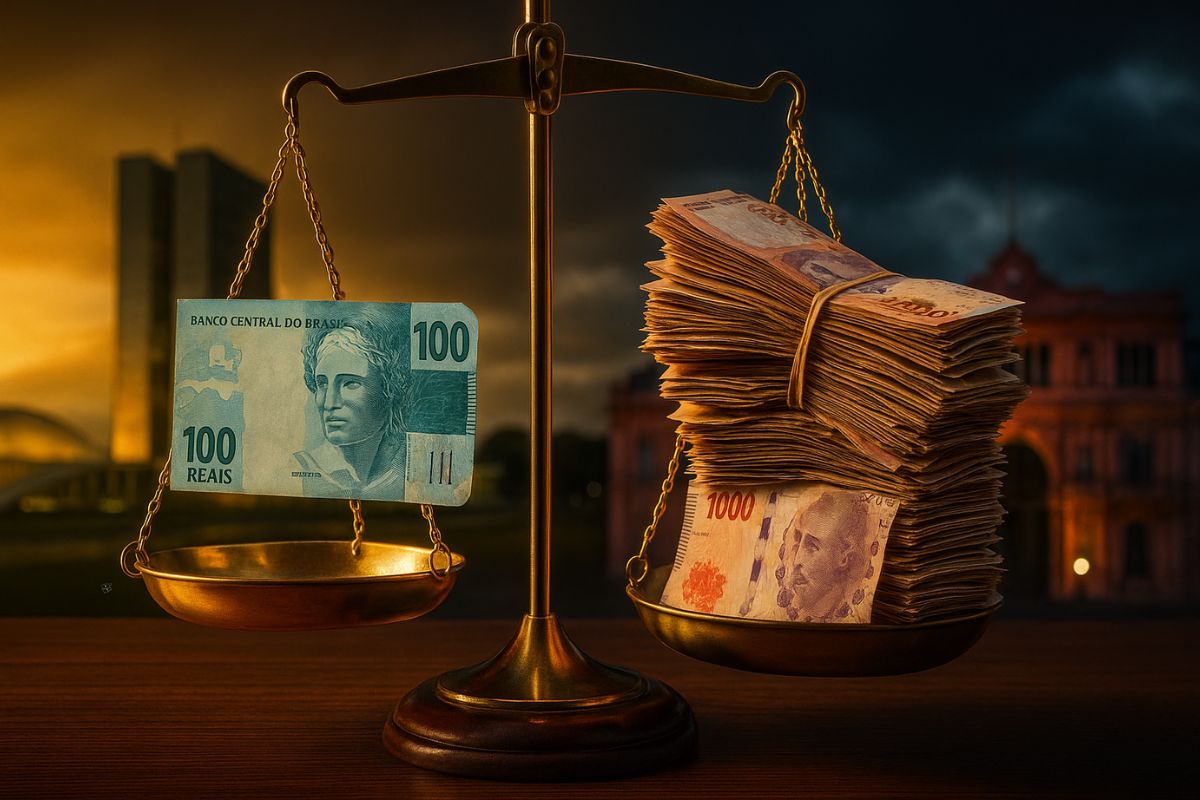


According to Valor Investe, the real has never been worth so much against the Argentine peso: 1 BRL now buys 271 ARS, reflecting the political and economic crisis in Argentina and the defeat of Milei’s government in Buenos Aires.
On this Friday, September 12, 2025, the market recorded an unprecedented data point: one real now buys 271 Argentine pesos, the highest nominal appreciation of the Brazilian currency against the neighboring currency since the start of the historical series. At the beginning of the year, the exchange rate was 163 pesos per real. In just nine months, the Argentine peso has lost 39% of its value against the real, highlighting the chronic instability of the Argentine economy.
The exchange deterioration is not limited to Brazil. Against the U.S. dollar, the global reference currency and basis for transactions with the International Monetary Fund (IMF), the peso has accumulated a depreciation of 29% in 2025. This decline further pressures the country’s international reserves and makes the rollover of external debt increasingly expensive, amplifying the challenges for Javier Milei’s government.
Political Crisis and Electoral Defeat in Buenos Aires
The most recent trigger for the spike in the exchange rate was the internal political crisis.
-
The largest food company on the planet, JBS, has just opened a 4,000 square meter laboratory in Florianópolis to develop customized proteins that modulate muscle mass gain, immune response, and metabolic performance.

-
After nearly 30 bids and competition among industry giants, a Spanish company purchases one of the largest airports in Brazil for almost R$ 3 billion and takes over the management of Galeão in a concession that will last until 2039.

-
The Federal Revenue Service now automatically cross-references everything you declare with data from banks, credit cards, brokerage firms, and insurance companies, and any discrepancy between your income and your expenses triggers an alert in seconds.

-
Amid global tensions, Brazil blocks the United States’ proposal at the WTO and paves the way for a trade crisis and possible retaliations.


Last weekend, President Milei’s party, La Libertad Avanza, suffered a significant defeat in the municipal elections of the province of Buenos Aires, which accounts for nearly 40% of the national electorate.
The victory of the opposition party Fuerza Patria was interpreted by the market as a thermometer for the national legislative elections, scheduled for October 26, 2025.
The result heightened perceptions that Milei may lose political support, reducing his ability to push forward austerity measures and structural reforms.
Immediate Reaction from the Markets
The reaction from investors was swift and strong.
This week, the Argentine peso lost 7.40% of its value against the real, while the Buenos Aires Stock Exchange (Merval) plummeted 11.90%.
The movement reflects risk aversion and the intensification of capital flight.
Financial institutions such as Itaú BBA and BTG Pactual already classify Argentina as one of the most volatile emerging economies at the moment, highlighting that the lack of political consensus exacerbates fiscal and exchange problems.
The Weight of Fiscal Uncertainties
In addition to the political crisis, the Argentine fiscal scenario is a constant source of tension.
The spending cuts agenda proposed by Milei faces strong social resistance and difficulties in the Congress, where the government does not hold a majority.
Analysts emphasize that, without structural reforms, it will be difficult to restore investor confidence and contain the devaluation of the peso.
The perception of risk grows week by week, increasing financing costs and limiting the government’s response capacity.
Direct Impacts for Brazil
The surge of the real against the Argentine peso generates contradictory effects for Brazil.
On one hand, Brazilian tourists gain purchasing power when traveling to Argentina, boosting tourism in border cities such as Puerto Iguazú and Buenos Aires.
On the other hand, the scenario is detrimental for Brazilian exporters.
With the real appreciated, national products become more expensive in the Argentine market, which historically ranks among the main destinations for Brazilian exports, especially in the automotive and manufactured goods sectors.
What to Expect Until the October Elections
Expectations are that exchange rate volatility will continue until the national elections on October 26.
The outcome will be crucial to indicate whether Milei will be able to sustain his liberal economic program or if the opposition will increase its political control, further complicating the implementation of fiscal adjustment measures.
Meanwhile, investors and analysts foresee a growing instability environment, in which any new political setback could accelerate capital flight and the depreciation of the Argentine peso even more.
The level of 271 pesos per real is not just a historic number, but a reflection of the fragility of the Argentine currency in light of the combination of political crisis, fiscal uncertainties, and loss of international confidence.
For Brazil, the immediate effect is cheaper tourism and a more challenging bilateral trade.
And you, do you think the Argentine crisis will deepen after the October elections? Or do you believe Milei will still have the stamina to regain market confidence? Share your opinion in the comments — we want to hear from those closely following this situation.







Adianta muita coisa não o real estar valendo muito frente ao peso, aí eles levantam o preço de tudo…. Estive na Argentina em julho e tava tudo um absurdo de caro, 1l. de leite era 12,00 diesel a 8,00 20 ovos 34,00. Caríssimo…. 🥵 🥵