





 Portuguese
  English
  Spanish
  3 min of reading
  2 comments


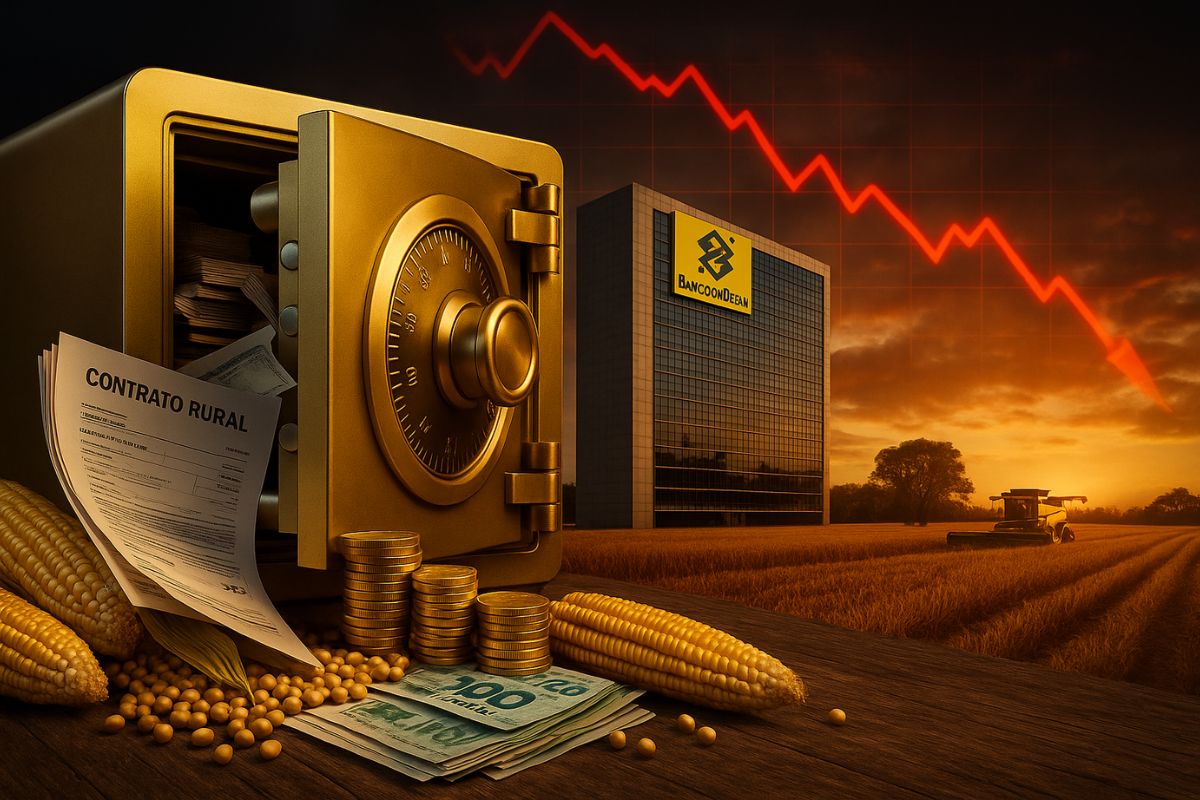


Banco do Brasil Faces a Hidden Risk in 2025 Pointed Out by Experts: The Agribusiness Postponed Portfolio Jumped from R$ 10 Billion to R$ 87 Billion in Just Six Months, Masking Delinquency and Eroding Results.
The so-called “hidden risk” at Banco do Brasil is not limited to profit decline. According to manager Christian Keleti, of AlphaKey, in a debate on the podcast Risk Brazil, the major concern is the agribusiness postponed portfolio, composed of credits that stop being classified as delinquent but are pushed forward through renegotiation.
This volume jumped from R$ 10 billion to R$ 87 billion in half a year. The problem is that this movement postpones the recognition of losses and pressures the provisions. Meanwhile, the bank’s profit projection dropped from R$ 36 billion to around R$ 20 billion in 2025, a drastic adjustment in a short time.
The Analysts’ Perception
For Keleti, this worsening is not a general reflection of the sector, but a specific phenomenon of Banco do Brasil.
-
Petrobras sends a message to Brazilian truck drivers after fuel collapse and reveals plan to have 100% domestic diesel.

-
Mothers and daughters come together, create an ‘express’ beauty salon and turn the idea into a network with 21 units, revenue of R$ 16.7 million and 12,000 subscribers.

-
End of the 6×1 schedule: how the reduction of hours can affect service companies, industry, and agribusiness.

-
Brazil Ignores Trump’s threats to BRICS, Buys 42 tons of gold and reduces the Dollar’s share by 6.45% in international reserves.


He cites statements from President Tarciana Medeiros, who indicated that the third quarter may be as bad as — or even worse than — the second.
Another worrying data point is the volume of delays between 15 and 90 days, which reached R$ 20.2 billion in the second quarter, functioning as a “conveyor belt” for clients already in difficulty.
For analysts, this set of factors shows that part of the delinquency is merely being postponed.
Timeline of the Problem
The risk gained momentum after two main triggers. First, the weak operational result disclosed in mid-2025.
Then, the abrupt increase of the postponed portfolio.
At the same time, U.S. authorities began to assess the situation under the perspective of the Magnitsky Act, used in the past to penalize BNP Paribas with a fine of almost US$ 9 billion.
In Brazil, a provisional measure released Treasury resources for refinancing the agro sector, with terms of up to 10 years, but experts consider the measure inadequate to cover the opened gap.
Impacts on Results and Dividends
With the pressure from provisions, the bank reduced the payout to 30%, shrinking the attractiveness of dividends.
According to calculations cited in the debate, the dividend yield may fall to 5.5%, well below what attracted thousands of individual investors in recent years.
On the Stock Exchange, Banco do Brasil’s shares fell from around R$ 30 to R$ 20 in six months, quickly reversing the appreciation that had taken years to consolidate.
For Keleti, the investor base may migrate to Itaú, Bradesco, or Santander, which offer more stable dividends in the current scenario.
Causes of Deterioration
Among the factors fueling this risk are crop failures, especially in Rio Grande do Sul, and the drop in grain prices, which reduced producers’ ability to pay.
Many chose to prioritize cooperatives and land protection mechanisms, instead of honoring loan repayments.
The SMEs (small and medium enterprises) are suffering from high-interest rates, increasing delinquency in another significant part of the bank’s portfolio.
The result is simultaneous pressure on two strategic segments.
The Tail Risk and Open Points
The scenario may worsen with the eventual imposition of the Magnitsky Act.
Although unlikely, an international sanction could generate additional losses and downgrade the perception of risk for the institution.
There are also significant gaps: it is unclear how much of the postponed portfolio will actually be lost, what the real exposure by credit rating is, and how far Treasury resources will be able to support the refinancings.
This uncertainty keeps the alert on the radar of investors.
The case of Banco do Brasil in 2025 shows that the agribusiness postponed portfolio can be as serious a problem as profit decline.
With smaller dividends, regulatory risk and sectoral challenges, the bank is experiencing a decisive moment.
And you, do you believe that Banco do Brasil will be able to reverse this situation or is the hidden risk still not fully priced in? Share your opinion in the comments — we want to hear from those who monitor the financial market in practice.









Os riscos ainda não estão todos precipitados!!
Para a matéria ficar mais completa, poderá numa revisão ou nova matéria, com um analista de balanço, baseado nos números atuais, fazer novas projeções com o resultado que o Banco poderá apresentar mantendo a atual média de perdas e aprovisionamentos que deverão ser feitos.
Isto é melhor do que um chute de quanto valerá a ação no futuro. O valor da ação é consequência.
O resto todo mantido igual. Mesmo número de agências (enquanto os Bancos particulares cortam), banco com o maior número de diretores do universo, militantes onde deveria ter gente de mercado.