





 Portuguese
  English
  Spanish
  5 min of reading
  0 comments


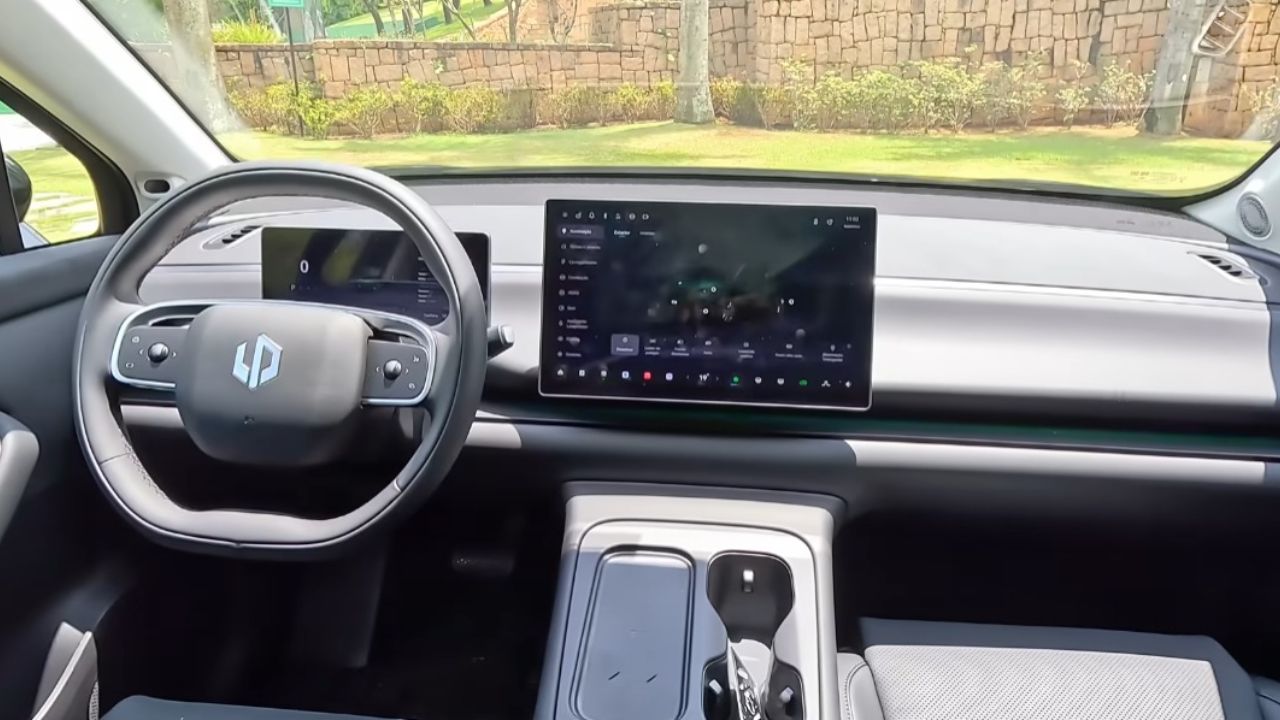
Brought by Stellantis, the Leapmotor C10 Uses a 1.5 Gasoline Engine Solely as a Generator for an Electrical System Promising 950 km of Range.
The Brazilian market for electrified SUVs has just gained a new and curious competitor. The Leapmotor C10, brought to the country by the Stellantis group (owner of Fiat and Jeep), debuts with the promise of being the first “hyper hybrid” in the country. The technology, which according to the Carro Chefe channel is a direct challenge to BYD, offers a combined range of up to 950 km (WLTP), but in a completely different way than we are used to.
The big idea behind this system is that the SUV is, in practice, a battery electric vehicle with range extender (REV). It has a naturally aspirated 1.5 engine that does not drive the wheels; its only function is to serve as a gasoline generator to power the electric system that actually moves the car. With 215 hp and an estimated price between R$ 199 thousand and R$ 219 thousand, the C10 comes to compete in a tight segment, but brings with it some design and usability controversies.
What Is the “Hyper Hybrid” System?

Differently from traditional plug-in hybrids (PHEV), where the combustion engine and the electric one can work together or separately to move the car, the system in the Leapmotor C10 is simpler in its logic. As detailed in the evaluation by Carro Chefe, the vehicle is 100% driven by the electric motor, located on the rear axle, which delivers 215 horsepower and 32.6 kgfm of instant torque. This guarantees the feeling of driving a purely electric car, with quick responses and silence onboard.
-
The car stored for 38 years: when opening the barn door, what appears is breathtaking and looks like a scene from a movie!

-
Fiat works miracles in the Brazilian market, lowers the price of its 0 km hatch to R$ 69,990, reestablishes the model as the cheapest car in the country, and reignites the battle against Kwid and C3.
-
Chevette with cooking gas: How the gas cylinder ends up being used in cars clandestinely and why this makeshift solution can result in leaks, explosions, damaged engines, and seized vehicles.

-
Fiat launches the new 2027 Toro hybrid with 48V, 176 hp, an electric motor of 15.5 hp, a 0.85 kWh battery, up to 7% fuel savings, 8% fewer emissions, and possible exemption from IPVA.


The 1.5 gasoline engine only comes into play when the main battery is low or when the driver demands maximum power in “Power+” mode. It functions as a generator, burning fuel to create electricity and recharge the battery, extending the total range to 950 km (WLTP). The 100% electric range, according to Inmetro, is only 111 km, reinforcing that the gasoline generator will be frequently used on long trips, a solution designed for the still deficient charging infrastructure in Brazil.
Space and Finish: The Strengths of the C10
Inside, the Leapmotor C10 impresses with its space, surpassing rivals like the Haval H6 in wheelbase. The rear floor is completely flat, and the comfort of the seats is a highlight, as is the panoramic sunroof which, unlike some direct competitors, features an electric shade for sun protection, a detail praised by Carro Chefe. The 435-liter trunk is about average for the category.
The overall finish is of good quality, with many soft-touch materials on the doors and dashboard, and interior options in caramel tones. The SUV also offers interesting modes, such as the “nap mode,” which fully reclines the driver’s seat and closes the sunroof’s shade for a quick rest. The suspension was considered a positive point, being firmer and more controlled than that of other Chinese SUVs, avoiding excessive “wobbling” at high speeds.
The Controversy of the “Generic” and the Lack of Buttons

Not everything is perfect in the design of the Leapmotor C10. The look, both external and internal, was classified by Carro Chefe as “very generic”. The front does not feature sharp creases and the minimalistic interior, although well-finished, lacks personality. However, the biggest criticism falls on usability: practically 100% of the car commands are concentrated on the central screen.
For simple tasks such as adjusting the external mirrors, directing the air conditioning, turning on the headlights, or activating the windshield wiper at maximum speed, the driver needs to navigate through menus on the multimedia system. This was seen as a negative point that could take attention away from driving. The steering wheel has buttons, but they serve as shortcuts to open menus on the screen rather than executing the functions directly.
To worsen the situation regarding screen dependence, the Leapmotor C10 arrives in Brazil, at least initially, without Android Auto and Apple CarPlay connectivity. The system has a native GPS, but the absence of the world’s most popular mirroring systems is a point of great strangeness, especially since it is a car from the Stellantis group, which offers this functionality even in its entry-level models, such as the Fiat Strada.
Price and Market Positioning


Stellantis has not yet finalized the official price, but the disclosed price range is between R$ 199,990 and R$ 219,990. If it comes at the top of the range, it will find heavyweight rivals. However, if positioned at the lower end, at R$ 199 thousand, the Leapmotor C10 becomes extremely competitive, entering the same price range as the GWM Haval H6 HEV (conventional hybrid) and staying below the BYD Song Plus (plug-in hybrid).
The big advantage of the C10 is offering the experience of driving a 100% electric car, with instant torque and rear-wheel drive, without the “range anxiety.” The driver can travel long distances knowing that any gas station can “recharge” their car. Weighing 1,972 kg, the performance is not sporty, marking a 0 to 100 km/h in 8.2 seconds, but it is adequate for the family-oriented proposal of the SUV.
The Leapmotor C10 is one of the most intriguing proposals to arrive in Brazil: it combines the drivability of a pure electric vehicle with the convenience of a gasoline generator for long trips. It is an engineering solution that directly tackles the biggest fear of Brazilian consumers: the lack of charging infrastructure.
But the trade-off comes with a cost: an interior that relies 100% on a screen and the absence of Apple CarPlay and Android Auto. Do you think this “hyper hybrid” technology is the ideal solution for Brazil? Or does the lack of physical buttons and cell phone mirroring create a problem that would make you abandon the purchase? Leave your opinion in the comments; we want to know what you think.







-

-

2 pessoas reagiram a isso.