





 Portuguese
  English
  Spanish
  4 min of reading
  0 comments



Scientific Analysis Revealed Unprecedented Secrets and a Million-Dollar Legal Dispute Marked the Fate of the Richest Hoard from the Viking Age Ever Found in Great Britain.
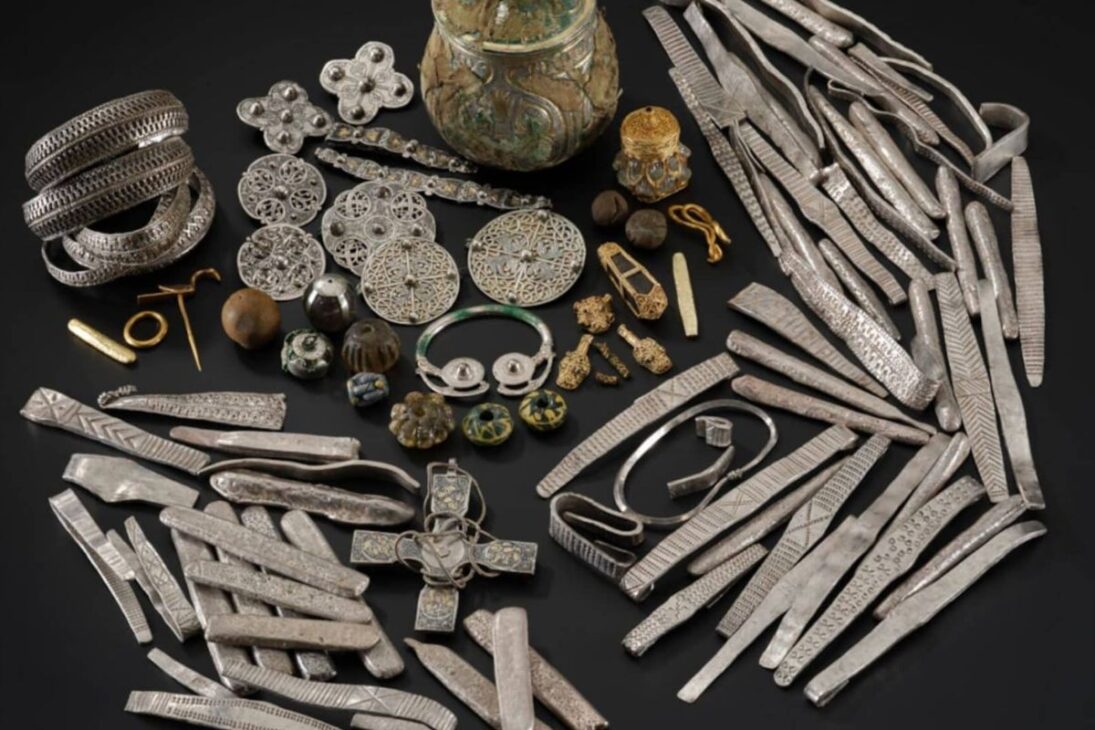
In 2014, the discovery of the Galloway Hoard by Derek McLennan in a field in Scotland marked a historic moment in archaeology. Considered the richest and most complex collection of Viking Age objects found in Great Britain, it contained over a hundred artifacts, ranging from silver ingots and rare bracelets to a Carolingian gold-plated silver vessel, along with organic materials like silk and linen, which rarely survive the test of time. Acquired by the National Museums of Scotland for £1.98 million, the find appeared to have a triumphant and well-defined ending.
However, the journey of this treasure was just beginning. Far from being a final point, the acquisition was the starting point for a meticulous scientific research process, a bitter legal battle for the reward, and a complete reinterpretation of its historical significance.
The story after 2014 revealed that the deepest secrets of the hoard were not only buried beneath the ground but were also skillfully hidden within the objects themselves and in the complex human relationships surrounding them.
-
For years, no one could cross a neighborhood in Tokyo because of the tracks, but an impressive solution changed mobility and completely transformed the local routine.

-
With 15 floors, an unusual building in Curitiba uses concrete, pilasters, and exposed roofs to create the effect of stacked houses.

-
Archaeologists opened a secret chamber that had been sealed by sand for 40,000 years inside a cave in Gibraltar and found what may be the last place where Neanderthals lived before disappearing from Europe forever.

-
The water that may have gone to the Moon with NASA during the Apollo 11 mission and been consumed by the astronauts springs in a Brazilian city at an altitude of 945 meters, famous for its thermal springs, above-average quality of life, and a natural radioactivity so unusual that it attracted Marie Curie.


The Scientific Unveiling of the Hoard: Secrets Under the Microscope
After being acquired, the hoard became the focus of one of the most important and detailed archaeological research projects in Scotland.
Led by the National Museums of Scotland in partnership with the University of Glasgow, the project “Unwrapping the Galloway Hoard” utilized cutting-edge technology to analyze each piece with unprecedented care.
Even before daring to open the delicate and sealed Carolingian vessel, scientists conducted extensive CT scans and 3D X-rays.
This non-invasive approach allowed for the creation of an accurate digital map of its interior, revealing a densely packed interior with precious artifacts, each individually wrapped in fabric.
This detailed analysis brought to light information that fundamentally changed the perception of the hoard and its owners.
The runic inscriptions found on silver bracelets, for example, were not Nordic names, as might be expected, but rather Anglo-Saxon names like “Ecgbeorht”.
This surprising revelation suggests a profound cultural integration in the region, where identities mingled. Additionally, the scientific analysis of the silk confirmed its origin in Central Asia, in modern Uzbekistan, underscoring the impressive reach of Viking trade and raiding routes.
The physical excavation of the vessel’s contents, guided by the digital maps, revealed even more hidden items, such as glass beads, an articulated silver brooch, and other small treasures, each carefully packed and preserved for over a thousand years.
The Legal Battle for the Million-Dollar Reward
Alongside these scientific discoveries, a much more earthly and contentious battle was unfolding. Derek McLennan, the discoverer, had a prior agreement with the Church of Scotland, the owner of the land where the treasure was found, to split any reward value.
In 2017, following Scottish law that rewards the discoverer, the Crown paid the full reward of £1.98 million directly to McLennan.
From that point, it was up to him to honor the contract he had made with the Church.
However, the two parties could not reach a consensus on the fair division of the money, leading to a long and draining conflict.
McLennan argued that the Church’s offer did not reflect his contribution to the search, while the institution accused him of breach of contract, demanding a significant portion of the sum.
The impasse brought the case to court, in a process that dragged on for years and attracted media attention. In 2021, just before the trial, a settlement was announced, the terms of which remain confidential.
McLennan publicly expressed his frustration with the litigation, stating that the lengthy legal dispute detracted from the joy and charm of the historic discovery he made.
The Public Legacy and the Reinterpretation of History
With the dispute over and the research progressing, the Galloway Hoard finally began its public journey, fulfilling its role as a national heritage.
The National Museums of Scotland created a highly successful traveling exhibition, “Galloway Hoard: Viking-age Treasure”, which toured various Scottish cities, including Kirkcudbright, the community closest to the discovery site, allowing local people to connect directly with their own heritage.
In addition to the physical exhibition, a vast digital archive was created with 3D models of the artifacts, making the hoard accessible for study and admiration by researchers and the public worldwide.
More important than its display, the hoard dramatically changed historians’ understanding of the Viking Age in Scotland, challenging the simplistic image of the Norse as mere raiders.
It does not tell a simple story of pillage but rather a complex narrative of interaction among four distinct peoples: Vikings, Scots, Anglo-Saxons, and Picts, who negotiated, fought, and lived alongside one another.
The hoard, believed to represent the wealth accumulated by up to four generations of a single powerful family, mixes precious heritages, spoils of war, and goods from international trade, painting a much more detailed picture of a multicultural society of negotiation, conflict, and coexistence in a turbulent period of British history.
The journey of the Galloway Hoard shows that the story behind an artifact can be as valuable as the object itself. In your opinion, who owns a treasure like this: the discoverer, the landowner, or the nation? Share your perspective in the comments.









-

Uma pessoa reagiu a isso.