





 Portuguese
  English
  Spanish
  4 min of reading
  0 comments


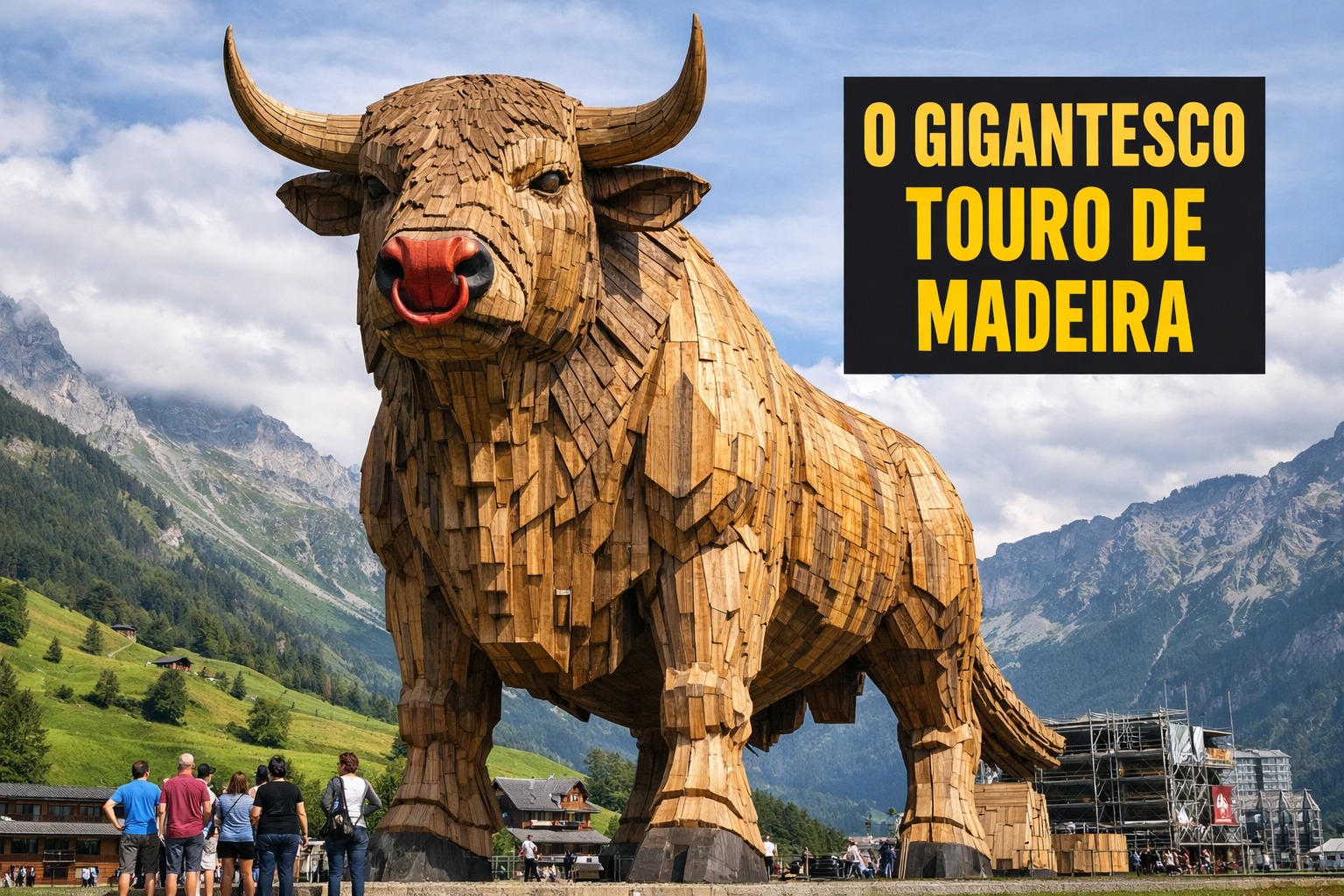
Monumental 21-Meter Sculpture, Created for the 2025 Swiss Federal Wrestling and Alpine Games, Leaves Glarus for Uri, Provoking Political Reactions, Local Criticism, and Symbolic Debates
“Muni Max,” the gigantic wooden bull created as a symbol of the Swiss Federal Wrestling and Alpine Games 2025, has ceased to be merely a monumental attraction and has become the protagonist in a dispute between cantons.
With a height of 21 meters, impressive dimensions, and an impossible-to-ignore presence, the sculpture has transitioned from public enchantment to political controversy following its transfer from Glarus to Uri.
A Symbol Fit for the Festival
Held only once every three years, the Swiss Federal Wrestling and Alpine Games required a striking emblem.
-
Spain surprises the world by erecting 62 artificial dunes, mixing sand with natural remains of posidonia, and causing the structure to lose only 1.4% of its volume in 1 year.
-
Meta and YouTube condemned for addiction to social media: ruling links the operation of the platforms to the worsening of anxiety and depression.

-
For just 96 dollars and with a 3D printer, an amateur created a prototype of a homemade guided missile with GPS, camera, and Wi-Fi tracking system, and this raised the debate about printed weapons to a frightening level.
-
The government will charge up to R$ 650 from pet owners in 2026, and tourists traveling with their dogs will have to pay a daily fee; the measure surprised thousands of pet ‘parents’ in Italy.

The 2025 edition, set to take place at the end of August in Mollis, in the canton of Glarus, found in Muni Max a grand representation.
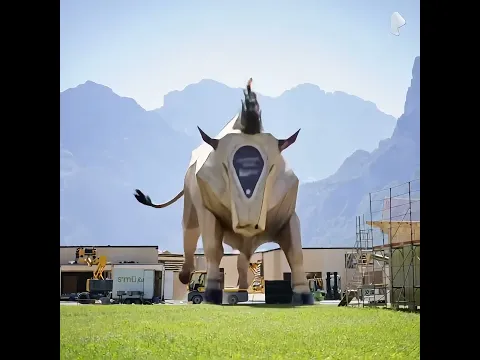
The bull reached 21 meters in height, 36 meters in length, about 10 meters in width, and weighed 182 tons.
Even during construction, the structure already sparked curiosity and attracted visitors. It was not just because of its size, but due to its cultural significance.
The project brought together around 220 companies and 500 carpentry apprentices from eastern Switzerland. More than 1,200 cubic meters of Swiss wood were used, organized into 437 prefabricated parts and connected by nearly 19,000 screws.
According to the creators, the artwork aimed to express the union between traditional craftsmanship and modern technology in wood.
The sculpture also symbolized the value of Schwingen, a Swiss wrestling style considered practically a national sport.
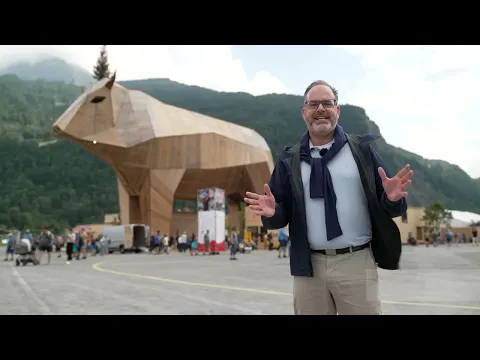

The Connection Between the Bull and the Fight
The association between the animal and the festival has a direct explanation. The winner of the competition, known as the “king,” receives a bull as a prize.
In 2025, champion Armon Orlik from the canton of Graubünden took home a specimen named Zibu.
Unlike other festive structures, Muni Max was not conceived as something ephemeral. As soon as the festival ended, the inevitable question arose: what would be the fate of the wooden giant?
Diverse cantons expressed interest, including Glarus, Uri, St. Gallen, Appenzell Outer Rhodes, Schwyz, and Graubünden. The dispute quickly left the symbolic realm and entered the strategic sphere.
Uri Steps onto the Scene
The canton of Uri presented an argument hard to ignore. Its coat of arms is adorned with a bull’s head.
The visual identification favored the creation of the association “Max, the Bull of Uri,” which led the acquisition campaign.
The proposal gained significant financial support. Total costs were estimated at around 1.85 million Swiss francs, with 1.2 million allocated for the purchase of the artwork.
Local businesses contributed, including entrepreneur Samih Sawiris. Franz-Xaver Simmen told the newspaper 20 Minuten that the entrepreneur’s participation was important but not majority.
The newspaper Blick summarized the symbolism of the choice by highlighting that Switzerland’s largest Muni would go to the canton whose coat of arms features a powerful bull.
New Name, New Role
Despite the enthusiasm, there was a cultural adaptation. In Uri, no one calls a bull a muni. The sculpture was renamed “Max, the Bull of Uri.”
The artwork will be internally accessible. An elevator will allow visitors to ascend its four floors.
Additionally, Max will receive a ring in its nose, made of locally sourced wood and painted red, in direct reference to the cantonal coat of arms.
The final destination will be the Nätschen region, above the village of Andermatt. The expectation is that the sculpture will become a tourist and cultural hub.
Reactions in Glarus
The decision sparked strong dissatisfaction in Glarus. Politicians and local leaders mourned the loss. Andreas Luchsinger told the Keystone-SDA agency that the canton would have kept Max for a long time.
Simone Eisenbart told the portal Watson that if Muni Max could speak, it would like to remain in Glarus. For many residents, the structure had quickly become a regional emblem.
A project for a permanent installation in Braunwald failed after opposition from environmental organizations. Criticism also fell on the lack of a unified vision for the future of the artwork.
Jakob Kamm stated to Keystone-SDA that regardless of its fate, Max would always be associated with the festival.
Arrival Surrounded by Debate
The transport to Uri mobilized 32 trucks escorted by the police. The operation reinforced the logistical magnitude involved.
Even so, not everyone celebrated. Residents of Andermatt questioned the accelerated granting of the construction permit.
The newspaper Sonntagsblick reported the emergence of a local dispute, noting that the coat of arms of Andermatt features a black bear.
As Max finds a new home and a new identity, the controversy reveals that in Switzerland, even a wooden sculpture can carry tensions between tradition, economy, environment, and regional pride.
With information from Swissinfo.



Seja o primeiro a reagir!