





 Portuguese
  English
  Spanish
  3 min of reading
  6 comments


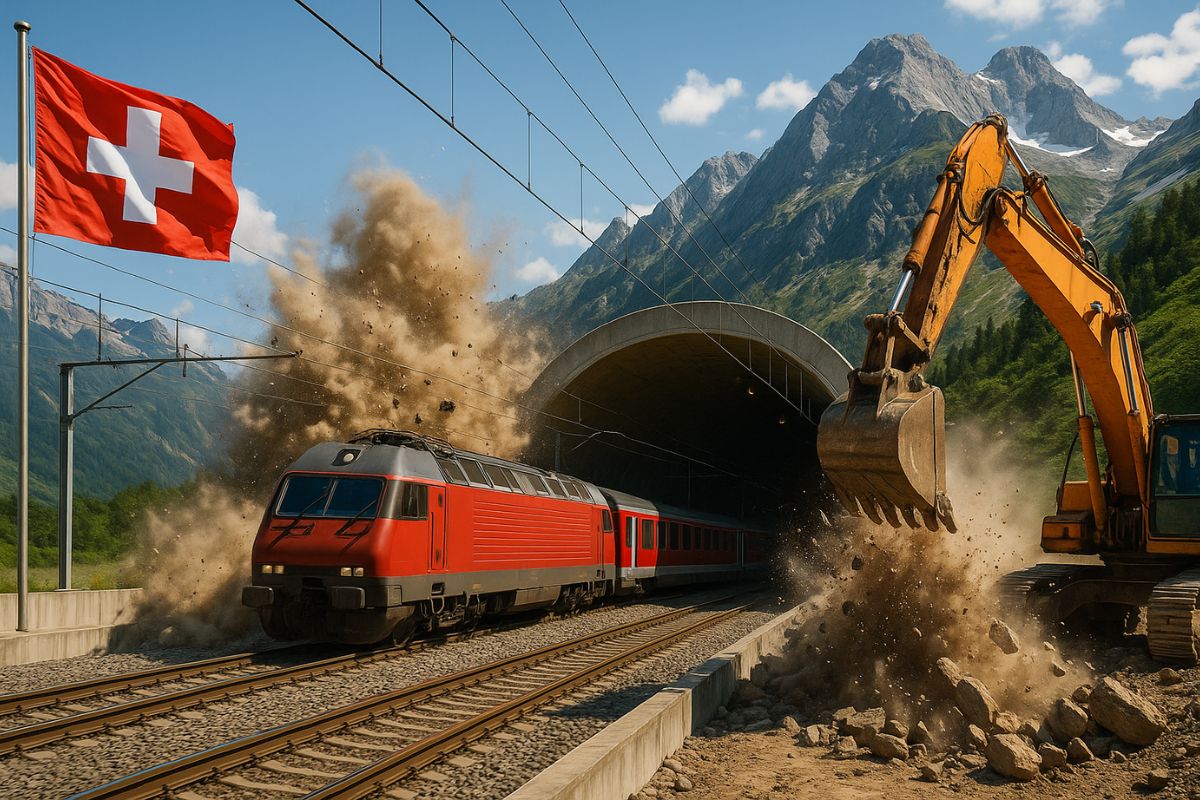


Monumental Work Took 17 Years And Created A Strategic 57 Km Link Between North And South Of Europe.
The longest and deepest railway tunnel in the world is the Gotthard Base Tunnel in Switzerland, an engineering feat that took 17 years to complete and began operations in 2016. With a length of 57.1 km and up to 2,450 meters deep under the Alps, it represents a milestone in the history of global infrastructure.
More than an architectural achievement, the tunnel changed European transportation. By connecting Zurich in Switzerland to Milan in Italy, it reduced travel time by almost an hour and increased the capacity for freight transport, alleviating alpine highways and reinforcing the continent’s integration.
A Strategic Crossing Through The Alps


The Gotthard Base Tunnel was designed to confront a historic natural barrier: the Swiss Alps. Before it, the railway route was winding and slower, limiting speed and transport capacity.
-
Attracting around 250,000 people a year, a lighthouse 200 meters from the sea, on a 60-meter high cliff, on the North Sea coast in Denmark, becomes one of the most impressive examples of how nature can threaten historical buildings.

-
The narrowest house in the world is only 63 centimeters wide, but inside it can accommodate a bathroom, kitchen, bedroom, office, and even two staircases.

-
In the middle of the sea, these enormous concrete and steel structures, built by the British Navy to protect strategic maritime routes, look like they came straight out of a Star Wars movie.

-
For years, no one could cross a neighborhood in Tokyo because of the tracks, but an impressive solution changed mobility and completely transformed the local routine.


With the new underground corridor, trains travel on a nearly flat path, which facilitates both high-speed passenger transport and heavy freight transport.
This feature transformed logistics on the continent. The tunnel has become a fundamental part of the Rhine-Alps Corridor, connecting Rotterdam in the Netherlands to the port of Genoa in Italy, creating a vital link between the north and south of Europe.
Engineering Of Superlatives
Building the longest and deepest railway tunnel in the world required one of the largest mobilizations of modern engineering. A total of 12.2 billion Swiss francs and the work of thousands of professionals from 15 countries were required.
More than 28 million tons of rock were removed using gigantic drilling machines.
The depth presented extreme challenges: pressure from the rocks, internal temperatures of up to 46°C, and unexpected geological variations. To overcome these obstacles, high-performance concrete was developed that could set quickly under adverse conditions.
Environmental And Economic Benefits
In addition to logistical efficiency, the tunnel brought significant environmental gains. By transferring freight from roads to rails, it reduced truck traffic on alpine highways, decreasing pollution, accidents, and damage to the region’s nature.
From an economic perspective, the work consolidated Switzerland’s position as a central hub in European transport, increasing trade competitiveness among countries and strengthening market integration.
The Tunnel Today And The Next Challenges
Despite the grandeur of the work, its operation requires constant maintenance. After the derailment in 2023, the tunnel was closed for more than a year and only reopened in September 2024.
In 2025, it remains active, but undergoes modernization works on safety systems and tracks, with scheduled interruptions until 2027.
Even with these challenges, the Gotthard Base Tunnel continues to fulfill its strategic role: transporting passengers and freight more quickly, safely, and sustainably across the Alps, reinforcing its position as one of the greatest achievements of contemporary engineering.
The longest and deepest railway tunnel in the world is a symbol of human capacity to overcome natural barriers and rethink mobility on the European continent.
But the maintenance costs and the risks of accidents show that engineering must be accompanied by constant vigilance and innovation.
And you, do you believe that works of this magnitude justify the billion-dollar investment? Do you think Brazil should invest in infrastructure projects of this level to better integrate its regions?
Leave your opinion in the comments; we want to hear from those who live this in practice.





Realmente o Brasil precisa pensar em aumentar a rede ferroviária do país. Eu acho que urge colocar este assunto em pauta entre as autoridades do nosso país
Se fosse no Brasil o Chefe iria contratar a Construtora O…….h para construir com 3x maior que o custo normal
De fato é uma obra magnífica. Entretanto não se pode negar que o túnel que liga Honshu a Hokaido no Japão não fica atrás em complexidade e dificuldade na construção, operação e manutenção, uma vez que o túnel em questão, embora menor em extensão, passa debaixo do oceano. Foram vinte anos desde o projeto inicial até a efetiva operação rodoviária e ferroviária, e até o momento não houve interrupção na operação. Esta e outras obras mostram o quanto o ser humano quando quer a palavra impossível deixa de existir.