





 Portuguese
  English
  Spanish
  3 min of reading
  0 comments


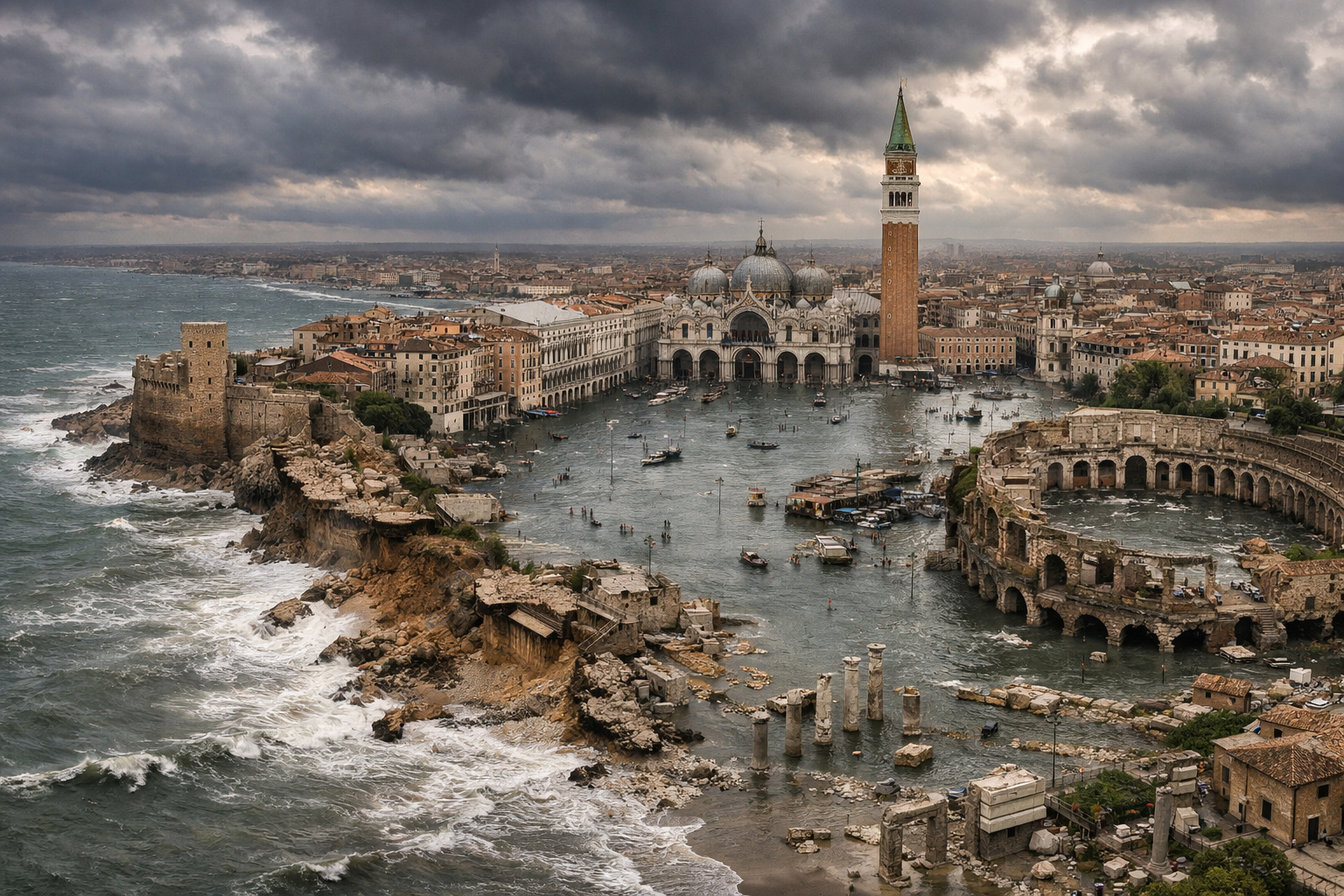
Historical Ruins Face A Silent Threat That Grows Year After Year With The Advance Of The Global Climate Crisis
Climate change has ceased to be an abstract threat and has started to directly impact the world’s historical heritage. Currently, ancient cities face increasing risks caused by flooding, coastal erosion, wildfires, and prolonged droughts. As a result, structures that have withstood for centuries have begun to show accelerated damage.
According to a recent report from IUCN, about 43% of historical sites recognized by UNESCO are already at high or very high risk. In comparison, in 2020 this percentage was approximately 33%, highlighting a concerning advance in environmental degradation. Moreover, factors such as excessive tourism and unplanned urbanization exacerbate these impacts.
Alexandria and Carthage Under Constant Threat from the Sea
On one hand, Alexandria, in Egypt, is suffering from the rising sea level of the Mediterranean. Between 1935 and 2022, studies indicate a significant retreat of the coastline. As a consequence, urban collapses have dramatically increased, rising from isolated cases to dozens per year.
-
Embrapa’s discovery reveals an unexpected advancement by allowing the production of seedlings from the caatinga using brackish water, opening a new frontier for farmers to face drought more efficiently.
-
6 sources of free fertilizer that you are throwing away every day and can transform your garden without spending anything.

-
With a water crisis on the radar, Sabesp invests in reclaimed water for data centers and transforms sewage treatment into a solution that saves millions of liters and protects public supply.

-
Foresea achieves 100% offshore waste reuse in 2025, eliminates landfill disposal, and consolidates sustainable strategy with 1,500 tons recycled.

Similarly, Carthage, in Tunisia, faces ongoing coastal erosion. In addition to the sea’s action, salt-laden winds corrode ancient structures, such as the Antonine Baths. Therefore, authorities had to isolate parts of the archaeological site to prevent greater collapses.
Wildfires, Floods, and Extreme Rains Accelerate Destruction

Meanwhile, in mountainous regions, the risk comes from wildfires and heavy rains. Olympia, in Greece, remains surrounded by dense forests. Consequently, heatwaves make the place more vulnerable to fire, as occurred in historical wildfires in the 21st century.
Similarly, Petra, in Jordan, suffers from sudden floods. This happens because its topography rapidly channels rainwater. According to projections, by 2050 the volume of precipitation could increase by up to 40%, further heightening the risk of structural damage.
Human Pressure Exacerbates Climate Effects
In addition to natural factors, human actions intensify degradation. Venice, in Italy, exemplifies this scenario. On one hand, the city faces increasingly frequent flooding. On the other, millions of tourists accelerate the physical wear of historical buildings.
At the same time, Asian cities like Hoi An, in Vietnam, are experiencing a significant increase in floods. According to recent studies, over 75% of events occurred in areas classified as high-risk, directly affecting local cultural heritage.
A Global Alert That Demands Immediate Decisions
In light of this scenario, experts warn that the preservation of historical heritage depends on coordinated actions. Although there are technological solutions, such as tidal barriers and drainage systems, these measures alone are not enough.
Therefore, without reducing emissions and effective environmental policies, cities that shaped the history of humanity could disappear as early as this century. Ultimately, protecting these sites means preserving the collective memory of the planet.
If you could choose one of these cities to protect first, which would it be and why?










-

Uma pessoa reagiu a isso.