





 Portuguese
  English
  Spanish
  6 min of reading
  0 comments


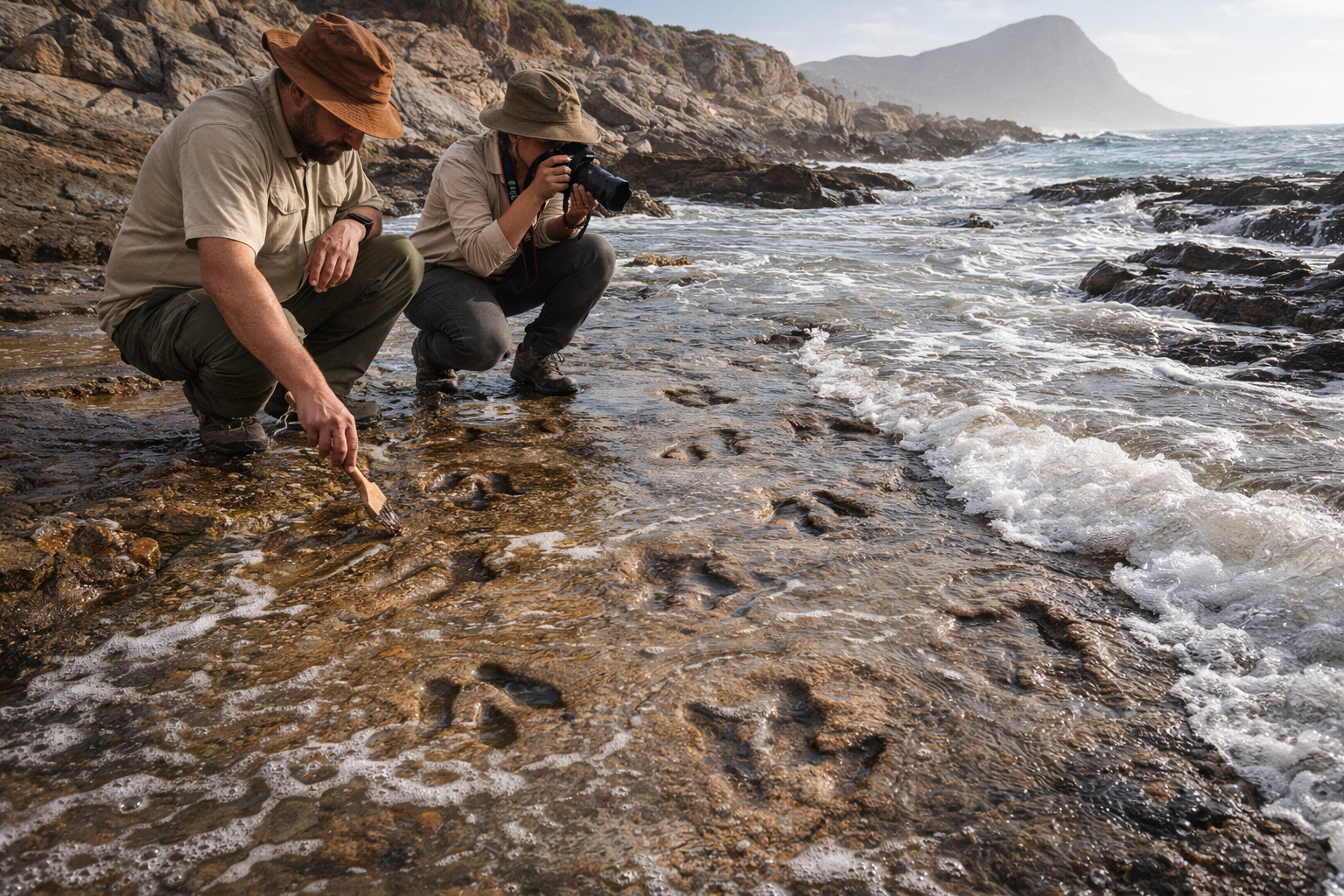
Dinosaur footprints with 132 million years were found in just 40 meters of rock in South Africa, forming the youngest record in the south of the continent.
In 2026, a study published in the South African Journal of Science and conducted by researchers from the African Centre for Coastal Palaeoscience at Nelson Mandela University documented dinosaur footprints on the southwestern margin of the Knysna estuary in the Western Cape, South Africa. The marks were identified in deposits of the Brenton Formation and appear both on low cliffs and on a surface of mud and silt in the intertidal zone, which is exposed for a short time before being covered again by water at high tide.
The finding draws attention not only because of the limited area of occurrence but also due to the scientific weight of the record: the authors describe an outcrop about 40 meters long and estimate an age of approximately 132 million years, at the beginning of the Cretaceous. According to the analysis presented in the article, these footprints likely represent the most recent record of dinosaurs ever identified in southern Africa, as well as constituting only the second report of Cretaceous tracks in the Western Cape province.
The discovery also reinforces the value of coastal areas as rare and vulnerable paleontological archives. According to the full scientific article, part of the fossiliferous surfaces of the Brenton Formation is inundated twice a day during high tide, a process that simultaneously reveals and erodes the traces. In a coastal strip where exposed Mesozoic deposits are scarce, the site enhances the understanding of the presence of theropods and possible ornithopods and sauropods in this ancient lagoon environment.
-
Artemis 2 makes history by bringing astronauts in a ‘fireball’ at over 40,000 km/h and 2,700 °C in an impressive reentry that challenges human limits.

-
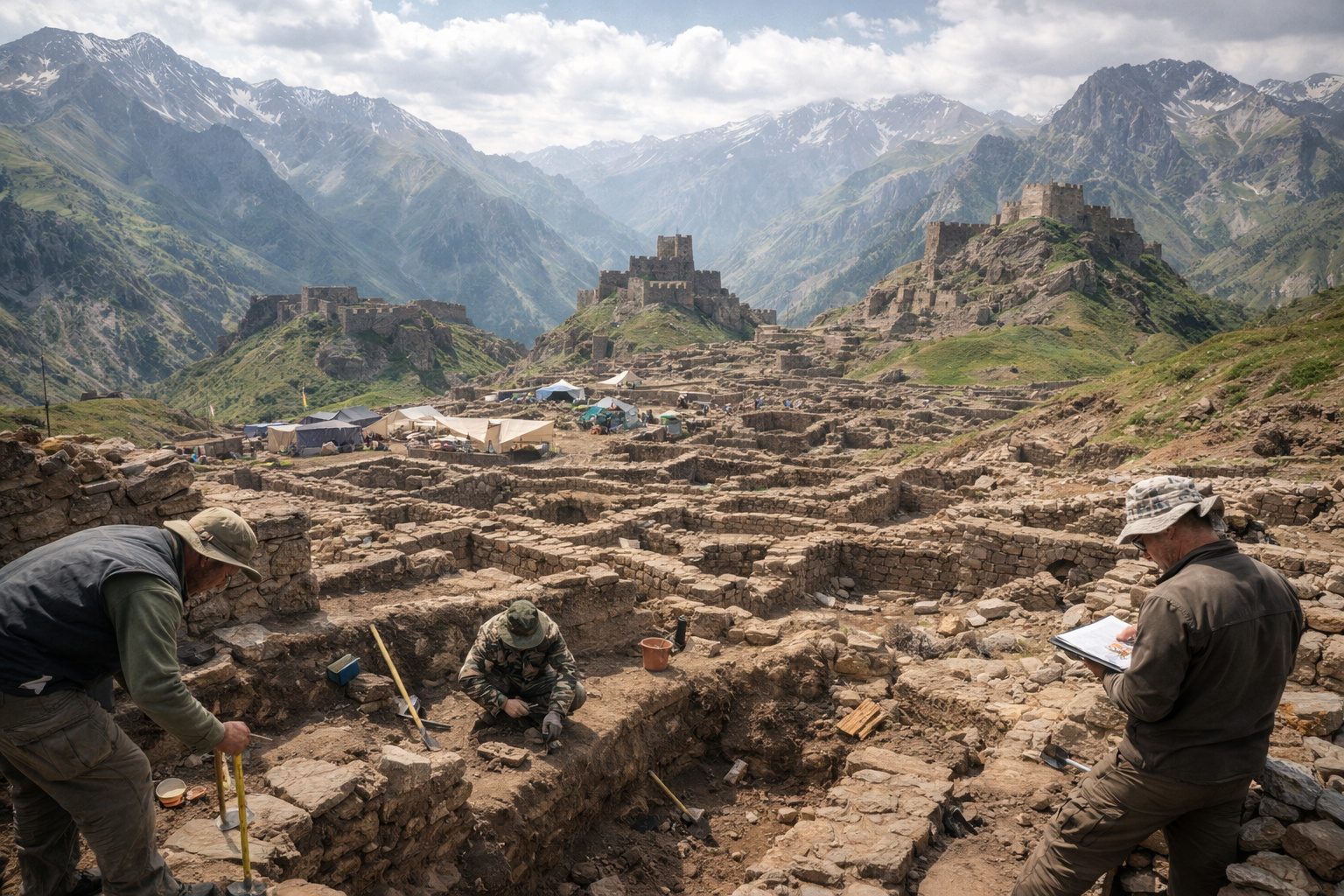
At over 2,000 meters above sea level, archaeologists have found a medieval city spanning 120 hectares with four citadels hidden in the mountains of Uzbekistan. This discovery dismantles the idea that the Silk Road was merely a passage and reveals a colossal urban center where no one imagined.
-
The humanoid robot from China that runs, does flips, and costs less than an economy car has just launched a global version, and the R1 from Unitree will be sold for $4,900 in the United States, Europe, and Asia, making a machine with 26 joints accessible to any small laboratory or enthusiast with the budget of a high-end iPhone.

-
NASA is building a space telescope to find killer asteroids before they hit us, and the unofficial mission emblem features a T-Rex screaming at the sky with two words: never again.

Brenton Formation and the geological context of dinosaur footprints in the Lower Cretaceous
The site where the footprints were found is part of the so-called Brenton Formation, a geological unit composed of sediments dating back to the Lower Cretaceous. This formation records ancient coastal and lagoon environments, where fine sediments were deposited along plains subject to variations in water level.
This type of environment is particularly favorable for the preservation of footprints. When a dinosaur walked on the wet ground, its marks could be quickly covered by new layers of sediment, protecting them from immediate erosion.
Over millions of years, these sediments consolidated into rock, preserving the impressions as indirect fossils known as ichnofossils.
In the case of the Brenton Formation, the presence of ancient coastal environments explains why the footprints were preserved in an area that is now directly exposed to tidal action.
How the tide hides and reveals one of the most recent dinosaur records in Africa
One of the most intriguing aspects of the discovery is the fact that the footprints are not permanently visible. Part of the rock outcrop is submerged during high tide, which means that access to the site depends on specific conditions.
During low tide, the surfaces with footprints are exposed, allowing for detailed study by researchers. At high tide, the water again covers the site, temporarily protecting the marks but also making access difficult and increasing the risk of erosion over time.
This natural cycle creates a unique dynamic: the same ocean that helped preserve the sediments over millions of years now acts as an agent of wear on the footprints.
Moreover, the intermittent exposure makes the site less visible, which may explain why it remained unknown for so long.
What the footprints reveal about the dinosaurs that lived in the region 132 million years ago
The footprints identified at the site belong to different types of dinosaurs, suggesting the presence of multiple species in the region during the Lower Cretaceous.
Although the exact identification of the animals is not always possible based solely on footprints, researchers can infer important characteristics, such as the type of locomotion, the approximate size of the individuals, and even behavioral patterns.
Some trails indicate bipedal dinosaurs, possibly carnivorous theropods, while others suggest the presence of herbivores of different sizes.
The arrangement of the footprints can also reveal behavioral aspects, such as group movement or recurrent use of certain areas, possibly associated with feeding routes or access to water.
These records are particularly valuable because they provide direct evidence of movement, something that fossilized bones do not always clearly reveal.
Why this is the youngest record of dinosaur footprints in southern Africa
The importance of the site is directly linked to its geological age. At about 132 million years, it falls within a period of the Lower Cretaceous for which there are few records of footprints in the southern region of the African continent.
Much of the known ichnofossils in Southern Africa are older, dating from earlier periods such as the Jurassic. This creates a temporal gap that hinders the understanding of the evolution and distribution of dinosaurs over time.
The discovery in Knysna helps fill this gap, offering a rare window into a specific moment in the geological history of the region. Furthermore, the fact that the site is located in a coastal environment broadens the knowledge about the habitats used by dinosaurs at that time, indicating that these animals frequented areas close to the coast.
The challenges of studying fossils in coastal areas exposed to the ocean
Although the discovery is scientifically relevant, it also presents significant challenges for its preservation and study. The constant action of waves, tidal variation, and natural processes such as erosion and weathering represent ongoing threats to the footprints. Over time, these marks may wear away or completely disappear.
Therefore, researchers use techniques such as photogrammetry and digital scanning to record the footprints in high resolution, ensuring that the data is preserved even if the site suffers future damage. This type of approach has become essential in modern paleontology, especially in environments where the physical preservation of fossils cannot be guaranteed in the long term.
The role of coastal discoveries in reconstructing the history of dinosaurs
Discoveries like that of the Brenton Formation show that there are still significant gaps in the global fossil record, especially in less explored or hard-to-access regions. Coastal areas, in particular, have proven promising for new finds, precisely because they combine sedimentary deposition processes with periodic exposure caused by the action of the sea.
These environments can preserve unique evidence, such as footprints and trails, that help reconstruct not only the presence of species but also their behavior and interaction with the environment. Each new site identified contributes to a more complete understanding of the distribution of dinosaurs over time and space.
Are there still important records hidden in coastal areas around the world?
The discovery of dinosaur footprints in such a small and partially submerged rocky area raises a relevant question for science: how many other similar records may be hidden in coastal regions, waiting for the right conditions to be revealed?
With the advancement of mapping and monitoring technologies, new areas can be identified and studied, further expanding knowledge about the history of life on Earth.
In light of this, an inevitable reflection arises: how many traces of millions of years remain hidden beneath the tides, appearing and disappearing without ever being seen?








Seja o primeiro a reagir!