





 Portuguese
  English
  Spanish
  6 min of reading
  0 comments


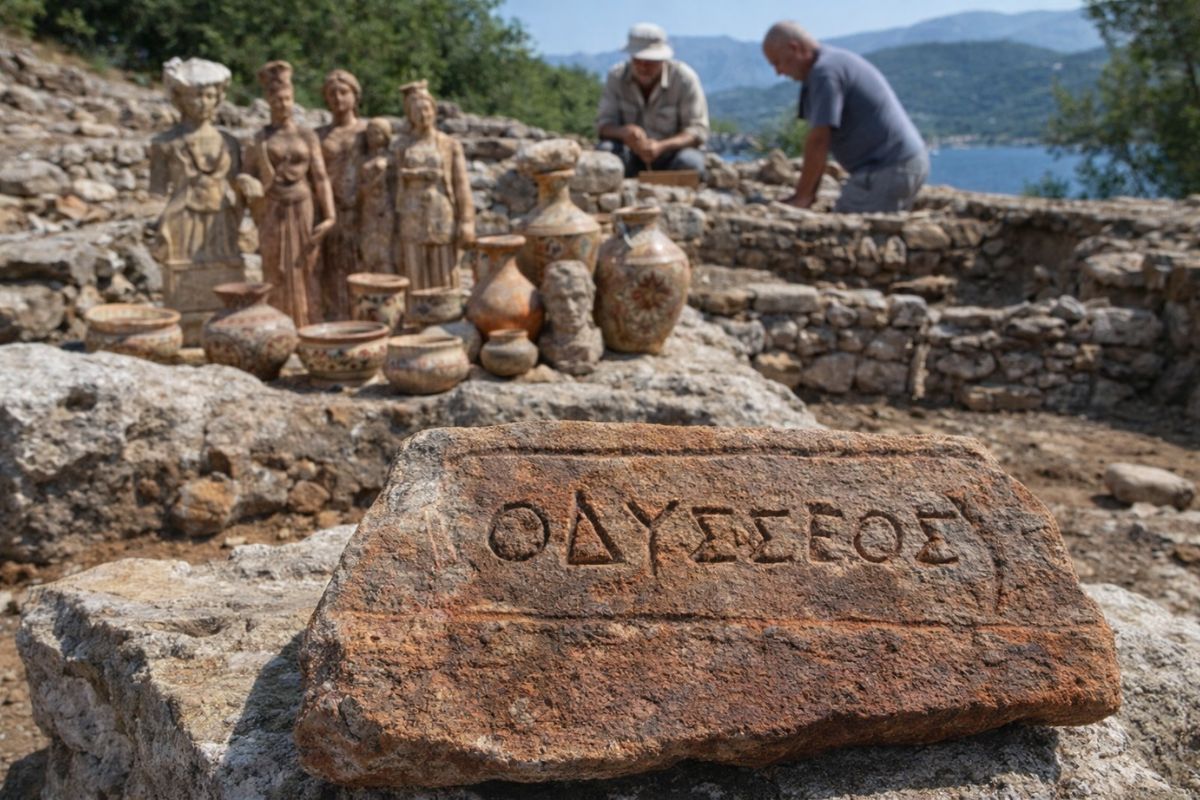
Archeologists identified on the Greek island of Ithaca what may be an ancient sanctuary dedicated to Odysseus, with fragments containing his name and votive offerings that reveal a continuous cult to the hero of Greek myth from the Mycenaean era to the Hellenistic period.
The Greek island of Ithaca has always been inseparable from the name of Odysseus. In Homer’s Odyssey, it is there that the hero desperately fights to return after ten years of war in Troy and another ten lost at sea. Now, archeologists have discovered on the Greek island of Ithaca what may be the physical proof that Odysseus was not just a character in an epic poem, but a central figure of a real cult that lasted for centuries. Excavations at a site already known as the School of Homer revealed votive offerings and a fragment of tile with a variation of the name “Odysseus” engraved on the surface.
The presence of artifacts ranging from the Mycenaean era to the Hellenistic period suggests that the cult at this site extended over many centuries, crossing profound political and cultural transformations. The sanctuary may not prove that Odysseus existed as a real person, but it demonstrates something equally powerful: that the myth shaped reality in Ancient Greece so concretely that it generated sacred spaces, rituals of devotion, and a tradition of offerings that survived for generations on the Greek island of Ithaca.
What archeologists found at the School of Homer site on the Greek island of Ithaca

The archaeological complex where the discovery was made has been known to researchers for decades. Named the School of Homer, the site is located in an elevated area of the Greek island of Ithaca overlooking the sea, in a position that corresponds to the ceremonial importance that a sanctuary dedicated to an epic hero would require.
-
Researchers at the University of Surrey have discovered that simply NOT removing water from a battery material can double its capacity, and as a bonus, the same system can desalinate seawater while storing energy.

-
Man builds house using foam panels, wooden base, adjustments with cement, impresses with the result by eliminating intense heat, extreme cold, and humidity inside the property with a simple solution.

-
While the USA prioritized the quantity of fighters, China surprised with a different tactic by planning to produce up to 300 aircraft per year, while the American fleet shrank by more than 60% and the F-35 does not keep up with the growing global demand.

-
5 tips to make the most of the longest passenger train journey in Brazil: it’s 13 hours and about 664 km with over 30 cities along the route, views of the Rio Doce, the best side of the carriage, and strategic dining times.

Recent excavations revealed a variety of votive offerings that include ceramics, metal objects, and ritual items deposited over several historical periods.
The most significant find was a fragment of tile with a variation of the name “Odysseus” inscribed, direct evidence that connects the site to the hero of the Odyssey. According to the Greek Ministry of Culture, the artifact was found along with other materials indicating continuous religious activity at the site.
This is not a standalone piece found out of context. It is part of a set of evidence that, together, points to the existence of a space specifically dedicated to the cult of Odysseus on the Greek island of Ithaca.
The votive offerings that span millennia on the Greek island of Ithaca

What makes this discovery particularly relevant is the temporal extent of the artifacts found. The votive offerings range from the Mycenaean era, around 1600 to 1100 B.C., to the Hellenistic period, which ended in 31 B.C.
This means that the site was used for rituals of devotion for over a thousand years, a continuity that is rare even in the most important archaeological sites in Greece.
Mycenaean artifacts in the sanctuary indicate that the association between Ithaca and Odysseus may predate Homer’s own Odyssey, which was composed around the 8th century B.C. If the oldest offerings date from the Mycenaean era, the cult of the hero or the figure who inspired him already existed before the poem was written.
The presence of Hellenistic materials shows that the tradition survived even after the major political transformations that redefined the Greek world. On the Greek island of Ithaca, devotion to Odysseus has withstood the test of time in a way that few cults have managed to equal.
What the sanctuary reveals about the relationship between myth and reality in Ancient Greece
The inevitable question in light of this discovery is: Did Odysseus really exist? The sanctuary on the Greek island of Ithaca does not answer this question definitively, but it shows that the distinction between myth and reality was much less rigid in Ancient Greece than we tend to imagine today.
For the ancient Greeks, epic heroes were not just characters in stories. They were figures deserving of temples, offerings, and rituals, just like the gods of Olympus.
The presence of inscriptions with the name of Odysseus in a religious context confirms that he was an object of cult, not just literary admiration. Other sanctuaries dedicated to Homeric heroes have been identified in different parts of Greece, but the location of this one in Ithaca carries a special symbolic weight.
In the narrative of the Odyssey, Ithaca is the final destination, the home that Odysseus seeks for twenty years. Finding a sanctuary dedicated to him right there reinforces the idea that myth and geography fed off each other over the centuries.
Why the School of Homer is one of the most important sites in current Greek archaeology
The archaeological complex of the School of Homer had already attracted academic attention for its location and for earlier remains that suggested ceremonial use. Recent excavations on the Greek island of Ithaca have elevated the site to another level by confirming the presence of elements that connect the site directly to the Homeric universe.
This is not just about ceramics and generic ritual objects. The fragment with the name of Odysseus transforms what was a hypothesis into concrete evidence.
The Greek Ministry of Culture classified the discovery as one of the most relevant in recent years in the archaeology of the country. The confirmation of a sanctuary dedicated to Odysseus on the island that bears his name in literary tradition has implications for the study of Greek religion, the transmission of myths, and the relationship between oral tradition and ritual practice.
For researchers who dedicate their careers to understanding how the ancient Greeks lived their beliefs in everyday life, this site on the Greek island of Ithaca offers answers that few other locations can provide.
What the discovery on the Greek island of Ithaca changes in the way we understand the Odyssey
The Odyssey is one of the most influential texts of Western civilization, read and studied for nearly three millennia. The existence of a sanctuary dedicated to Odysseus in Ithaca adds a layer of material reality to a narrative that many consider purely fictional.
It does not prove that the hero sailed the seas facing cyclopes and sirens, but it demonstrates that, for the Greeks living on that island, the story of Odysseus was true enough to justify centuries of rituals and offerings.
This is perhaps the greatest contribution of the discovery: to show that myths do not exist in a vacuum. They create spaces, shape landscapes, and generate practices that root themselves in the territory.
On the Greek island of Ithaca, the myth of Odysseus came out of the pages of Homer and transformed into stone, ceramics, and devotion. And now, millennia later, archaeology has brought this story back to the surface.
What do you think: does the discovery on the Greek island of Ithaca bring Odysseus closer to real history or merely confirm the power that myths had over the lives of ancient Greeks? Which mythological hero would you like to see confirmed by archaeology? Leave your thoughts in the comments. This type of discovery proves that history still holds secrets that can change everything we know.









Seja o primeiro a reagir!