





 Portuguese
  English
  Spanish
  4 min of reading
  0 comments


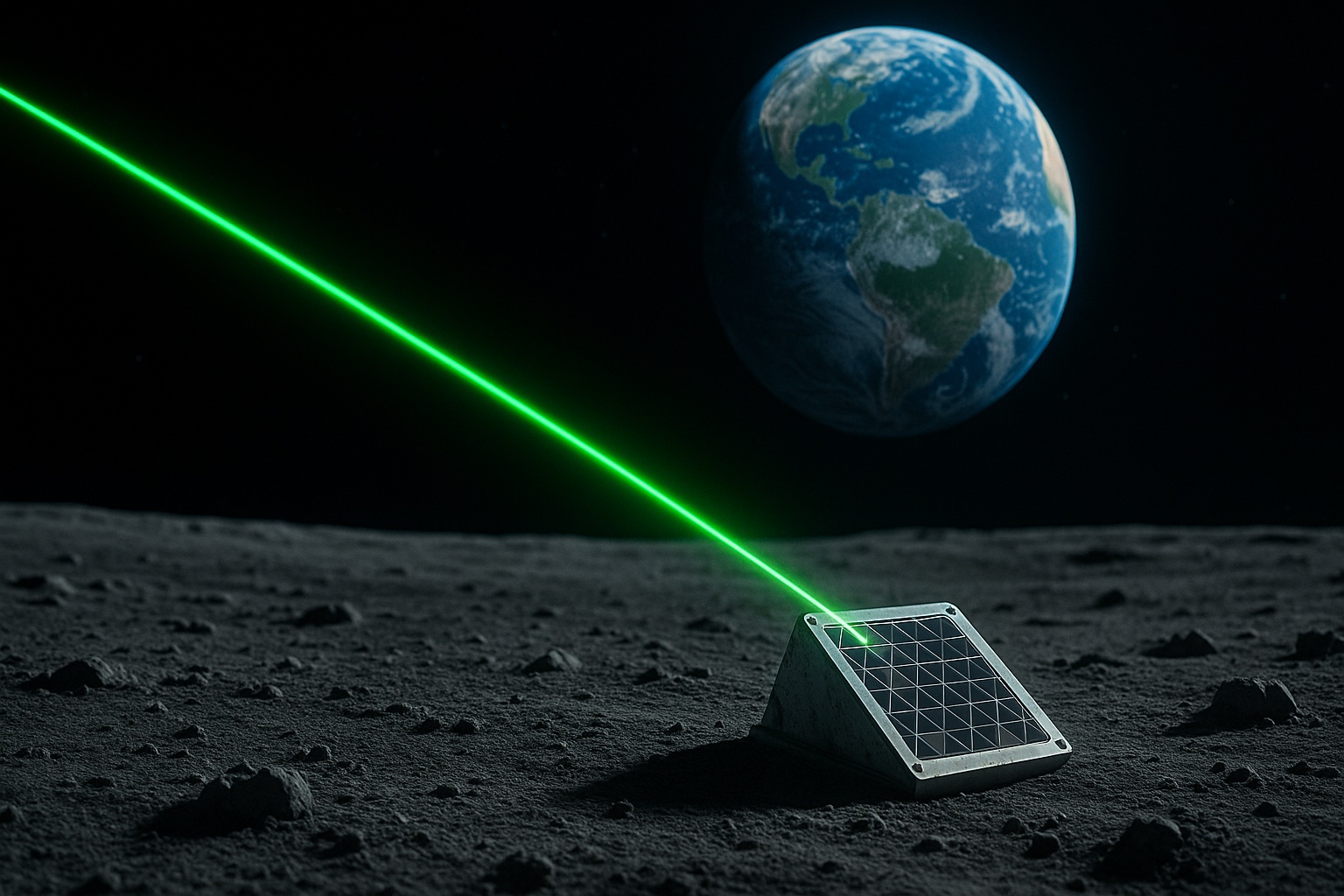
Mirrors Left by the Apollo Missions Still Reflect Lasers from Earth, Allowing Precise Measurements of the Distance to the Moon Even After 50 Years.
When the astronauts of the Apollo missions walked on the Moon between 1969 and 1972, they left more than just footprints and flags. One of the most enduring experiments installed on the lunar surface was the corner reflectors, devices made up of special mirrors that have a simple yet powerful function: to return any beam of light exactly in the direction it came from.
More than 50 years later, these mirrors are still functioning. Scientists on Earth fire super powerful laser beams toward the Moon, which, upon reaching the corner reflectors, return to their telescopes. This process allows for an accurate calculation of the exact distance between the Earth and the Moon — with an error margin of just a few millimeters.
The Most Accurate Measurement Ever Made

The average distance between the Earth and the Moon is 384,400 km, but it varies by up to 50,000 km over the month due to the satellite’s elliptical orbit.
-
Embraer arrives in Mexico with 7 new E190-E2s in 2026, after 5 jets have already been delivered, while Mexicana surpasses 1 million passengers, plans a fleet of 20 aircraft, and expands strategic routes across the country.

-
China is not joking around and is secretly expanding its nuclear weapons infrastructure: a giant dome the size of 13 city blocks, 600 warheads, destroyed villages, and a modernized military network in record time in China, says CNN.

-
Goodbye iron and wrinkled clothes: LG’s smart wardrobe uses TrueSteam vapor, hangers that vibrate up to 180 times per minute, and cycles of 20 to 30 minutes to remove odors and reduce wrinkles without washing.

-
In Venezuela, an area around Lake Maracaibo records the highest concentration of lightning on Earth, with about 250 strikes per km² per year and storms that light up the sky for up to 297 nights, driven by the humidity from the Caribbean and mountains that trap the air.


Thanks to experiments with the corner reflectors, we now know that the Moon is moving away from the Earth at a rate of 3.8 cm per year.
This data is only possible because the laser beam, when traveling to the Moon and back, allows us to measure the exact time taken for the light’s journey. Since the speed of light is constant, scientists can calculate the distance with extremely high precision.
The Most Enduring Apollo Experiment
The mirrors installed by the Apollo 11, 14, and 15 missions, in addition to two uncrewed Soviet missions (Lunokhod 1 and 2), still remain on the lunar surface today. They are, in fact, the longest-lasting scientific experiment left by humankind outside of Earth, functioning continuously for over five decades.
This makes the corner reflectors a kind of “permanent message” from humanity in space — not just a symbol, but an active scientific instrument that still produces relevant data.
The data obtained from the lasers reflected off the Moon have helped accurately confirm fundamental aspects of physics and cosmology:
- Einstein’s General Theory of Relativity was validated with tests that showed that gravity works the same way on Earth and on the Moon.
- The Moon’s rotation and small oscillations in its orbit have been mapped in detail.
- The gradual retreat of the Moon allows us to predict how the Earth-Moon system will evolve over millions of years.
In other words, these small mirrors have been essential to deepening our understanding of celestial mechanics and gravity.
The Engineering of Lunar Mirrors
The corner reflectors are not just simple pieces of glass. Each set is made up of dozens of quartz prisms cut into cubic shapes, known as corner cubes. This structure reflects light exactly in the direction of origin, regardless of the angle at which it arrives.
In practice, this means that no matter if the laser beam hits the mirror at an angle, it will always return to the emission point. This property is what allows for precise scientific communication between Earth and the Moon.
Current Challenges and Limitations
Although they still function, the corner reflectors face growing problems. The lunar surface is constantly bombarded by dust, micrometeoroids, and extreme temperature variations, which can impair the efficiency of the mirrors.
In recent years, scientists have observed that the reflected signals have become weaker, possibly due to the accumulation of lunar dust. This opens up opportunities for new projects: modern missions are already considering bringing more advanced mirrors to complement and replace the old ones.
The Invisible Link Between Earth and Moon
It is curious to think that every night, when we look at the Moon, there is an active invisible connection between it and Earth. Laser beams cross space, hit the mirrors left by the astronauts, and return with accurate information, almost as if we were engaged in a constant scientific dialogue with our natural satellite.
These mirrors represent one of the most elegant and lasting forms of science ever performed: simple, yet capable of generating profound knowledge that has transformed our view of the universe.
More Than Science, A Symbol
The lunar corner reflectors are both an experiment and a symbol. They prove that science can be enduring, that seemingly simple ideas can withstand the test of time, and that space exploration has left marks not only of presence but of knowledge.
If humanity one day returns to live on the Moon, these mirrors will still be there, reminding us that the pursuit of knowledge was one of the first things we took beyond our planet.









-

-

3 pessoas reagiram a isso.