





 Portuguese
  English
  Spanish
  11 min of reading
  1 comment


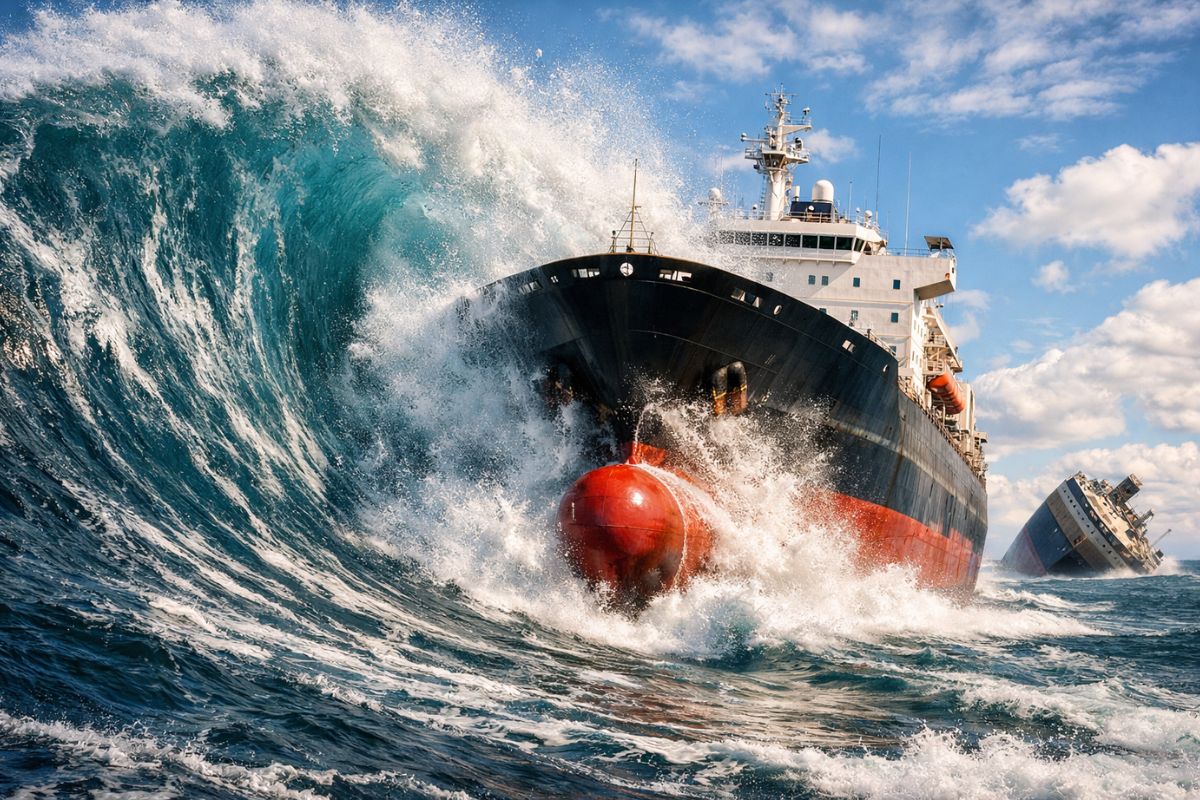


Understand How the Ship Hull, Naval Engineering, and Stability Mean That a Giant Wave Does Not Sink a Ship Even in a Storm at Sea.
The most impressive videos of storms at sea show a wall of water taller than a 10-story building advancing against a steel hull weighing over 100,000 tons. Intuition says that this gigantic wave should split the ship in half, capsize it, make it disappear. Yet, the bow rises, the water explodes in spray, the deck floods for a moment, and the ship regains its position and continues onward. It’s in these kinds of scenes that many people wonder how a giant wave does not sink a ship when, on land, the same amount of water would mean total destruction.
For decades, we have seen ships crossing rough seas, facing extreme winds and waves capable of bending steel without sinking. It’s not that the sea is less dangerous than it appears; it’s that ships are much more complex than we imagine. The shape of the hull, how the weight is distributed, how the steel flexes, and, most importantly, the crew’s decisions create a safety margin so that, for the most part, a giant wave does not sink a ship. But this margin is not infinite. When it runs out, physics continues to operate, but against the ship, as happened in the sinking of the cargo ship El Faro.
The Illusion That Nothing Can Bring Down a Giant
Seen from the outside, a large cargo ship passing through a storm seems invincible. The hull disappears behind the foam, the deck vanishes for seconds, the ship heels at angles that seem irreversible, and yet, it returns to position. For those who have never been at sea, it looks like a camera trick, almost a mechanical miracle.
-
He started running at 66 years old, broke records at 82, and is now a subject of study for having a metabolic age comparable to that of a 20-year-old, in a case that is intriguing scientists and inspiring the world.

-
Oldest tree on the planet reappears after 130 years of searches: Wattieza, 385 million years old, was 10 meters tall and had no leaves or seeds; Gilboa fossils in New York solved the mystery in 2007.

-
A 48-square-meter house assembled in hours with 4,000 bricks made of recycled plastic that does not absorb moisture, has natural thermal insulation, and costs less than 90,000 reais in a complete kit.

-
Luciano Hang revealed that Havan’s air fleet has already accumulated more than 20,000 landings, 10,000 flight hours, and 6 million kilometers traveled, and he says that without the planes, the company would never have grown so quickly.


What the video does not show is the amount of forces involved. The waves that hit a ship in rough seas can generate impacts capable of deforming structures, tearing away equipment, and pushing the steel to the limits of fatigue. If this same energy were discharged onto a fixed building on land, the result would be catastrophic. The difference is that the ship does not stay still waiting for impact; it was designed to deflect, redistribute, and dissipate this force. It’s this combination of shape, buoyancy, and stability that explains why so many times a giant wave does not sink a ship.
The Shape That Makes Steel Float

Before talking about the impact of the waves, it’s essential to understand why something made almost entirely of steel even floats. A solid block of steel is much denser than water and sinks mercilessly. A ship, however, is a hollow shell filled with air.
When it enters the water, it does not push the water down; it displaces the water to the sides. The water reacts by pushing back.
The greater the volume of water displaced, the greater the upward force. There comes a point where this buoyancy equals the weight of the ship, and that’s when the hull finds balance and starts to float. A 100,000-ton ship needs to displace 100,000 tons of water just to stay afloat.
All that remains above the waterline becomes margin, a cushion between a spectacular water boarding and a real disaster.
In a storm, this balance constantly adjusts, with each wave throwing more water onto the deck and each liter draining back into the sea.
How the Hull Dissipates the Wave’s Force

The defense against the wave begins at the first point of impact, the bow. If you observe a large ship from the side, you’ll notice that the hull does not rise straight from the water to the deck.
It flares outwards. This curvature is called flare and is one of the first reasons why a giant wave does not sink a ship on the initial impact.
When water strikes a vertical surface, the force concentrates like a hammer blow. On a curved surface, the story changes. The water glides, rises, spreads out, and disperses into spray, wasting part of the energy that could deform the hull.
At the same time, as the water rises along this widened hull, the displaced volume rapidly increases, which means more lift at exactly the worst moment. This is called reserve buoyancy, the hidden margin that only appears when the sea turns hostile.
The deck also helps. Viewed from the side, it is not completely flat. It rises slightly towards the bow and stern.
This is the sheer, responsible for gaining height where the waves are likely to come aboard. This space between the sea level and the deck is the freeboard. Large ships appear disproportionately tall from the water not for aesthetics, but because that extra height is survival.
Below the waterline, another element comes into play. Many ships have a rounded volume projecting from the bow just below the surface, the bulbous bow. In calm seas, it helps reduce resistance to forward motion.
In rough seas, it adds volume exactly where the bow tends to bury itself between two waves, increasing the buoyancy and helping the hull rise.
All this reinforces the same idea: the hull is a hydrodynamic machine designed to redirect forces, not a rigid block waiting to take a hit.
Floating Is Not Enough: Why the Ship Does Not Capsize
Resisting the wave is more than just floating. It’s not capsizing. In a large ship, almost everything truly heavy is located below: engines, generators, fuel tanks, ballast tanks, cargo holds. Above are relatively light structures, like the bridge, cabins, and ventilation systems.
This mass distribution creates a low center of gravity. When a wave pushes the ship sideways, the hull tilts, but the weight wants to stay as low as possible.
The more the ship tilts, the more gravity attempts to return that weight to the center, generating a force that pulls the hull back to vertical.
This is called righting moment, the invisible mechanism that makes the ship seem to fight against its own fall.
Engineers measure this capacity through the metacentric height, the distance between the center of gravity and the point where the buoyancy force acts when the hull tilts.
A large metacentric height means quick and strong corrections, uncomfortable but safe. A small height generates smooth movements but with less margin of safety if something fails.
Every ship is designed through a compromise between comfort and survival, and this balance defines how far a giant wave does not sink a ship and at what point the angle becomes too dangerous.
When Water Enters, Physics Changes Sides

Up to now, we have talked about everything that happens outside. However, the true enemy often lies within. The worst scenario for a ship is not a huge wave outside, but the water that enters and stays.
When water begins to accumulate inside the hull, the extra weight settles on top, exactly where it shouldn’t be.
The center of gravity rises, the righting moment weakens, and the ship starts to fight less to return to vertical. Each sway corrects a little less than the previous one. Slowly, the list stops being just a movement and becomes a state.
This is how many real capsizes start, not with a single spectacular scene but with a slow and continuous loss of stability.
This is why, in a storm, watertight integrity is sacred. Doors must be closed, hatches secured, ventilations protected.
A single point through which water enters can turn that scenario where a giant wave does not sink a ship into a situation where any extra slam pushes the hull beyond the limit.
At the same time, the openings that exist to drain the water from the deck must function, because every liter that remains on board adds weight, raises the center of gravity, and steals safety margin.
The Hull That Flexes to Avoid Breaking
Even when the water remains outside, the stresses on the structure are enormous. A ship is not a floating rock; it’s a long structure that moves with the sea.
Imagine the hull traversing large waves. When a crest passes over the center, that part is supported, while the bow and stern are partially suspended.
The ship curves upwards, in a movement known as hogging. Seconds later, the crests pass under the bow and stern, the center loses support, and the hull curves downwards, a sagging.
This cycle repeats constantly in heavy seas, hundreds or thousands of times in a single storm. If the ship were too rigid, these alternations would break the hull as if it were a metal ruler forced without rest.
That’s why ships are full of caverns, longitudinal reinforcements, and a keel that acts as a steel backbone.
In extreme conditions, a large hull can flex several meters between bow and stern without breaking, distributing the stress across thousands of joints.
The problem arises when the rhythm of the waves syncs perfectly with the natural frequency of that flex. That’s when resonance appears.
It’s like pushing a swing always at the right time. Each wave adds a bit more energy to the same point; they don’t cancel each other out but accumulate.
Steel doesn’t break at once; it fatigues, weakens, until it gives in. Some ships have broken this way, not due to a single monstrous wave, but due to a perfect sequence of common waves at the worst possible rhythm.
Compartmentalization: The Last Margin Before Capsizing
If there is damage, ships still have one last line of defense: compartmentalization.
The interior is not a vast empty space. It’s divided by watertight bulkheads that create separate compartments. If one section floods, the others can remain dry.
A ship designed to maintain buoyancy with certain flooded compartments can suffer significant damage and continue floating.
It’s not invulnerability; it’s time. Time to pump out the water, correct stability, change course, call for help.
This combination of shape, buoyancy, stability, flexing, and compartmentalization is what makes it so that, in most cases, a giant wave does not sink a ship. But all this depends on a factor that no equation guarantees: the human factor.
El Faro: When Human Decisions Erase the Margin

To understand how far this margin extends, it’s necessary to look at a case where the engineering was sufficient to face the sea, but the decisions were not. On September 29, 2015, the cargo ship El Faro departed Jacksonville for San Juan, Puerto Rico. It was a routine trip on a familiar route, with an experienced ship. Nothing indicated it would be different from the previous ones.
As El Faro advanced, a tropical system named Joaquim began to form hundreds of kilometers offshore. Initially, it was just a storm.
The models indicated it would follow the typical behavior of so many Atlantic cyclones and turn northeast. The captain plotted a course that passed south of the predicted path, near but theoretically safe.
The crack appeared when the ocean did not follow the plan. Joaquim, instead of turning northeast, turned southwest and rapidly intensified, becoming a high-category hurricane, with violent winds and waves well above 10 meters.
Even so, El Faro continued in the same direction. Doubts began to arise on the bridge, questions about the route, about the ship’s age, about the real strength of the system.
The captain maintained the course. Later, it was discovered that he was using outdated weather data, while more recent satellite information was available on board. The technology was there; the decision did not follow.
In the early hours of October 1, the ship entered the most dangerous zone of the hurricane. The waves began to strike abeam, and the hull started to consistently heel. It was no longer a normal roll; it was a tilt that was not fully correcting.
At some point, a small hatch was either left open or gave way under pressure. Water began to enter a hold. It was not a significant visible breach; it was precisely the kind of failure that seems small until it is not.
The water accumulated inside, the center of gravity rose, and the righting moment weakened. Each roll left the ship in a slightly worse situation than the previous one. In the engine room, the violent motion dislodged oil inside the tanks.
The pumps began to suck in air, the engines lost pressure, and El Faro ended up without propulsion. Without engines, a ship in a storm loses the ability to keep the bow against the waves and begins to take a beam on, the worst possible angle.
The waves stop lifting the hull and start pushing it sideways, increasing the heel angle and making it even easier for water to enter.
The captain made a call for help over the radio and ordered the abandonment. But abandoning a ship in the midst of a hurricane is not the same as in a drill.
El Faro was still operating with lifeboats deployed, an outdated design allowed by regulations made for another time. In extreme winds and huge waves, those lifeboats were almost useless. No one survived.
Years later, the data recorder was recovered from the bottom of the sea. Investigations showed that there was not a single cause but a chain of failures.
Outdated meteorological procedures, lack of proper oversight, an aging ship without certain upgrades, regulations that still tolerated outdated safety equipment, and decisions that were not corrected in time.
The physics that keeps the ship afloat had not changed. What changed was the safety margin that human decisions left available.
The Real Limit of How Far the Wave Does Not Sink a Ship
After all this, the conclusion is less comfortable than it seems. Large ships do not survive giant waves because they are invincible, but because they operate within a very specific margin where design, physics, and operational discipline work together.
As long as this current holds, the impressive scene repeats: the giant wave does not sink a ship, the hull flexes, the righting moment corrects, compartmentalization buys time, and the drainage system alleviates the water weight.
When one link in this chain fails, that same structure that seemed unstoppable reveals itself to be fragile. The next time you watch footage of a cargo ship crossing a sea that seems impossible, remember that you are not witnessing a miracle. You are seeing the result of thousands of correct decisions accumulated over decades.
And when you hear of a ship that did not return, remember the reverse. It was not always a single wave that brought it down.
Oftentimes, it was a route that should not have been maintained, a data point that wasn’t reviewed, or a door that wasn’t closed in time.
And you, after understanding all this, do you think we underestimate the risk of the sea or overestimate how a giant wave does not sink a ship thanks to naval engineering?








Great, well explained. I have been thrice to Antarctica on board various ships, each one crossing roaring forties, furious fifties and screaming sixties, and during cyclones, one realizes the value of a Captain and the team of people who design, develop, fabricate, test, and calibrate each and every component. I was keen to establish a shipborne acoustic radar on board a ship, that made me to realise that ship is a moving monester of acoustic noises, as wind and turbulent waves keep on striking continuously.
You deserve my sincere complements.