





 Portuguese
  English
  Spanish
  4 min of reading
  2 comments


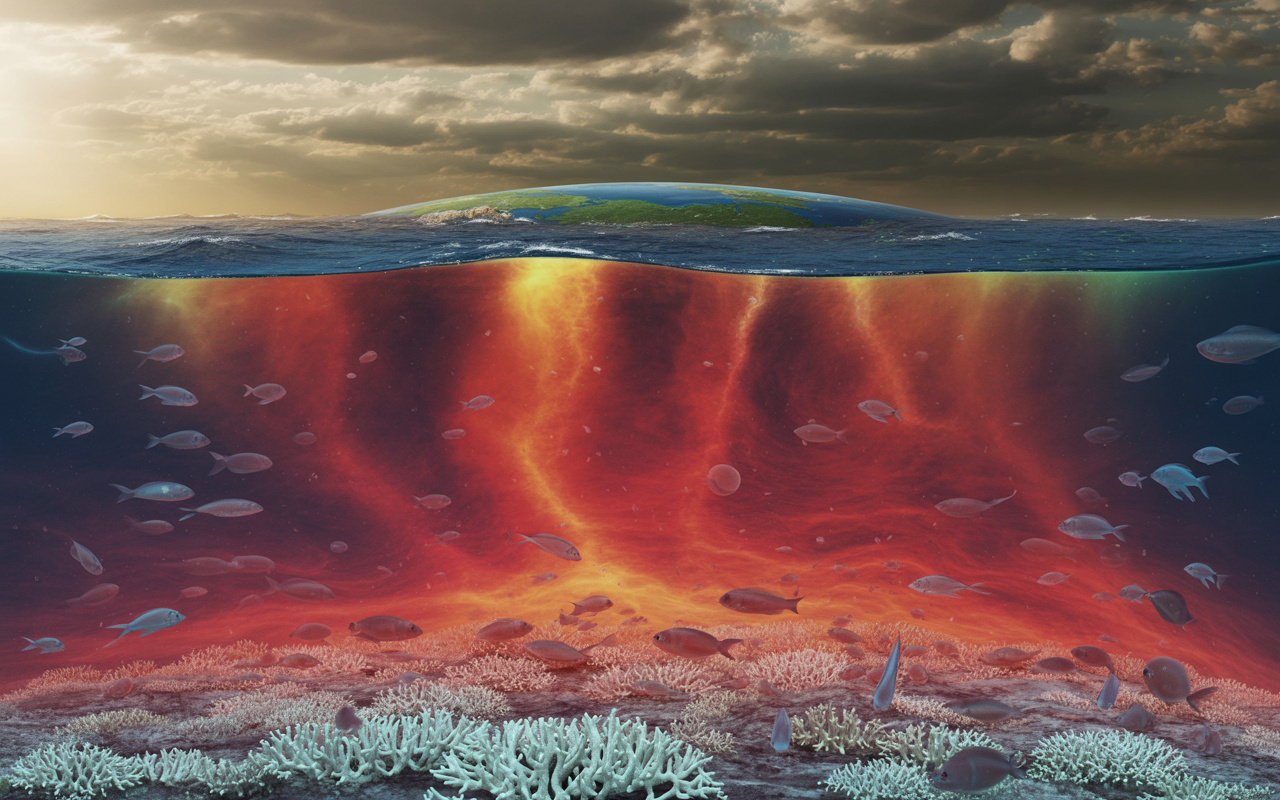


Record High Marine Heatwaves Heat Oceans Up to 5 °C Above Normal, Affect Ecosystems, Fishing and Climate and Sound Global Scientific Alarm.
What is happening in the planet’s oceans in recent years is not an isolated event or a momentary phenomenon. It is a broad, growing, and increasingly measurable process: marine heatwaves. In various regions of the globe, satellites and oceanographic buoys have recorded giant areas of the ocean remaining for weeks or even months with temperatures well above the historical average, in some cases exceeding +5 °C relative to the local climate standard. Scientists classify this phenomenon as one of the most concerning signs of the modern climate crisis, precisely because it occurs out of the sight of most of the population.
What Are Marine Heatwaves and Why Are They Different
Marine heatwaves are prolonged periods during which the surface temperature of the sea remains significantly above the historical average for that region and time of year.
Unlike normal variations, these events last long enough to alter biological, chemical, and physical processes in the ocean. It is not just about warmer water: it is about an entire environment functioning out of balance.
-
The Moon has essential rare earth minerals for 99% of the electronics you use in your daily life and a future fuel that is almost nonexistent on Earth: now the race to explore the satellite has turned into a global competition among more than 70 countries.
-
Scientists reveal an impossible artifact for its time made with iron from space, and the discovery reignites a historical debate about the Bronze Age in China.

-
The humanoid robot G1 has gained a new digital brain that has transformed it into a true domestic worker: it learns by observing the environment, interprets objectives, and executes complete tasks without receiving step-by-step instructions.

-
They seemed like common bones, but scientists were surprised to find a relic over 12,000 years old that dates back to before the Bronze Age.


In many recent cases, ocean areas the size of continents experienced abnormally high temperatures for consecutive months. What was once considered rare has been occurring with increasing frequency since the 2000s, with a strong acceleration starting in 2015.
Extreme Records Detected by Satellites and Oceanographic Buoys
Data from systems like NOAA, Copernicus Marine Service, and space agencies show that, in 2023 and 2024, more than 90% of the global ocean surface recorded some level of thermal anomaly.
Regions of the Pacific, North Atlantic, and Mediterranean faced persistent episodes, with thermal deviations exceeding historical records.
In certain areas, the warming was so intense that researchers observed statistically improbable values in climate series from decades. This led scientists to classify some episodes as unprecedented observational events, something that would only be expected once every thousands of years in a stable climate.
Why Are the Oceans Warming So Quickly
The oceans absorb more than 90% of the excess heat generated by global warming caused by greenhouse gas emissions. This role as the planet’s “thermal buffer,” however, has physical limits.
As the atmosphere retains more energy, the sea begins to continuously accumulate heat, reducing its capacity to dissipate it.
Furthermore, altered atmospheric patterns, such as wind blocks and changes in ocean currents, contribute to keeping warm water masses stationary for long periods. The result is an ocean that not only warms but remains warm long enough to cause structural damage to ecosystems.
Direct Impact on Coral Reefs and Biodiversity
Coral reefs are among the systems most affected by marine heatwaves. The prolonged increase in temperature causes coral bleaching, a process in which they expel the symbiotic algae responsible for their survival. Without these algae, corals enter energetic collapse and can die within a few weeks.
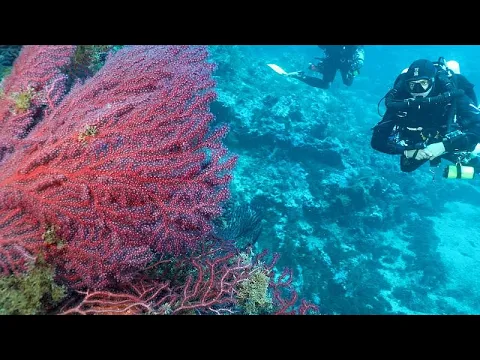
Recent events have shown simultaneous bleaching in multiple oceans, something scientists consider extremely alarming. The loss of reefs affects not only marine biodiversity: it compromises coastal protection, artisanal fishing, and tourism in dozens of countries.
Effects on Fish, Food Webs, and Global Fishing
Fish and other marine organisms are highly sensitive to temperature. Heatwaves alter migratory routes, reproductive cycles, and food availability. Important commercial species tend to migrate to cooler waters, causing unexpected disruptions in traditional fishing and significant economic losses.
In some cases, there is mass mortality of organisms that cannot adapt quickly. This disorganizes entire food webs, affecting everything from small invertebrates to large marine predators.
The Role of Marine Heatwaves in the Planet’s Climate
Warmer oceans not only affect marine life. They directly influence the global climate. Warm ocean surfaces provide more energy to the atmosphere, intensifying storms, cyclones, and extreme events.
Additionally, they reduce the ocean’s capacity to absorb carbon dioxide, creating a feedback loop that accelerates global warming.
Recent research indicates that marine heatwaves may be linked to the increased frequency and intensity of extreme climate events on land, such as prolonged droughts and torrential rains.
A Silent, Yet Measurable and Dangerous Phenomenon
Unlike wildfires or urban heatwaves, marine heatwaves occur far from human everyday life.
Still, their effects are broad, cumulative, and long-lasting. Scientists warn that without significant reductions in global emissions, these events will cease to be exceptions and will become the new oceanic normal.
Climate models indicate that, in high-emission scenarios, some regions of the ocean may spend most of the year in heatwave condition, making the natural recovery of marine ecosystems unfeasible.
What Scientific Data Already Makes Clear
Marine heatwaves are not speculation or a distant future projection. They are already happening, have been measured, mapped, and analyzed by some of the world’s leading scientific institutions.
The consensus is clear: the ocean is entering an unprecedented thermal state in the recent history of Earth, and this will have profound consequences for marine life, the global economy, and climate balance.
The challenge now is not to prove that the phenomenon exists, but to decide how far humanity is willing to act to prevent this silent collapse from becoming irreversible.





Algo está estranho nessa matéria. A atmosfera aquecendo o oceano me parece improvável. Se você esteve no ensino médio deve lembrar do mc”delta”t.
A massa (m) de 1m3 de ar é de 1,2kg enquanto que a água teria massa de 1000kg. Já em relação à capacidade térmica, a água apresenta valores da ordem de 4.000 J/kg.K enquanto que o ar tem 1.000 J/kg.K. Então, fica claro que para transferir calor do ar atmosférico para a água a relação é de 4.000, ou seja para elevar a temperatura de uma massa “m” de água de 1ºC, seria necessário que a mesma massa de ar estivesse a 1.000ºC.
Estranho, muito estranho!
Isso mesmo ! Calor sobe , frio desce !