





 Portuguese
  English
  Spanish
  6 min of reading
  0 comments


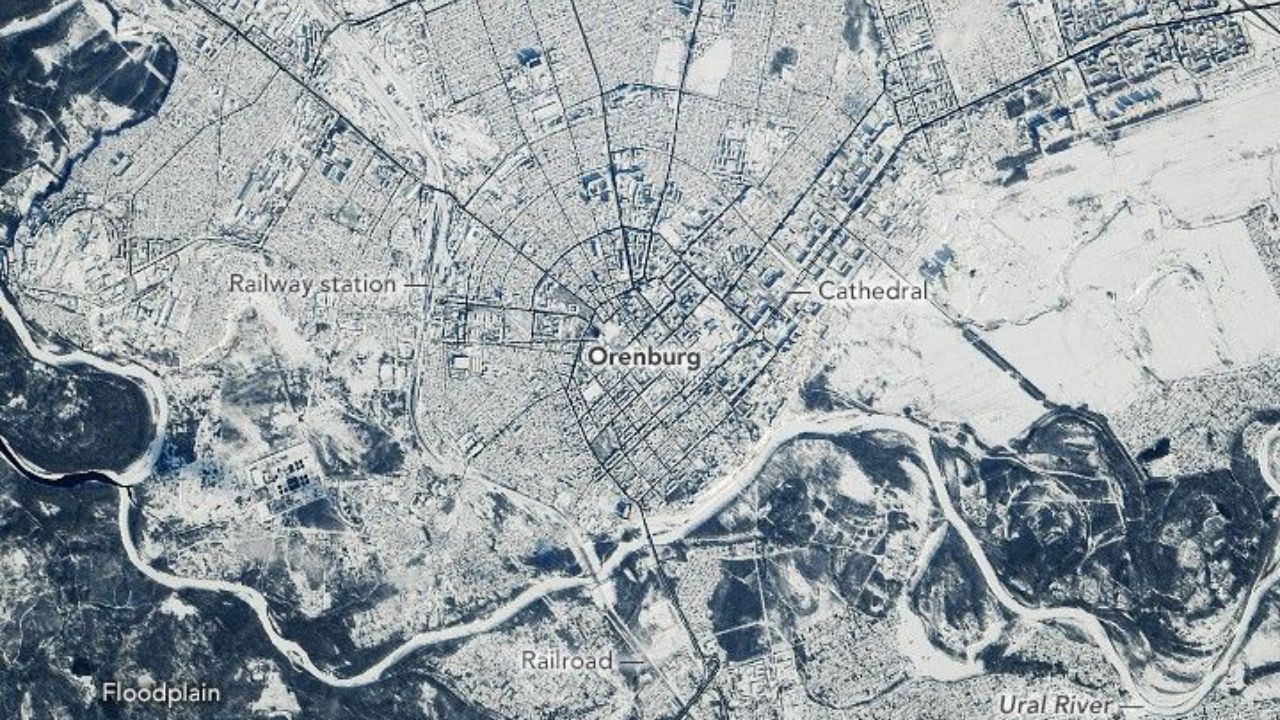
NASA image reveals Orenburg covered in snow for up to 5 months, with temperatures below −30 °C and urban landscape transformed into total white.
In 2021, an analysis published in the NASA Earth Observatory, a record made by a cosmonaut aboard the International Space Station showed Orenburg, in southwestern Russia, under complete snow cover, in a scene that drastically alters the visual reading of the city as seen from space. In the material “Winter is Long in Orenburg,” NASA highlights that the snow enhances the urban grid and transforms streets, neighborhoods, and areas near rivers into a large almost continuous white field, interrupted mainly by shadows, forest patches, and geometric traces of human occupation.
The contrast is so strong that, in certain sections of the orbital image, the urban structure is primarily identified by the radial pattern of the roads, the shadows cast by buildings, and the differentiation between urban areas and darker bands of vegetation. According to the NASA Earth Observatory, the photograph was captured on February 20, 2021 with a digital camera equipped with a 1000 millimeter lens, a level of magnification that allowed distinguishing central elements of the city even under the almost uniform dominance of winter white.
Temperatures below −30 °C and winter that can last up to 5 months shape the landscape
Located in a region of severe continental climate, Orenburg faces long and intense winters. During the coldest months, temperatures can drop to −30 °C or lower, with prolonged periods below zero that can extend for weeks.
-
They have orbited the Moon and are now returning home: the astronauts of Artemis II are making final preparations for a descent at 38,000 kilometers per hour, with a landing in the ocean scheduled for this Friday at 9 PM Brasília time.

-
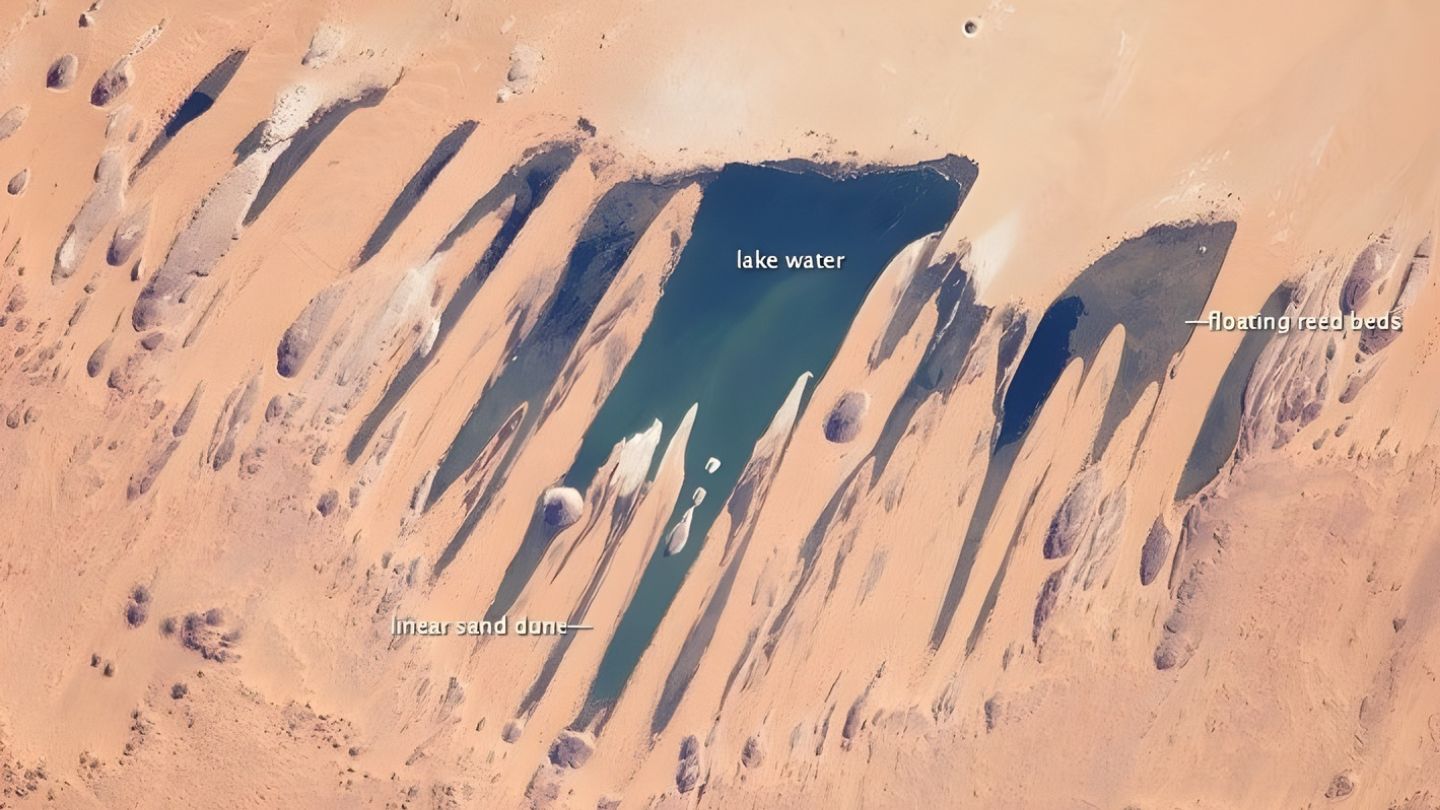
In the heart of the Sahara, the Ounianga Lakes form 18 permanent mirrors of water in an area of 62,000 hectares where it has hardly rained for decades, creating a blue archipelago fed by underground aquifers in the driest desert on the planet.
-
An American has spent over 30 years building a 34-meter training ship in his backyard in Maine using recycled steel from Navy ships, and is now trying to win the dispute that keeps the vessel grounded.

-
With 17 seniors aged between 90 and 99, the group breaks the record for the oldest choir in the world and becomes news in the United Kingdom.

The winter in the region can last up to five months, usually between November and March, during which snow progressively accumulates over the entire city.
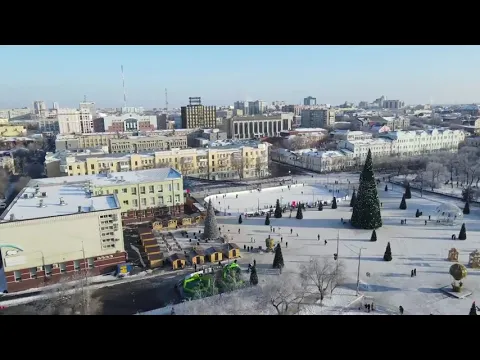

This persistence of cold is what allows for the formation of a continuous snow cover capable of completely altering the appearance of the territory when viewed from space. The absence of frequent thawing prevents the urban surface from reappearing for long periods.
City with more than 500 thousand inhabitants disappears under uniform snow cover
With a population of over 500 thousand inhabitants, Orenburg is not a small or isolated city. Still, the NASA image shows that its urban scale virtually disappears under winter.
Entire neighborhoods, wide avenues, and industrial zones are visually leveled by the accumulated snow. The urban infrastructure continues to exist but loses contrast with the environment.

From an orbital perspective, the city ceases to be a complex set of buildings and begins to visually behave like a continuous surface, with few variations in color. This effect is rare in large cities.
Snow covers rivers, roads, and industrial areas, creating geometric patterns visible from space
The analyzed image shows that snow covers not only open areas but also important structural elements.
Frozen rivers become part of the white landscape, while roads and railway tracks appear only as subtle lines.
Industrial areas, normally marked by visual contrast, are also camouflaged under the snow cover. What remains visible are geometric patterns formed by urban organization, creating a kind of “abstract map” of the city. This type of pattern is one of the most striking elements in orbital images.
Solar radiation reflected by snow completely alters the reading of the territory
Snow has a high reflectivity index, known as albedo, which means that a large part of the solar radiation is reflected back into the atmosphere. This phenomenon contributes to the extremely bright appearance of the images.
Moreover, the high albedo helps maintain lower temperatures, reinforcing the cycle of intense cold. The combination of continuous snow cover and high reflectivity creates a unique visual signature in NASA’s images.
This differentiates regions like Orenburg from other urban areas on the planet.
Extreme continental climate intensifies contrast between seasons
Orenburg presents one of the clearest examples of continental climate, characterized by large variations between summer and winter.

In summer, the region can record temperatures above 30 °C, while in winter it faces negative extremes. The variation creates a radical transformation of the landscape throughout the year.
The same city that appears completely white in winter can display intense colors and vegetation during the warmer months. This seasonal contrast is one of the factors that make the orbital record even more impactful.
The Urals region marks a geographical transition that influences the climate
Orenburg is located near the Ural Mountains, an area that marks the geographical division between Europe and Asia.
This position contributes to the formation of cold air masses that move through the region during winter. The absence of significant natural barriers allows polar air to advance easily.
This geographical factor helps explain the intensity and duration of winter in the city. The local atmospheric dynamics are decisive for the observed phenomenon.
Snow accumulation reduces urban contrast and makes it difficult to identify structures
As winter progresses, the accumulation of snow becomes more homogeneous, further reducing the contrast between different surfaces. Roofs, streets, and open areas begin to reflect light similarly.
This makes it difficult to distinguish between different types of structures. The result is an image in which the city appears “erased,” with few visual elements capable of indicating its real complexity. This effect is amplified in satellite images.
Record highlights the importance of orbital images to understand climatic extremes
Images like that of Orenburg demonstrate how Earth observation from space can reveal patterns that are not perceptible at the local level. The orbital scale allows for visualization of the impact of climatic phenomena on entire urban areas.
Moreover, these images help monitor changes over time. The use of NASA data is essential to understand how climatic events shape the planet on a large scale. This type of analysis is increasingly relevant.
Phenomenon shows how cities can disappear visually under extreme conditions
The case of Orenburg highlights that, under certain conditions, even large urban centers can lose their visual identity when observed from space.
The continuous snow cover creates a uniformity that masks the complexity of the city. This phenomenon is not common in regions with milder climates.
The extreme visual transformation reinforces the impact that climate can have on the perception of territory. This broadens the understanding of the relationship between environment and urbanization.
What the NASA image reveals about the impact of winter on an urban scale
The analyzed image shows that winter is not just a season, but a phenomenon capable of completely redefining the appearance of a city. It alters colors, shapes, and even the way the territory is visually interpreted.
In the case of Orenburg, winter transforms a complex city into an almost uniform surface, highlighting the power of natural phenomena on an urban scale. This type of transformation is one of the most impressive aspects of extreme weather.
How far the climate can transform entire landscapes seen from space
The observation of Orenburg raises a relevant question: how many other cities around the world undergo such radical transformations but are not widely known? The combination of extreme cold, persistent snow, and orbital observation creates unique records.
These phenomena show that the planet still holds extreme scenarios capable of completely altering the appearance of entire regions.
In light of this, an inevitable reflection arises: how many other cities can visually disappear under ice, snow, or water and only reveal their true form when weather conditions change?








Seja o primeiro a reagir!