





 Portuguese
  English
  Spanish
  5 min of reading
  0 comments



Scientists Present A New Surprising Hypothesis About The Origin Of The Moon, Challenging Traditional Theories And Rewriting Astronomy
For nearly four decades, scientists have accepted that the origin of the Moon is due to a massive impact with an object the size of Mars, a process that would have launched debris into space, which later grouped together to form the natural satellite.
New research suggests that the Moon may have a different origin: Earth’s gravity may have captured an object from a binary system of space rocks, placing it in orbit.
The New Proposal About The Origin Of The Moon
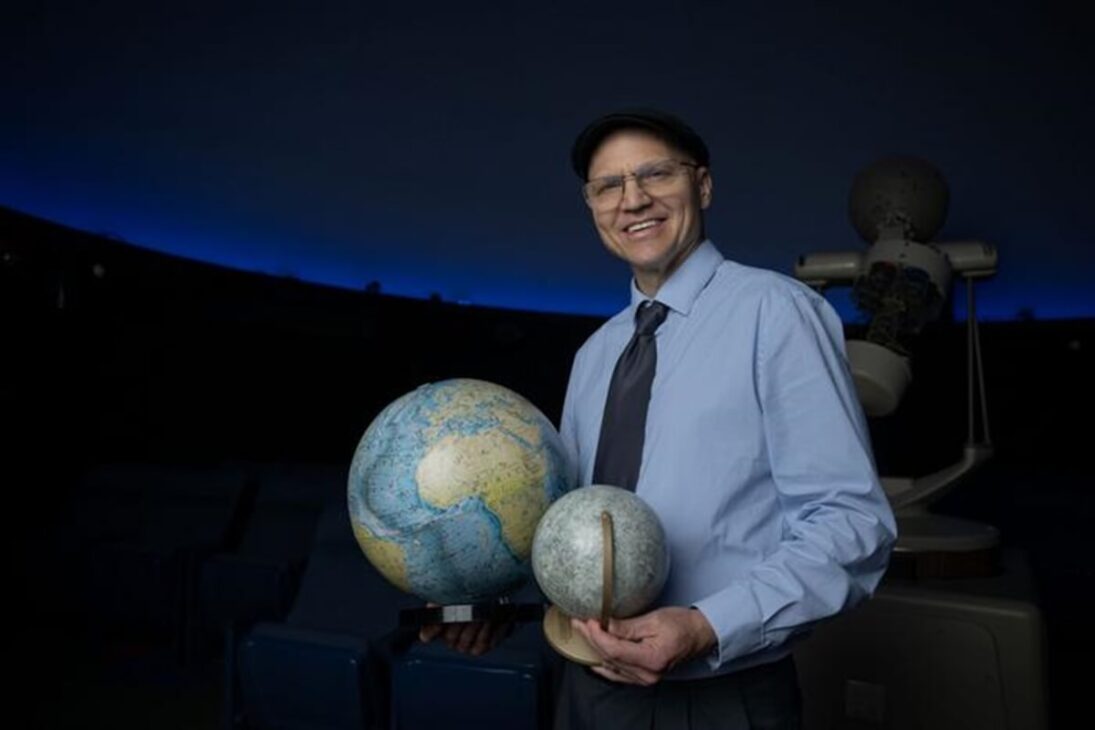
This alternative theory, published in the The Planetary Science Journal by Penn State researchers Darren Williams and Michael Zugger, raises new possibilities about the origin of the Moon.
-
In Mexico, a 3,000-year-old Maya site with the dimensions of an entire city may have been built as a colossal map of the cosmos, created to represent the order of the universe and reveal how this people organized space, time, and rituals.

-
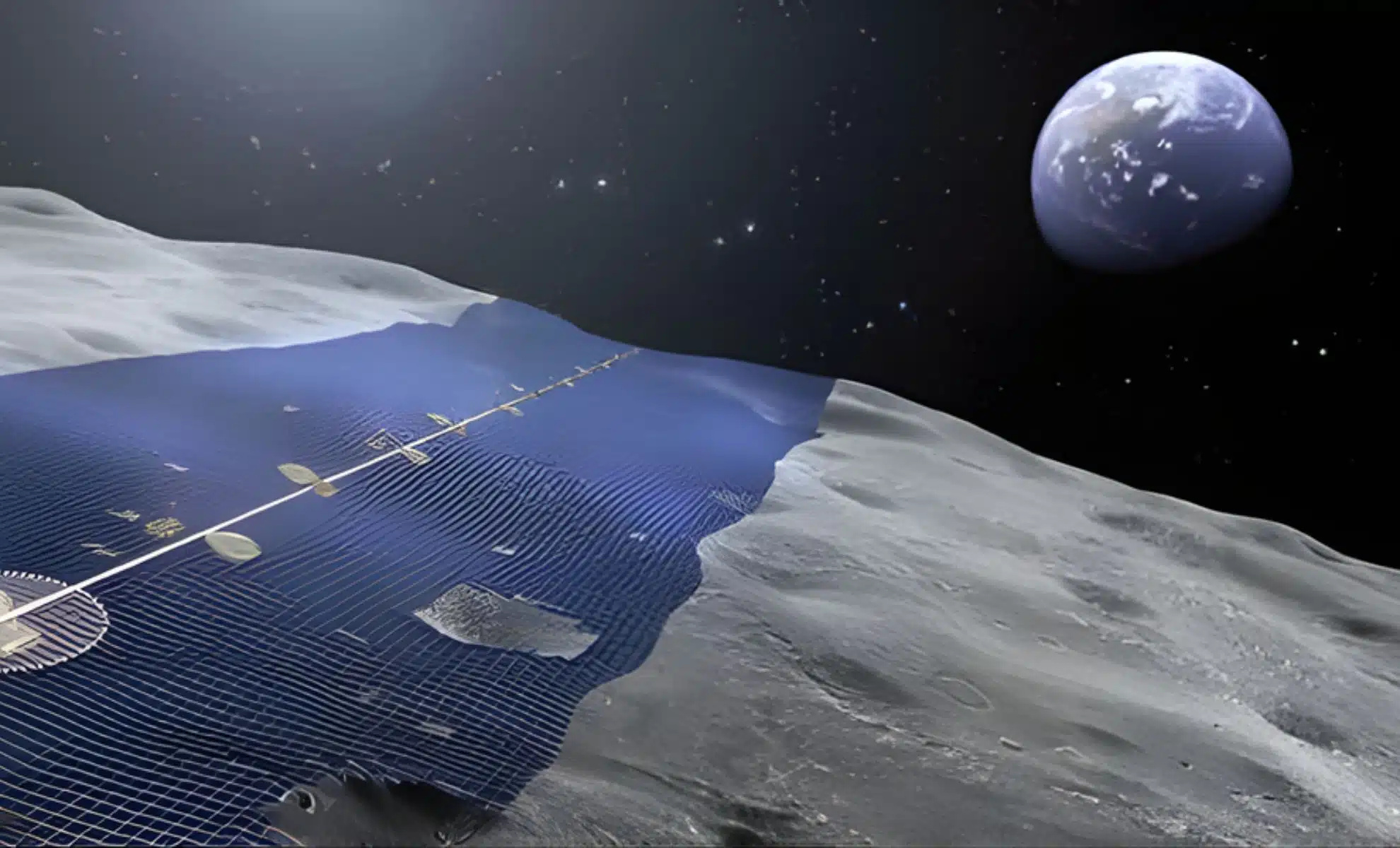
Japan wants to build a solar ring of 10,900 kilometers on the Moon to continuously send energy to Earth.
-
Weighing almost 1 ton, with temperatures of up to 3,000°C, the ability to launch 10,000 fragments within a radius of 1 km, capable of penetrating concrete and melting steel, Turkey’s terrifying bomb emerges as one of the most destructive non-nuclear weapons ever presented.

-
After a submarine disappeared beneath the “Doomsday Glacier,” scientists announce a new monstrous machine capable of operating at 3,000 meters depth to return to the heart of the ice and investigate a threat that could raise sea levels worldwide.


The proposal suggests that Earth would have captured the Moon through a process called binary exchange capture – a mechanism already known to explain how Neptune captured its largest moon, Triton.
Williams explains that, upon observing the Moon’s orbit, it becomes apparent that it is more aligned with the Sun than with Earth’s equator. This poses a challenge to the impact theory, which would suggest that the Moon should orbit over Earth’s equator.
On the other hand, the binary exchange capture process occurs when a planet encounters two objects orbiting each other. During this cosmic encounter, the planet’s gravity can separate the pair, capturing one object as a satellite and ejecting the other into space.
This process, which has already been demonstrated in larger planets, is now proposed for planets the size of Earth as well.
Simulations And Mathematical Modeling
Using computer simulations and mathematical modeling, researchers have demonstrated that Earth could indeed capture satellites varying from 1% to 10% of its mass, which includes our Moon, which has about 1.2% of Earth’s mass.
For this to happen, certain conditions would need to be met: the approach speed of the objects should be less than three miles per second (approximately 10,783 km/h), which may seem fast but is relatively slow by solar system standards.
Additionally, the binary pair would need to pass at a distance of about 20 Earth radii, or about 80,000 miles, for Earth’s gravity to be able to capture one of the objects.
From Capture To Orbit Adjustment
However, capturing the Moon is not enough to ensure that it would have the stable circular orbit we observe today. Initially, the Moon would have followed a highly elliptical trajectory, coming very close to Earth at some points and moving far away at others. It was at this point that tidal manifestations came into play.
The gravitational interactions between Earth and the newly captured Moon remained activated as a sort of “brake” on the orbital oscillations.
Over time, these interactions continued to smooth the Moon’s orbit, making it circular in a stable manner while slowing its rotation until it always showed the same face to Earth, as is the case today.
Williams explains that currently, Earth’s tide is moving ahead of the Moon, which ends up speeding up its orbit.
This is known as a “pull”, a small thrust that, over time, causes the Moon to move further away from Earth, about three centimeters each year.
Chemical And Scientific Implications
One of the greatest contributions of this new theory is the possibility of explaining the chemical similarities and differences between lunar rocks and those of Earth.
According to the proposal, the Moon would have formed in the same region of the solar system, which would explain the similarities.
However, originating as part of a separate object would explain the differences.
Although the researchers acknowledge that the scenario proposed depends on certain specific conditions, such as the presence of a binary pair with the right mass, they also point out that such a configuration would not be impossible.
They note that binary objects were common in the early days of the solar system and that we can still observe many of these pairs in the asteroid belt and the Kuiper belt, in addition to Neptune.
A Futuristic Vision: Capture Of Moons In Other Solar Systems
Another intriguing aspect of the research is the possibility that the capture of moons around rocky planets is not something exclusive to Earth.
Satellites may be captured more frequently in other solar systems than previously thought.
This opens new possibilities for the habitability of planets outside our solar system, as large moons could be more common than we imagined, with direct implications for the search for extraterrestrial life.
Challenges In Proving The Theory
However, proving this theory will be an extremely difficult task, considering that the events it describes occurred more than 4.5 billion years ago. Although mathematical simulations show that they are physically possible, we no longer have direct data on the processes that occurred during that primitive period.
For now, concrete evidence of this theory remains out of reach, but it opens a fascinating new chapter in the debate about the origins of the Moon.
Williams states that, while the scientific community has long relied on a single theory about the Moon’s origin, there are now at least two possibilities.
This, in itself, raises a significant number of new questions and areas for future research, in addition to renewing the mystery of how our natural satellite really formed.
Whether the Moon arose from a capture or a cosmic collision, it remains an essential element for Earth. Its presence affects tides, weather, and even the planet’s stability.
New studies continue to reveal more about the origin of the Moon, but it remains a constant companion to Earth – a fascinating and mysterious object, whose origin continues to evolve over time.








Seja o primeiro a reagir!